Ten things I learned at Featherston Booktown Karukatea Festival 2026

Featherston turning it on for Booktown
Made possible by


Claire Mabey spends four days at one of New Zealand’s largest book festivals in one of New Zealand’s smallest towns.
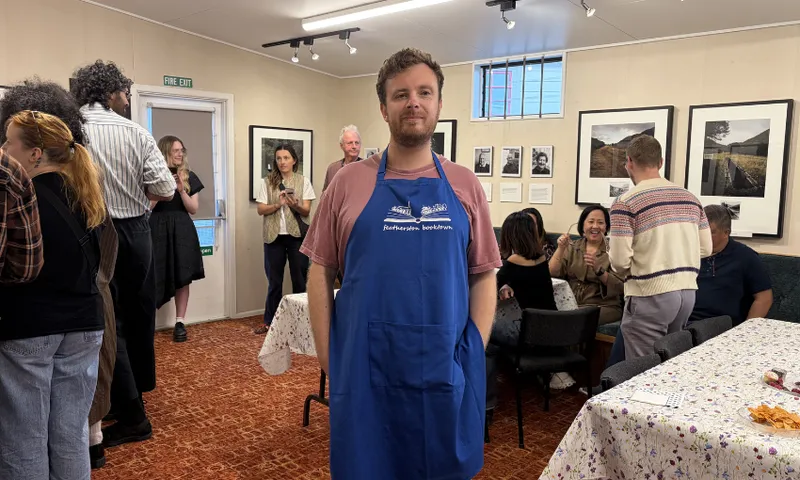
Featherston Booktown Karukatea Festival has grown into one of Aotearoa’s most beloved writers festivals. It’s one of those rare beasts that manages to take over an entire town: as well as panels and paper-making, workshops and heavy-hitting conversations there are food trucks, buskers and shop windows full of themed displays, like books made out of rose quartz in the window of the crystal shop. Everywhere you look the people are wearing royal blue Featherston Booktown aprons, grinning ear to ear, high off the buzz.
Booktown’s new director, poet Jordan Hamel, is delighted with this first festival. Despite the “insane weather” (wind that makes Wellington’s gusts looks like kitten’s breath), “people have turned out in droves and the community have supported it in a really cool way. There’s something in the air around Featherston in a way that you weren’t expecting. There’s play, surprise, humour as well as really big conversation happening on stage. Each room is like another world.” I caught Hamel just before he dashed off to see his mum for Mother’s Day before returning to run the last events of the festival.
Here are 10 things I learned at Featherston Booktown:
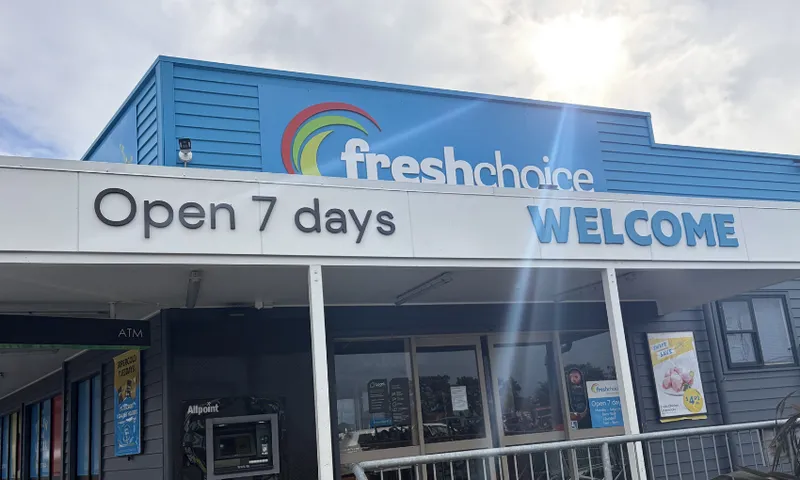
Greytown’s Fresh Choice is best in the country, says Toby Manhire
Manhire travelled to Featherston to host a session called The Shaky Isles: The National Shift from 2017-2023 in which he and guests Henry Cooke, Te Aniwa Hurihanganui, Phil Goff and Chris Finlayson walked through the Ardern years for an audience of nearly 400 in the festival’s hero venue, Anzac Hall. Because of the lack of accommodation in Featherston, most festival guests stay in Greytown (shout out to the Oak’s Estate Motel – delightful place with autumn trees that go mad in the Wairarapa gusts). Just before the event, Manhire was heard declaring that Greytown’s Fresh Choice has the best layout, the finest produce and the nicest staff in the country. Featherston’s Fresh Choice is “fine”, but “nothing special”.
Featherston has an impeccable vintage store
Sure, there’s C’est Cheese, but next door there’s Barbara Black Vintage Trader stuffed with actual vintage clothing, shoes, art, books, hats, coats and jewellery. It’s an absolute gold mine and a person could lose track of time very easily and be late to their own Featherston Booktown event.
The train ride to Featherston is ridiculously good looking
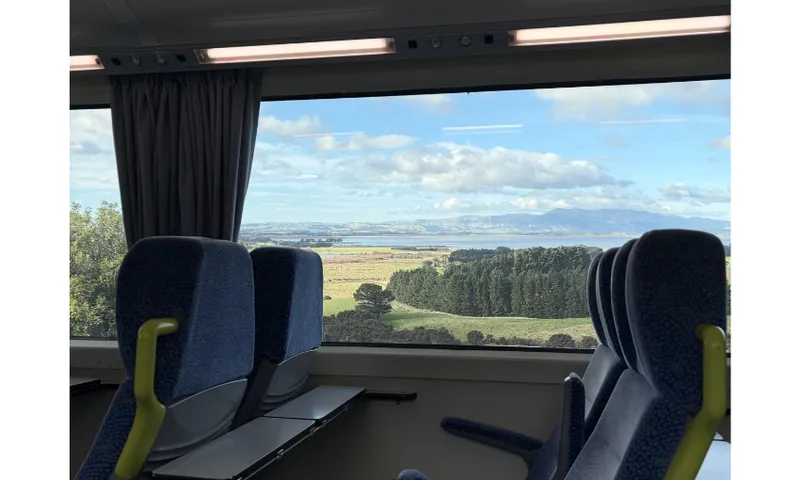
I took the train from Wellington early on Thursday morning to get to a superbly organised Featherston Booktown schools programme and was stunned by the sweeping views, the ease and the cheap fare! For less than $15 Wellingtonians can glide through the Remutaka Range and arrive in the middle of Featherston in under an hour. The views are gorgeous: as soon as you burst out of the tunnel it’s all crystalline greens, peaceful estuary winking in the sunlight and autumnal trees hemming the valleys. Highly recommended.
The state of the fourth estate is pretty depressing
In an event chaired by Michelle Duff called The State of the Fourth Estate: Surveying Aotearoa’s Media Landscape, Mike McRoberts (now the National Business Review’s first ever Māori editor) asked Māori affairs correspondent Te Aniwa Hurihanganui how many Māori journalists were left at TVNZ’s 6pm bulletin after Maiki Sherman’s resignation. “I think I’m the only one now,” replied Hurihanganui. The 90-minute conversation – which took in the end of Newshub, shrinking newsrooms and the death of the Broadcasting Standards Authority – could have been heart-crushingly depressing were it not for Hurihanganui’s passion for her job: “I want to be in Māori affairs because I want people to understand what it means to be Māori in New Zealand”; and Duncan Greive’s assertion that the tech environment in which we operate can mean that access to great media is better than ever and that the quality of journalism available is as good if not better than ever, too; and Mike McRoberts saying that even when the comments section at the NBR can get pretty gnarly on his pieces, he’s at least reaching an audience who might not otherwise seek out kaupapa Māori stories.
It was, though, pretty depressing. McRoberts told the (again, huge) crowd that one of the best camera operators he worked with at NewsHub is now a truck driver; Greive recalled Gavin Ellis telling him that his first gig was as one of 14 journalists covering Mt Albert and now you’d be lucky to find six journalists covering the whole of Auckland. Hurihanganui, Greive and McRoberts all shared an opinion that while the BSA needed a shake up, its demise is “grimly instructive”.
On the matter of Maiki Sherman, McRoberts said the timing of it “smacked of politically driven” motivations; Hurihanganui said that while mistakes had been made and had to be acknowledged, “we’ve lost a truly brilliant journalist”. Greive said that it was “unbelievable” that it was a career-ending incident and that in the past there might have been “cooler heads around the table” to deal with it. Everyone agreed that election year heightened the fraught atmosphere between media and politicians and referenced Luxon’s withdrawal from appearing on Breakfast with Tova O’Brien as symptomatic of the crackling tensions.
Mike McRoberts is not selling a miracle cure for cataracts
In the same event, McRoberts revealed he’s been the victim of deepfakes. The latest had him promoting a cure for those suffering cataracts or glaucoma in collaboration with an ophthalmologist (also the victim of the AI creators). The deepfakers made McRoberts say that the reason he left Newshub was that his eyesight was failing. Meta refused to do anything about it because the video didn’t have a Facebook URL; and meanwhile the ophthalmologist is taking calls from patients eager for Mike’s miracle cure. Greive said that Meta does have the tools to manage such AI travesties and we could have them here but nobody – government and business alike – is forcing their hand. He referenced the recent AI scam involving Catherine McGrath, CEO of Westpac, saying the bank is still endorsing Meta by using the platform and they should instead be publicly announcing they’re withdrawing their custom from that platform and the like.
Duncan Greive revealed The Spinoff story he’s most proud of
Also in the same session, Duff asked each of the journalists to share which story they’re most proud of. McRoberts’ was the documentary Kia Ora, Good Evening about his te reo Māori journey; Hurihanganui is proud of the fact she’s been determined to stay in her job despite abuse, cuts and loneliness; and Greive talked about “I will come forward” – written with Alex Casey – being a defining moment in the early days of The Spinoff.
Dominic Hoey could not get behind Hamnet (the book)
Mandy Myles from Bookety Book Books hosted a “bookety book club” with novelists Hannah Kent and Josie Shapiro; poet Josiah Morgan; and novelist/poet Dominc Hoey. “I struggled,” said Hoey who found O’Farrell’s widely acclaimed story about the death of Shakespeare’s son as told through the eyes of his little-known wife, Agnes to be “overwritten” and the third person narration distancing. Kent and Shapiro found the visual landscapes beautiful and the deep insights into motherhood, childbirth and the loss of a child to be very meaningful. Hoey was unmoved. A representative of Hedley’s – the festival’s official bookseller – said that after the event they sold tons of copies of Hoey’s novel, 1985. So being a hater can totally work.
Every poetry book should have the word cunt in it at least once
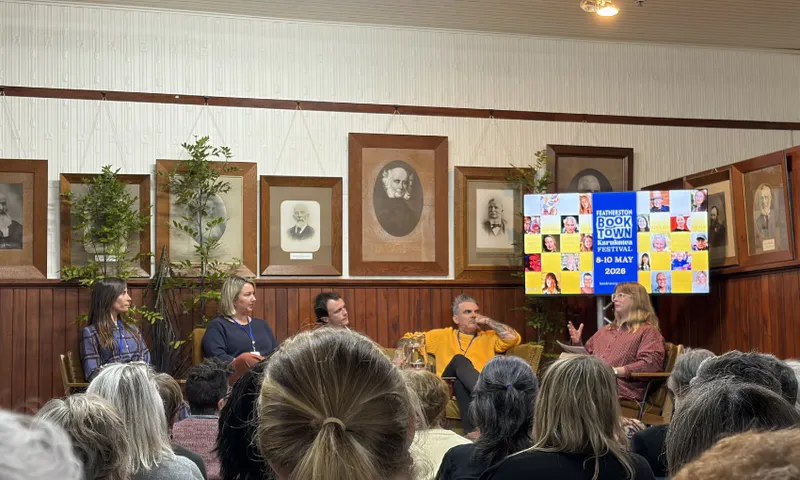
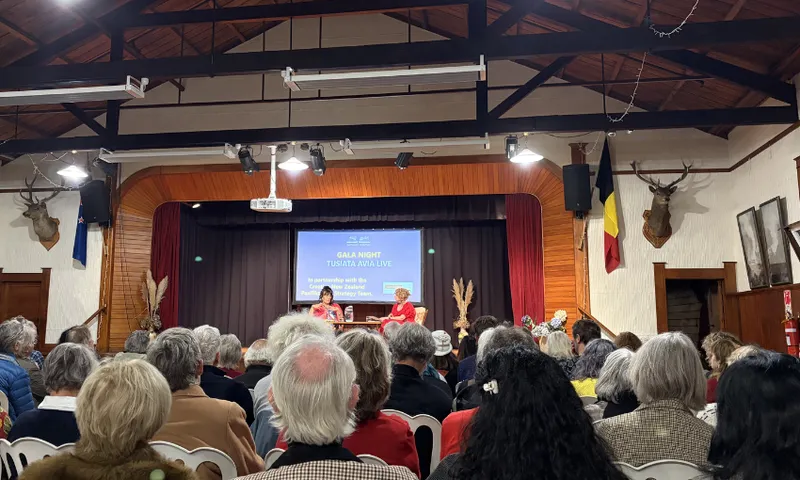
“If anything is going to stop poetry from being rarefied it’s ‘cunt’,” said one of Aotearoa’s best poets, Tusiata Avia, to Susie Ferguson. The pair headlined Featherston Booktown’s gala night in which Avia and Ferguson discussed Giving Birth To My Father, Avia’s “memoir in poetry”.
Avia talked about her relationship with her father and how close they were and how his death was, for her, so much like labour: “he laboured himself out of this life”. She talked about how difficult his funeral was – like a soap opera – and how hard this book was to write.
Towards the end of the event Avia performed 250th Anniversary of James Cook’s Arrival in New Zealand – the poem that got David Seymour all worked up to the point his public ire resulted in Avia receiving death threats. It was a brilliant reading: hilarious in Avia’s honey-sweet voice. “It’s an entirely reasonable poem,” she said. Everyone cheered.
Australian writer Hannah Kent is spellbinding
On Sunday morning Australian author Hannah Kent sat down with one of the country’s/world’s best interviewers and memoirists Noelle McCarthy to talk about Kent’s relationship with Iceland. I only caught the last 20 minutes but sat, utterly captivated, as Kent told the audience about her arrival in the country as a young woman, mystified by the “oblivion”, the dark, dark of the place; and her host forgetting to collect her from the airport. She talked about moments of synchronicity that “pushed” her closer and closer to Burial Rites, the historical novel that launched her stellar career. I could have stayed there all day.
Short story writers Ingrid Horrocks and Michelle Duff are working on novels
Ingrid Horrocks’ All Her Lives and Michelle Duff’s Surplus women are two of the best short story collections out over the past decade. In a session chaired by Mary McCallum, Duff and Horrocks spoke about how exposing fiction feels compared to non-fiction (Duff is an acclaimed journalist and Horrocks an acclaimed memoirist), and how intentional the collections were – how each story is part of a set and are stronger for the throughlines across the stories. While both still love the short story – the ephemeral nature of them and the potency – they’re currently working on novels, which is thrilling news for their fans. Horrocks’ All Her Lives is up for the Jann Medlicot Prize for Fiction in next week’s Ockham New Zealand Book Awards. Tune in next Wednesday May 13 to find out whether the short story might finally triumph in the richest literary award in Aotearoa.
Editor’s note: We originally said McRoberts had asked about Māori journalists at TVNZ. In fact he asked about Māori reporters on TVNZ’s 6pm bulletin.
The Spinoff Books section is proudly brought to you by Unity Books and Creative New Zealand. Visit Unity Books online today.

Claire Mabey
Claire Mabey is a children's author of The Raven's Eye Runaways, The Raven's Eye Rebellion, and a picture book Cass and the Beast illustrated by Jill Calder. For a long time Claire worked on literary festivals and is the founder of Verb Wellington. She lives in Te Whanganui-a-Tara with her partner and son.


