Auckland Writers Festival 2026: a selection of reviews from the record-breaking books fest

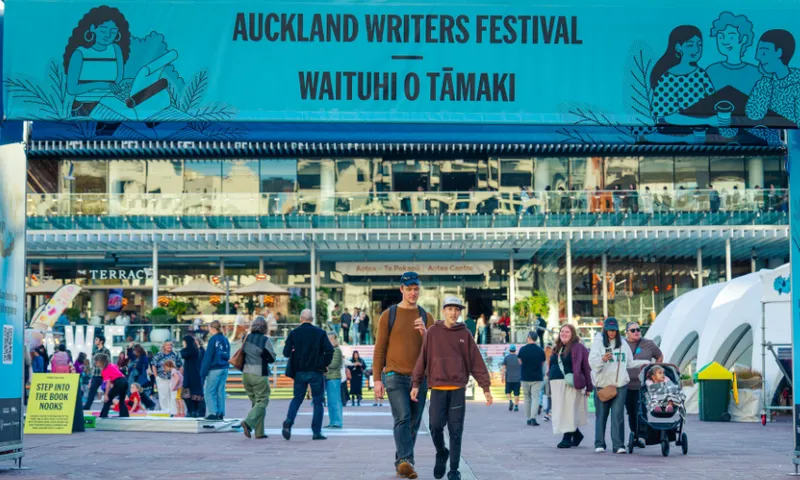
Tens of thousands of people gathered at Aotea Centre to celebrate books, conversation and ideas at Auckland Writers Festival 2026.
Made possible by

A review round-up of Auckland Writers Festival events by Spinoff staffers.
Book people are the best. Every year the tens of thousands of people from the very young to the very old who fill Aotea Center for the Auckland Writers Festival (AWF) remind me that people not only care about books but they care enough to spend money (or attend one of the many free events) to listen to discussions about them. AWF’s talented, always-smiling and serene artistic director Lyndsey Fineran told the crowd at the festival’s gala night that 2026 has seen the best sales figures in the festival’s history. The book sales across the festival’s three-day, 6,000+ student attendee schools programme were the highest ever, too.
In a time of political upheaval, declining rates of literacy and AI anxiety, this upward trajectory is extremely encouraging. Being in a venue filled with thousands of stimulated, excited, merry book lovers is a potent pick-me-up. I think it’s time other cities took note of AWF’s astonishing success built over years and years of hard work, reputation-building and honing of systems. Book festivals are going off – they’re pop-up places where children and adults alike can see the magic of stories unfold in front of their eyes, receive lifelong advice, exercise their own minds and curiosities, participate in robust conversations that expand, educate and challenge. Book festivals build communities, sustain art and celebrate a breadth of stories and perspectives. They’re becoming, like libraries, an essential meeting place – and if they’re well supported they will only grow in strength as local and global shifts and events inspire an urge to collectivise and gather and talk.
Hats off to the Auckland Writers Festival team and supporters who pulled off a phenomenal festival – a highlight not only of Aotearoa’s literary calendar, but of the world’s. / books editor Claire Mabey
Here is a round up of just a few of the events Spinoff staff members attended (we have a male-heavy line-up of reviews here, which is purely accidental):
Patrick Radden Keefe
Jack Tame apologised before doing it, but then ploughed ahead and called the esteemed New Yorker journalist and author Patrick Radden Keefe a motherfucker. That would be harsh if it wasn’t for the context.
Tame, interviewing Radden Keefe about his new release London Falling and the outrageously impressive line of books that came before it, said that he had been a longtime fan of Radden Keefe’s written work and so was intrigued when the author launched a podcast, Wind of Change. It was the first time Tame had heard Radden Keefe’s voice, and on finding this brilliant writer also had an incredible voice for podcasting, he thought “this motherfucker!”
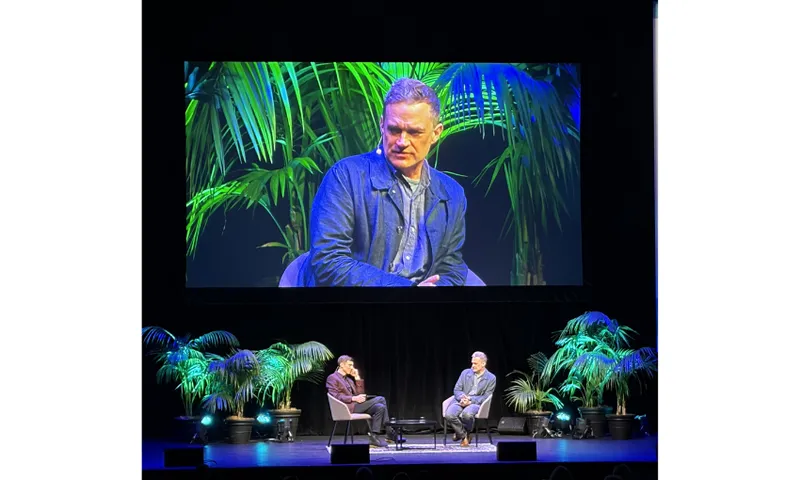
Watching Radden Keefe on stage at the Aotea Centre, it was impossible not to feel the same combination of awe and envy Tame described. Here he was talking about uncovering who killed Jean McConville, a mother-of-10 abducted by the IRA in the 1970s. Then onto his part in exposing the Sackler family’s role in the proliferation of addictive pharmaceutical drug Oxycontin. Now let’s discuss how he delved into the CIA’s propaganda machine. You get the picture.
Still, throughout a 75-minute conversation about this next-level journalism, Radden Keefe managed to be self-deprecating in the most genuine and charming way. A skilled live storyteller (so often those that can spin a yarn on paper cannot do the same in person), he was quick-witted and ready to delve into the darkness and difficulty of his work. How did he convince the parents of a dead teenager to open up to him for his latest book? What did he do when this grieving family banned him from publishing certain facts? How did he say no when one of the world’s most notorious gangsters, El Chapo, wanted him to ghost write his memoir?
He was generous. He was nuanced. He was an absolute motherfucker. / Veronica Schmidt
Gilbert Enoka in the Schools Programme
Auckland Writers Festival hosted 6,000 students over three days – it’s one of the most successful, optimistic and energetic aspects of what is already a successful, optimistic and energetic operation. Kids are so enthusiastic, open-minded, curious and articulate and the AWF team do a phenomenal job of serving them with a rich programme of writers from all corners of the literary world.
I went along to see Gilbert Enoka talk to hundreds of secondary students and had my own mind blown. Enoka is the author of Become Unstoppable which draws on his years of being the high performance sports psychologist who transformed how the All Blacks approach their game. To be honest, I didn’t think his session would hold much for me. How arrogant! How wrong! “Any victory without character is hollow to me,” he said from the stage. I was hooked.
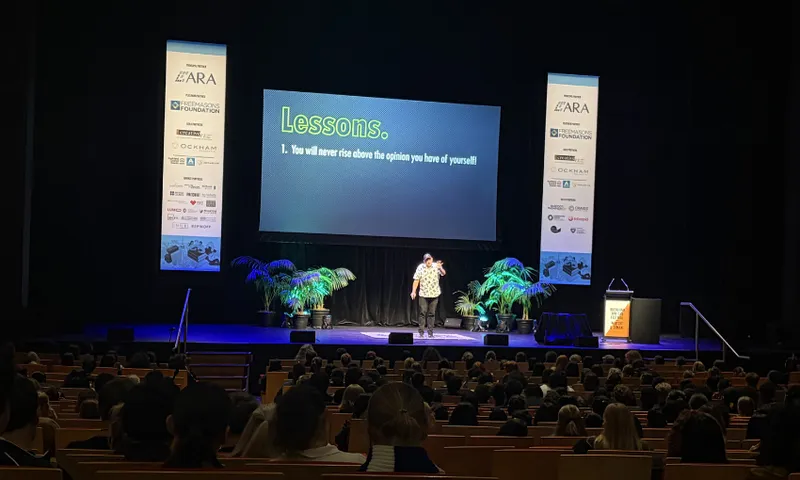
In a swift 30-minutes Enoka gave vital life advice. “Living in the world is a duel between mind and emotion,” he said. “If your mindset isn’t right you’ll do dumb things when emotions spike.” He went on to talk about his theory of the invisible backpack: everyone is carrying one and inside it are such treasures as self doubt, insecurity, debt, anxiety, fear of failure. All those lovely human conditions that cause pressure. “You can’t improve on what you don’t talk about,” he advised. I wish I had had access to this kind of conversation when I was a teen. Enoka was generous, wise and deeply earnest: “Know me, be me, stay me” he proclaimed from the stage. Sounds so simple but as we all know is deeply complex in a roiling, confusing world. I suspect the students lucky enough to hear him will carry his insights and wisdom for the rest of their lives, even if they don’t quite know it yet. / Claire Mabey
Festival Gala Night: Resetting the Compass
An invitation to take part in the Festival Gala Night must feel like a double-edged sword. If, of all the festival’s authors, you’re one of the eight that gets the call up, you must be an esteemed or upcoming writer. Well done. Now, here’s your prize: a hospital pass.
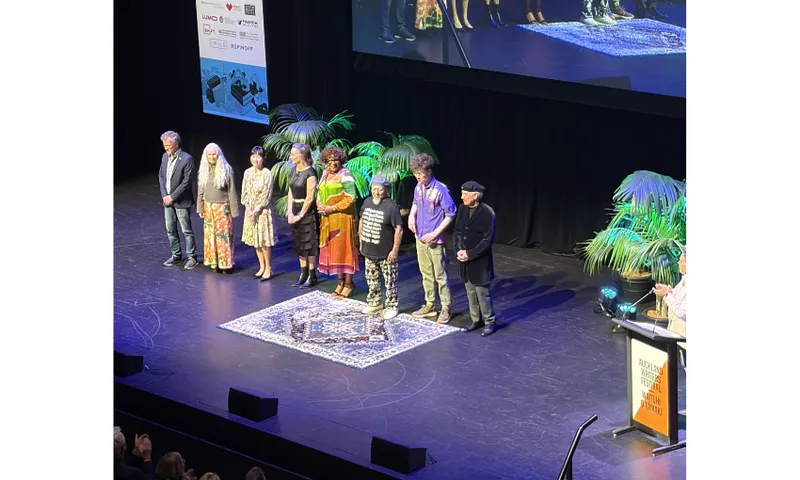
The opening night gala requires writers to take the stage and pretty much perform. This isn’t the usual fare of the festival – discussions on process and published work; a reading; a workshop – the authors are given a topic and asked to speak. It seems a cruel and unusual punishment for people used to working alone and producing art for the page. It’s also hard on the audience.
This year’s theme was “resetting the compass”, and the night’s needle sometimes found its north star, and other times headed south.
But, look, there were some splendid moments. The Scottish poet Michael Pedersen described himself as a “big, lanky streak of piss”, Tāme Iti was as generous as he was sage, and Witi Ihimaera finished up with a gloriously theatrical bow.
Hats off to Miriama McDowell for hosting with great warmth, and to writers Tayari Jones, Elizabeth Knox, Michael Pedersen, RF Kuang, Yann Martel, Witi Ihimaera, Tāme Iti and Dr Lucy Hone for taking on the challenge.
Is it the right format for a gala? Could be time to reset the compass. / Veronica Schmidt
Yann Martel
The book Son of Nobody has been sitting on my desk at The Spinoff all week, with lunchtimes devoted to finishing it in time for author Yann Martel’s session. It’s a novel that splices family drama and domestic life with a newly unearthed Trojan epic and the academic analysis it warrants. Greek myths “marked” him from a young age, Martel told the audience at Kiri Te Kanawa Theatre on Friday evening. The Iliad is, he said, about dysfunctional men who can’t get over their anger, describing the war as nihilistic and “curiously modern”.
In discussion with Paula Morris, he spoke of facts and their limitations, the “phenomenon of faith” and how humans are “post-rational” beings. Life of Pi, his Booker Prize-winning smash hit, was his way of comprehending faith and spiritual thinking. (The Iliad and Odyssey are also faith objects, he explained, like The Bible.) “You need faith in something.”
Martel said he sees stories as a way to “understand life”. He writes to answer his own questions. “Every book of mine has been an attempt to understand something”. Each one is, he said, a quest. “I try to live a better life and be less fearful.”
What he said about books as a participatory medium really resonated (a McLuhanism for those who subscribe to that). Martel said a book happens when you bring your life to it; there’s a collaborative nature to reading fiction. Cerebral, empathetic and warm, I could have listened to him for hours but we only had one.
He discussed Son of Nobody, Life of Pi and High Mountains of Portugal. It wasn’t until near the end of the hour that the deeply moving Beatrice and Virgil came up. It’s about the Holocaust, something he described as having spores. Any dehumanising thoughts and actions, Martel told us, were spores of holocaustal behaviour. I kept thinking about that long after the talk ended, signing queues finished and everyone went out into the dark night. / Emma Gleason
R. F. Kuang and Josh Silver
Two rising (arguably already risen) stars of the literary world paired up to tackle the question of ownership and story, as embedded in their novels Yellowface (Kuang) and Fruit Fly (Silver). The prompt of their session – Who Gets to Tell the Story? – is compelling and had endless potential for tough discussions about exploitation and appropriation in fiction writing. Unfortunately, it didn’t live up to that potential.
Chaired comfortably by Victor Rodger, the session rarely touched on the prompt, instead circling more generally around the two authors’ works and largely operating as two separate interviews rather than a panel discussion. Questions about translating gay sex terms and reviewing Virginia Woolf felt particularly far from the course. Despite that, Kuang and Silver offered up food for thought on the importance of artists being able to explore beyond their own lived experience, and Kuang in particular spoke beautifully on the purpose and potential of fiction.
Near the end of the session, Silver turned to Kuang and revealed that her novel Yellowface served as a very real inspiration for him as a writer. He then made a point to respond to one of her answers directly. They exchanged a small back and forth and the panel finally felt like a discussion. I just wish we as the audience got more of it. / Madeleine Chapman
Ian McEwan
What better way to end a long week than with a conversation between Ian McEwan and Simon Wilson, two very nice men? Wilson was in front of us at the Kiri Te Kanawa Theatre, while McEwan was beamed in from the UK – his well-appointed study filled with piles of books.
Like Son of Nobody, parts of What We Can Know take place at a university. Like Yann Martel, McEwan talked about the power of novels, describing them as machines for understanding. “We’re locked into our subjectivity. Literature is one way of sharing it.” He explained he uses biography, which drives the plot, as a “metaphor for our groping of the human puzzle”.
Zooming out to his wider canon, he spoke of Atonement and On Chesil Beach (books I read as a young adult and are overdue a revisit). In both, there are “fault lines in understanding” and “victims of their time”. McEwan is baffled that people hate Bryony, the narrator of Atonement and cause of its tragedy. “You’ve got to forgive her.”
His latest book, What We Can Know, is largely about knowledge and misunderstanding – many of his books are – but also the environment. I knew we were going to hear about climate change. It’s the backdrop of What We Can Know – a book that takes place in a partly submerged United Kingdom (the book calls it “the inundation”) – and an enduring topic for Wilson too. He described the novel as a “very English apocalypse” and categorises What We Can Know as “cli-fi”. It has been read, he pointed out, as both optimistic and pessimistic.
The latter, McEwan said, can be extremely harmful. “The moment we stop believing in the idea of progress… we’re in a kind of death loop.” The premise of the book is, he stressed, that “we will scrape through”. Human culture rewinds itself. “But it’s going to be a very bumpy ride. It already is.” / Emma Gleason
Witi Ihimaera Smiler
“Joy.” I wrote that word three times in my notes app as I sat, spellbound, by Witi Ihimaera Smiler who, at the age of 80, is charged with a new energy, who has gone back to the beginning to “swim his way home”. A standing ovation greeted Pāpā Witi as he and Stacey Morrison took to the stage, and the the hour was full of love, and wonder and mauri that flowed back and forth between master-student and his audience.
Ihimaera Smiler said that learning te reo Māori is a metaphysical experience. “Every day I left te ao Pākeha and entered te ao Māori and I was in heaven.” Not that his year of immersion at Te Wānanga Takiura o Ngā Kura Kaupapa Māori o Aotearoa was easy. “I have tinnitus, two stents in my heart, I’m losing my memory and I have sugar diabetes,” he said. The rangatahi got him through; and a few canny tricks. “If I got asked a horrible question I pretended I had to go to the toilet, or I dropped my glasses.”
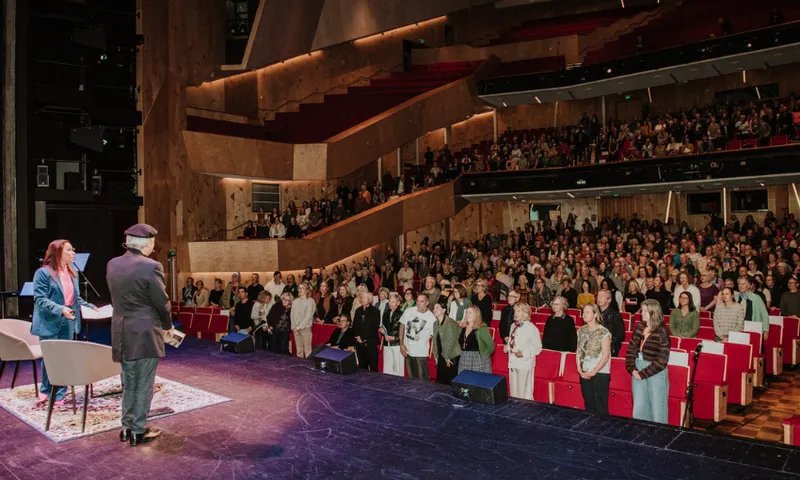
Ihimaera Smiler is all warmth: his energy is palpable as is his will to connect with everyone in the room. He brought out his long-time collaborator Kingsley Spargo to perform a spine-tingling story (Spargo on taonga pūoro and brass instruments) about the love of a father: so strong it could even defy the gods. “Pūrākau contain messages that carry through to us today,” he said. It was an electrifying moment: a reminder of how the master storyteller is always the performer, too. The entertainer.
When Morrison asked what his secret was, he replied that we all have to discover ourselves and rediscover ourselves. He talked about his nanny, intelligent as the wheke, a creature also adept at camouflage from the shark – “like Māori have had to hide from the Pākeha to survive.” Ultimately, it was learning to understand language trauma, language loss, that charged Witi’s learning. “Learning te reo Māori is just the first step in rediscovering ourselves,” he said.
In the end, Ihimaera Smiler turned the questions back to us: “Who are you? Who are we? Who should we be? What is New Zealand? What should it be? Have we got the capacity, the fortitude as a people to get there? I’m not the only one swimming home. You are too.” / Claire Mabey
The Spinoff Books section is proudly brought to you by Unity Books and Creative New Zealand. Visit Unity Books online today.

Group Think
Multiple Spinoff contributors coming together to collaboratively author a post, video or podcast.


