Polymarket and Kalshi let users wager on anything from election outcomes to the return of Jesus Christ. Fans say they’re valuable forecasting tools, but the New Zealand regulator says it’s gambling, pure and simple.
It started with a YouTube video. In 2024, Andrew Lin, a politics student at the University of Waikato, watched someone explaining the advantages of prediction markets for telling the future, alleging they were more reliable than polling or the reckons of talking heads on TV. He wanted to get involved. “I liked that you could create your own markets,” he recalls. Lin started asking questions for others to place bets on: who would lead the Labour Party at the next election? Would the Opportunities Party make it into parliament? Will any new party enter New Zealand’s parliament before 2030? “I didn’t have any experience doing formal gambling or placing bets,” he says. “It seemed like an interesting way to see what others are thinking.”
Prediction markets are digital platforms where users can ask questions about the future and place bets on the results. Hundreds of millions of dollars are wagered each week on everything from the price Bitcoin will reach in February, to whether Jesus Christ will return by 2027 (just 4% of people have bid on “yes”) ,to whether the UK prime minister will be out by the end of the year (66% of people have put money on it). On the day of the recent Super Bowl, Polymarket and Kalshi, the two biggest prediction market companies, saw collective trading volume of US$1.2 billion.
While these companies argue they’re legitimate financial markets rather than gambling sites so shouldn’t be subject to the strict regulation the latter often is, they’re facing increasing scrutiny. In the US, both Polymarket and Kalshi are embroiled in numerous state-level lawsuits, though the Trump administration has pledged to protect them. In New Zealand, the Department of Internal Affairs last week said prediction markets were operating here illegally and have told the companies to get out.
For Lin, the stakes are low: he doesn’t use real money, having signed up to a website where you can get free prediction credits, and buy more for cash if you run out. Justin, an engineer based in Auckland who didn’t want his last name published, has taken a similar approach. He uses a platform called Manifold, where the markets use a credit system called “mana” rather than real money. The appeal for him is the thrill of predicting. “It makes me feel more engaged and connected to events, because I want to see how things go. He got into using prediction markets after reading about “superforecasters” – people who are very good at predicting the future.
Prediction markets have precedent in Aotearoa. In the mid-2010s the website iPredict was set up by Victoria University of Wellington and the New Zealand Institute for the Study of Competition and Regulation. Punters could bet on everything from student politics to the New Zealand election. While the website had been granted an exception to gambling regulation as a futures dealer – in the past, “futures” betting took place by trading contracts based on the future prices of commodities like grains or oil – it was shut down in 2016 over money laundering concerns. VUW still owns PredictIt, a prediction market for politics operating in the US, where only American citizens can place bets.
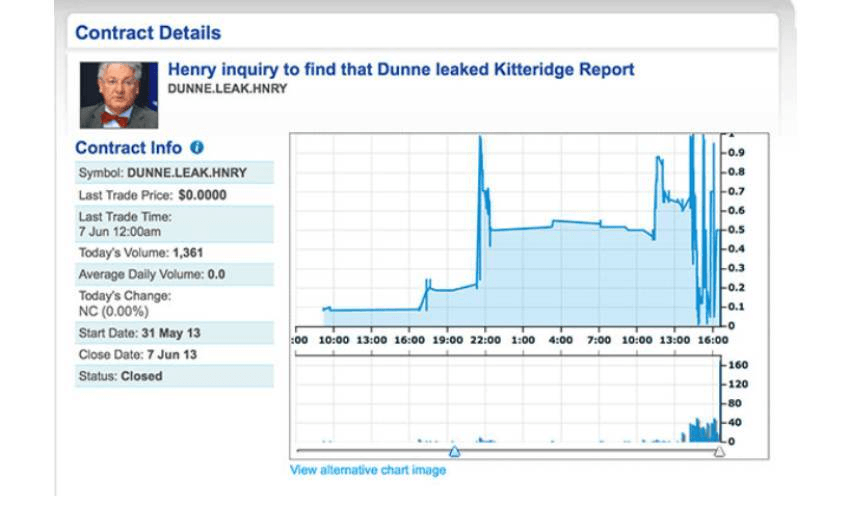
Prediction markets can be accurate; a data analysis of Polymarket showed users were right 90% of the time across different world events. The companies are keen to push this aspect; in December 2025, Polymarket CEO Shayne Coplan described them as “the most accurate thing we have as mankind right now”. Unlike standard political polling, which focuses on what people want to happen, the market incentivises people to say what they think will happen – a subtle but important difference. The data feedback is constant. “You can see live reactions to events, traders making decisions,” Lin says.
But there are limits to prediction markets, too. Thomas Pfeiffer, a professor at Massey University who studies how information moves, says the average person using Polymarket or Kalshi is likely to be “younger, male, more risk loving, more a tech fiend”, possibly someone who was burned by the fluctuating crypto market and wanted to invest elsewhere.
The CEO of Kalshi has said he would like to “financialise everything and create a tradable asset out of any difference in opinion”. In that world, where everything is a form of betting, prediction markets would be a live opinion poll about every conceivable issue in the world. But without it, the markets have a disadvantage over standard political opinion polling, as there is no way to compensate for demographics.
Prediction markets also come with the risk of insider trading. Being in the know about an issue means you can stand to gain financially from it. “From a libertarian perspective, it’s not a negative thing – information in the market can travel fast and lead to more accurate pricing,” Pfeiffer says.
Essentially, people with more information are incentivised to trade more, so the markets have up-to-date knowledge. Clearly, people with more information have benefitted: a user on Polymarket made $400,000 betting that Venezuelan president Nicolas Maduro would be removed by the end of January, placing $20,000 just before Trump announced strikes on Caracas – just one example of suspiciously well-timed bets.
Markets could change incentives, with a political adviser perhaps financially gaining from advice they’ve traded on. Insider trading is banned on the stock market so the public has confidence to invest – but does the same logic apply in prediction markets? And could politicians scrolling Kalshi change their choices as a result? “I’m not sure whether prediction markets would have an impact on political strategy – you need finer-grade information about which voters are supporting you,” Pfeiffer says. But he acknowledges that if uptake was high enough, “it’s not impossible” politicians would look to the market.
Justin has watched some YouTube videos about insider trading in prediction markets and says it would put him off placing bets on a market using real money. “I feel confident to dabble, but I don’t want to risk too much on this sort of stuff.” He’s seen things change quickly during sports games. “Each match takes huge swings depending on momentum.”
To Pfeiffer, prediction markets may work more effectively when those placing bets are people with knowledge of a specific area. He’s been researching using prediction markets with scientists, who place bets on whether the results of a scientific study can be replicated – useful information, potentially, for science funders or journalists making sense of a novel result.
He’s also intrigued by Metaculus, where predictions are focused around “topics of global importance”: the homepage currently showcases recent markets for AI, French municipal elections and maritime piracy. People using the site can win cash prizes, but this isn’t directly related to what they’re gambling on.
Can prediction markets say anything useful about New Zealand? “The US is so influential on the internet, a lot of questions [on prediction markets] seem more relevant there,” says Lin. On Polymarket, most questions related to New Zealand are to do with sports. Some bets are unsurprising: fewer than 1% of people are betting on New Zealand to win the 2026 Fifa World Cup, a $152m market. Outside of sport, there are 32% odds that New Zealand will recognise Palestine before 2027. Last week, nearly 100% of people were betting that the Reserve Bank would maintain its current OCR on Thursday, which it did.
Manifold has fewer punters, but more specific questions: will Christopher Luxon, ChrisHipkins and Winston Peters all be leaders of their respective parties at this year’s election? Will Trump express interest in claiming any part of New Zealand? And, intriguingly, would a particular user enjoy their trip to New Zealand in January? “I usually enjoy trips unless I get sick, flight issues etc.”
Lin thinks there will always be a niche for prediction markets in New Zealand, even if they’re just trading fake money. “There’s an appetite to take data and turn it into something,” he says. Still, he’s using the platforms less now than he was a year ago. “I think the novelty has worn off.”