The man who brought fish and chips to New Zealand

Meet James Henry Pomeroy: inventor, fishmonger, and the man responsible for deep fried blue cod on a southern beach.
The best fish and chips I’ve ever had were all in the south: Port Fish Supply, Port Chalmers, Kai Kart, Oban, and Bluff Kitchen, Bluff. There’s one thing they all have in common: fresh blue cod.
Because blue cod (rāwaru) lives in the cold waters around Stewart Island and the lower South Island, it develops very lean, tight muscle fibres. In eating terms, that gives it firm, flaky flesh which is exceptionally well-suited to deep-frying. That same leanness is also a limitation. There isn’t enough fat to protect the cell structure, so it goes mushy when frozen. Which means one of the world’s great fish and chips experiences can only be found in New Zealand’s deep south.
That’s not to say the other fish on that familiar New Zealand Commercial Fish Species poster aren’t great eating too, they’re just different. Snapper is for a sheltered cove with a pink sunset on a warm evening. Kahawai is for a rugged surf beach with seagulls swarming and friends laughing. Tarakihi is for a busy public beach while young children run and splash. Blue cod is a quiet moment of contemplation under a starry sky.

Eating fish and chips on the beach is a quintessential New Zealand experience. And yet it occupies an awkward place in the national culture. It isn’t ours. Fish and chips are a famously British dish.
So how did it get here? It’s easy to imagine the early British settlers hopping off the boat in 1840 and celebrating with a feast of potatoes and freshly caught fried fish. But they didn’t, because the dish didn’t exist yet – not in Britain, anyway.
The first fish and chip shop in London was opened in 1860 by Joseph Malin, one of a wave of Jewish immigrants who introduced the dish to the UK in the latter half of the 19th century. Early English sources often referred to battered fried fish as “Jewish fried fish” or “fish the Jews’ way”.
The earliest newspaper mention of fish ’n’ chips on a New Zealand menu is from 1894, when the Ship Hotel at 115 Princes St, Dunedin advertised “fried fish and potatoes” for three pence. It’s hard to know for sure whether this was fish and chips as we would recognise it today. The Ship Hotel was a sit-down restaurant that mostly served roasts and stews. There was no other fried food on the menu, so it’s unlikely they had a deep fryer for just one dish. It’s possible the fish could have been pan-fried, and the potatoes could have been roasted or mashed.
The first dedicated fish and chip shop in New Zealand appears to be Invercargill’s London Fried Fish Shop, opened by James Henry Pomeroy in May 1903. A short newspaper article about the opening referenced the imported deep fryer, saying the shop had been “fitted up with a special stove and other appliances for the rapid and thorough cooking of fried fish and chipped potatoes. The combination makes a tasty dish”.
An advertisement described the store as being “opposite Council Chambers”. The historic Provincial Council Building, constructed in 1864, is still standing today. Directly opposite, at 31 Kelvin Street, is the holy site where fish and chips were bestowed upon New Zealand.
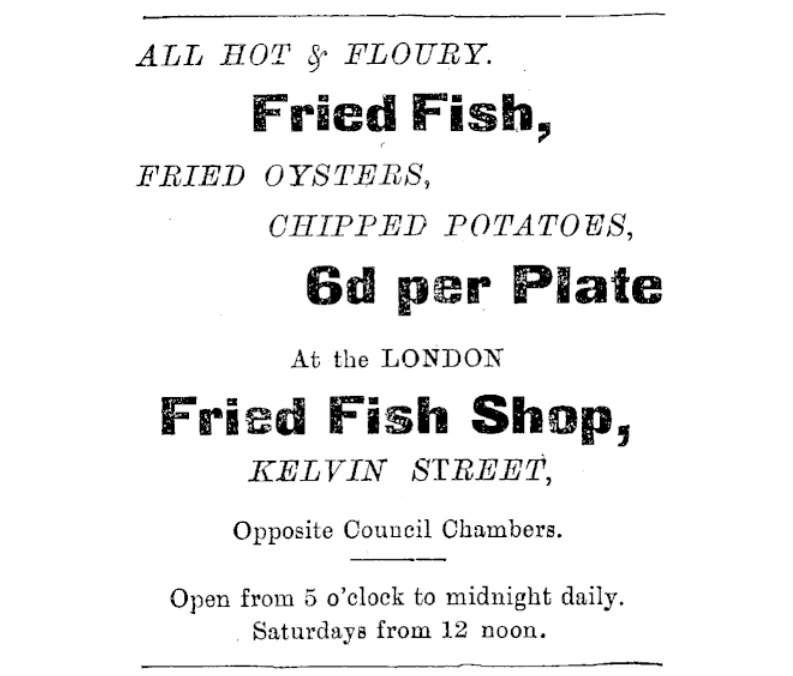
A reporter euphemistically referred to the man behind the shop, James Henry Pomeroy, as “our energetic fishmonger”. Born in Cornwall, England, he moved to Invercargill, New Zealand in 1872, where he founded Pomeroy & Sons fish merchants. The company grew from a small wooden shop on Esk Street to a network of fishmongers and a fleet of ships.
Aside from his fishing empire, Pomeroy was a prolific inventor. He held patents for frozen crates for transporting meat, improvements in single-use bottles, a joining mechanism for railway tracks, and the “Pomeroy patent hat fastener”, which was claimed to be “the prettiest and most comfortable, as well as the most effective attachment for ladies’ hats ever invented”.
His son and collaborator John Pomeroy was even more inventive, patenting a self-refilling fountain pen, a painless rabbit trap, a new kind of sheep shears, a hair curler, some “menstruation appliances”, and inflatable cricket pads (he later admitted the pads were a failure because “more runs were scored as a result of the ball hitting that pad than could have been obtained in any other way”).
Pomeroy Jr’s most significant invention was the Pomeroy bullet, a type of ammunition that exploded on impact. It was incredibly effective against German zeppelins in the first world war because the detonation would ignite the airships’ flammable hydrogen gas.
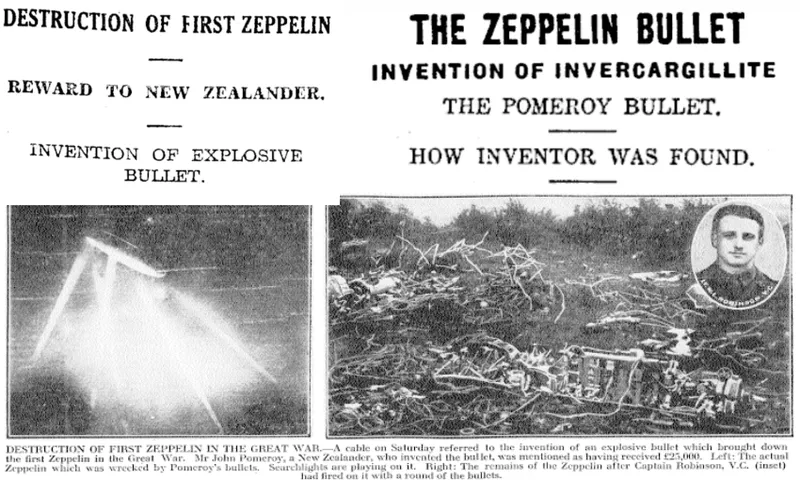
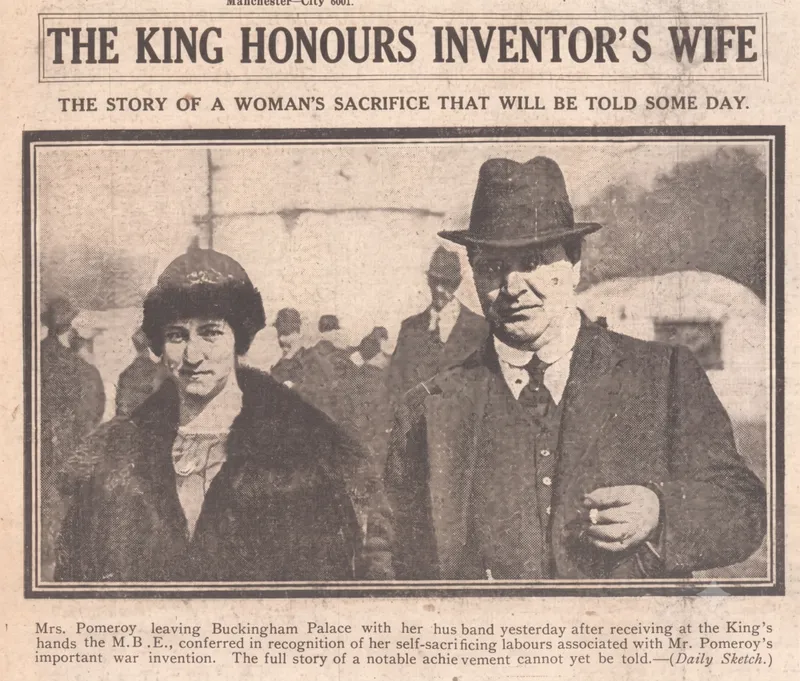
His wife and co-inventor Amy Amelia Pomeroy was awarded a Membership of the Order of the British Empire in a ceremony at Buckingham Palace. John refused a knighthood but accepted a £25,000 royalty payment from the Crown.
He later sold armour-piercing bullets to the US military prior to WWII and was rumoured to have developed a “death ray” for the Chinese government during the second Sino-Japanese war. He later made a fortune selling an “elixir of life” in the United States. He died penniless in Melbourne, running a pie cart, having spent everything trying to invent a cure for his cancer.
The elder Pomeroy was combative and would often wade in on public debates via newspaper letters to the editor. In one argument about blue cod migratory patterns he called his opponent an “unscrupulous middleman to whom a competent inspector would be a source of terror”. In early 1897 his wife was fined £20 for selling intoxicating liquor without license. He launched a long and expensive legal challenge. When that failed, he refused to pay the fine until he was threatened with debtor’s prison. In 1908, he was one of a group of Invercargill businessmen who publicly campaigned against the prohibition of alcohol.
In 1905, one of his shops was caught selling illegally-caught trout. The following year, his son Charles was caught red-handed fishing during closed season. In 1909 his grandson Robert was sentenced to a year at Boys Training Farm, a juvenile delinquent facility, and when the boy wasn’t released on time Pomeroy sued for a writ of habeas corpus and won. He retired from business sometime after that and moved to Melbourne with John. He died in 1930, aged 77.
Pomeroy was, in his way, the personification of kiwi ingenuity; an innovator who studied new technologies and found ways to apply them to local industries. He was also, it seems, a cantankerous, lawbreaking bully who used the courts as a personal weapon. These two things were probably not unrelated.
Think about what it actually took to open New Zealand’s first fish and chip shop in 1903. You had to learn that commercial deep fryers existed, find a manufacturer in the UK willing to deal with you, arrange shipping to one of the most remote cities on earth and put it together in a wooden shop in Invercargill. It took someone who was stubborn, intelligent, creative, and a bit unreasonable. But some things, like blue cod on a southern beach, are worth being unreasonable about.

Joel MacManus
Joel MacManus is a senior writer for The Spinoff. He previously worked at RNZ and Stuff, and began his career at Critic Te Ārohi. His writing explores the political, economic and cultural systems that underpin modern New Zealand. He won the 2025 Voyager Media Award for Best Columnist, Opinion or Critique.


