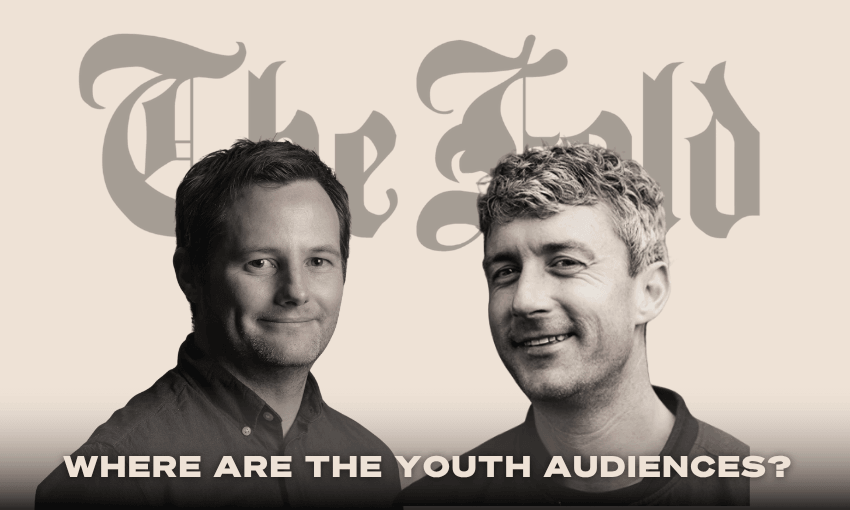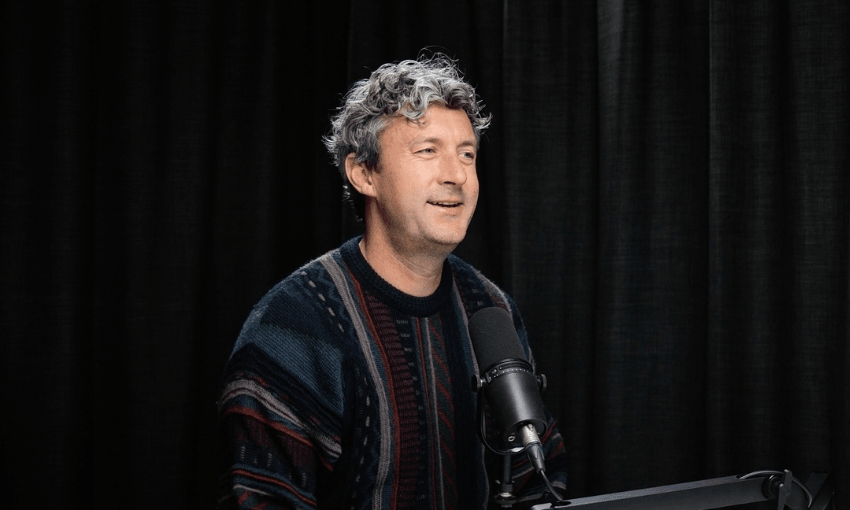



Duncan Greive started The Fold podcast in 2019 to track New Zealand’s media. Today marks its final episode – he looks back on the biggest stories from its time.
It’s just shy of seven years since I announced the arrival of The Fold to The Spinoff’s family of fine podcasts. “The idea is that the podcast will happen at least monthly, with emergency pods whenever big local media stories break,” I wrote as it launched.. Perhaps if I’d been able to keep to that original scope The Fold would still be going – but since then we’ve published 350 episodes, with the very last of them arriving in feeds today.
I started The Fold because media suddenly felt like one of the most interesting beats around. After decades of broad stability, in which large domestic media companies operated in competition with one another, but also with powerful moats protecting them, the story of the 2010s was one of global tech giants bringing a very different kind of fight. They brought amazing utility to audiences and advertisers, but profound challenges to society and government too. After initially being dismissed by local media, 2019 felt like the year tech started to take great chunks out of local media revenues.
It’s somewhat unfortunate to note that as I wind up The Fold, those trends have continued unabated in many respects, and that successive New Zealand governments have failed to make any substantive effort to address the complex challenges brought by big tech. For all that, the large institutions of our media have survived, albeit often in quite radically different configurations. So as I leave The Fold to commit myself wholly to Lume, a tech startup which is in many ways a response to what I processed and observed on The Fold, it feels like the right time to rank the seven most substantial media stories of the last seven years.
- Spark Sport calls time early
Launched in March of 2019, Spark Sport initially looked like a fierce challenger to pay TV giant Sky, which had until that point dominated sports essentially unchallenged. Despite a rocky start, it used the 2019 Men’s Rugby World Cup to drive around 200,000 subscriptions, and followed that up with rights to all NZ Cricket’s domestic fixtures for six years.
This came as part of a global megatrend which saw telecommunication companies like Spark move aggressively into streaming, both sports and entertainment – they would not just be connections, but content too. This forced Sky into playing very aggressive defense, including a massive deal with NZ Rugby, which included granting the organisation a 5% stake in Sky itself.
It didn’t last. Just as Optus and BT withdrew in Australia and the UK, Spark’s commitment proved short-lived. When Jolie Holland succeeded Simon Moutter as CEO, it lost the leader who had championed the project. In December of 2022, Spark announced it would be shutting Spark Sport. Yet instead of the contracts landing at Sky, Spark instead transferred them to TVNZ. In so doing it allowed the state media behemoth to find out what sports did for its platforms, during a period when rights costs were exploding, all for a heavily discounted cost.
Its echoes continue to this day. Without Spark Sport, TVNZ might never have built out the subscription tech which allowed it to buy the 2026 FIFA World Cup. Without Spark exiting, Sky might not have been able to purchase NZ Rugby’s next package at heavy reduction from its previous deal. Spark’s time in sports was brief, but it ultimately changed the trajectory of New Zealand’s two biggest broadcasters.
- The rise of the renegades

Part of the rise and rise of big tech is about the creation of tools which allow anyone to create a media company from scratch, with tools and potential audiences which would have been unimaginable a few years before. Global platforms saw political and cultural trends flow effortlessly through borders, subject to none of the same scrutiny and regulatory oversight to which institutional advertisers and media were subject.
For a period of time that meant new forms of orthodoxy were established at mainstream platforms with surprising speed, and successive reckonings around how gender, race and sexuality were covered and framed flew around the world. This saw a large number of broadcasters leave long-running roles in mainstream media for various reasons. Where in previous generations, that might have been the end of their careers, now there were options. There were also audiences who shared their belief that certain relatively widely-held views were being chased out of circulation.
Sean Plunket used his very public split with Mediaworks as a spur to launch The Platform. Post-Covid discontent led to the rise of Reality Check Radio, Voices for Freedom and Counterspin Media. A constellation of other voices from across the political spectrum set up YouTube channels, Instagram accounts and Substacks. Eventually, the Broadcasting Standards Authority decided that it was obligated to engage with this new media world, taking the view that The Platform was subject to its supervision – a decision which directly led to the coalition government announcing the authority’s closure.
- Grenon’s war for NZME
One of the startups animated by the same spirit as The Platform was a brand called The Centrist, which, despite its name, largely published stories critical of a perceived leftward turn among mainstream news media in Aotearoa. It was initially funded by Jim Grenon, a wealthy investor who had moved here from Canada a decade or so earlier.
The Centrist seemed to give Grenon a taste for media, but not the influence he desired. In early 2025, during a period of extreme destabilisation for New Zealand media (see below), Grenon took a substantial shareholding in NZME, publisher of the NZ Herald and broadcaster of ZB along with a host of other news and entertainment media assets. Over a few feverish weeks he upped his stake and aligned with other shareholders to force a dramatic annual general meeting, which ultimately ended with former National party finance minister Steven Joyce being elected chair, and Grenon joining the board.
There were fears it would lead to a profound rightward shift in the Herald’s coverage, yet aside from a shift toward video and an occasional series of “good news” stories under the heading “on the up”, there has been little discernable change in the Herald’s editorial intent. Grenon might be content with his current position and influence – or might be biding his time ahead of a full takeover (he politely but persistently declined requests to guest on The Fold). At least it gave Herald columnist Shayne Currie a very juicy in-house story to feverishly cover for Media Insider.
- Media enters its $1 store era
The first episode of The Fold was an interview with Stuff CEO Sinead Boucher. Within six months she returned to the show, still as CEO, but this time also as Stuff’s owner. May of 2020 was a memorable month for any number of reasons, and for most people will be remembered because we were coming out of lockdown while the rest of the world continued to battle Covid-19 – but within media circles it will always be synonymous with Boucher dramatically beating NZME to purchasing Stuff from its Australian owners.
The most shocking element of the story was the price: she paid just $1 for a vast company, comprising the biggest news website in New Zealand, and a large stable of print news products. Back under independent control, Boucher made a string of bold moves, announcing a staff shareholding, quitting Facebook, dropping the Dominion from the Dominion-Post and publicly apologising for its historic coverage of Māori and other groups.
While the price was a product of a very specific moment, and Boucher deserves huge credit for having the nerve to take the plunge, given all that was unknown at the time, it also served as something of a public verdict on media values. Share prices have stayed low since, and a large number of organisations have changed hands for tiny fractions of the values they once commanded – most notably Three, which was sold to Sky by Warner Bros.-Discovery (which had only bought it a few years earlier) for exactly the same price Boucher paid for Stuff.
- Australia stares down the platforms
When The Fold began, New Zealand and Australia had broadly similar regulations around big tech – which is to say, relatively few of any consequence. What it did have was a history of more activist policy around media, including far larger and better-funded public media entities, anti-siphoning laws around major sports and strict rules about the volume of local content on broadcast channels.
Over the past seven years, Australia has become a global leader in terms of its reckoning with the social and business impacts of big tech companies. An incomplete list includes:
- A news bargaining code, about to enter its second act, which pumped hundreds of millions into news media
- A social media ban for under-16s
- Aggressive protection of copyright in the face of fierce lobbying from AI companies
- Age verification for pornography access
- A requirement that streaming platforms heavily invest into local content
It has necessarily been messy work, and not all companies have played ball (Google – which has a deal with The Spinoff along with a number of other local media companies – has been a conspicuous participant, while Meta no longer carries news in Australia). There have been many valid critiques of its approach. But it has worked tirelessly to engage with the many challenges associated with digital media. New Zealand, by contrast, has abolished the Broadcasting Standards Authority and allowed TV advertising on Sunday mornings.
- The end of Newshub

There have been a number of catastrophic losses of key institutions in recent years. The shutdown of Bauer Media on a Zoom. The chaotic on-air end of Today FM. The loss of most news bulletins from Whakaata Māori and TVNZ, and the vanishing of Sunday and Fair Go from our screens.
These represented job losses and profound changes to our news and information systems, and all are missed. But for sheer breathtaking scale and consequence, nothing compares to the end of Newshub, announced in February of 2024. Since its beginnings as TV3 News, it had been the ultimate challenger brand, taking on the ratings and resource of TVNZ with a rare energy. Its ability to generate new and original talent was without peer in our media, and it made being perpetually bankrupt look fun.
At least until it was abruptly culled, during the vicious post-Covid advertising downturn. To their immense credit, most staff stayed on and continued putting out exceptional news products, breaking consequential stories until the end. In the aftermath, Stuff started making the 6pm bulletin, the NZ Herald significantly expanded its video output and RNZ made a dramatic surge in online news. But nothing has replaced, nor could replace, what Newshub gave to New Zealand.
- The pandemic upends media
Covid-19 is a far bigger story than media, one which reshaped our politics, the way we work, our health and education systems and created a permanent and mistrustful segment of society. It’s threaded in different ways through all the previous six stories. But its impact on media alone was profound enough to make it the single most important media story of the past seven years.
Its immediate impact was truly bizarre. It created a completely unprecedented demand for news, with every day’s traffic or ratings looking like an election had occurred or war commenced. Yet at the same time, because advertising was the largest funder of journalism, lockdown orders meant the vast majority of advertisers stopped all spending – meaning revenues went close to zero across most of the media.
Through late 2020 and much of 2021, with borders closed, interest rates low and stimulus ringing cash registers, the economy boomed and media with it. The government announced a Public Interest Journalism Fund, which briefly created a costly talent war amongst media outlets. Then a sharp rise in interest rates created a profound planned recession, sending advertising plunging again – only this time with sharply raised fixed costs.
Because the pandemic had made the whole population extremely online, when the halting recovery came, it disproportionately benefited big tech companies over domestic media. This ultimately led to a permanent reorientation of many publishers towards audience revenue, often derived from paywalled news. Shows which were previously commercially funded, like The Traitors or Celebrity Treasure Island, arrived at NZ on Air’s door.
Audience migration to user-generated content platforms had a number of profound consequences. A segment of the audience lost trust in mainstream media, seemingly permanently, over what they perceived as a too-cosy relationship with news media through the 1pm Covid briefings. In reality “Jessica, then Tova” was less about favouritism than an acknowledgement that the political editors had a 6pm bulletin deadline to meet – but that got lost in a conspiratorial frenzy which persists even today.
It’s worth noting that media made significant errors through the pandemic, on both business and editorial sides. It shut down important debates without explaining why, and too-blithely dismissed concerns from various audiences, creating a sense of acceptable and unacceptable beliefs which denigrated and belittled people with legitimate questions around vaccines. But the penalties for errors were existentially high, and arbitrarily distributed.
For the most part, though, our media operated with extraordinary dedication to cover stories, put out shows, and evolve platforms under enormous pressure. This is, if anything, increasing, as generative AI feasts on its collective output without a hint of compensation. Yet those who remain working in this industry keep putting out work, much of it exceptional, despite the prevailing weather. I’ll no longer be covering it – but I will be very gratefully watching, reading and listening.