Chris Hipkins is batting for a draw

Labour leader Chris Hipkins is desperately trying to keep his wicket. (Image: Mark Cosgrove/Getty Images/The Spinoff)
Hipkins has been so focused on negating the case against Labour that he never built a cohesive argument for Labour.
National sent two balls just outside Chris Hipkins’ off stump last week, hoping to bait him into poking out his bat. Two new government policies – a rates cap on councils and a social media ban for under-16s – were tactically announced during the penultimate sitting block of parliament in an attempt to goad the opposition into taking an unpopular stance. Both of the proposals have flaws, but they’re difficult to argue against without sounding like you want higher rates for everyone and to sacrifice teenagers to the monstrosities of the algorithm.
Hipkins believed in the leave. He let both balls run through to the keeper. By announcing that Labour would support both bills to the first reading, he denied National a potential attack line while still leaving open the option of killing the bills after the select committee hearings.
Usually, a governing party would be happy to have bipartisan consensus for a proposed bill. In this case, National was so frustrated that they pretended it never happened. A few hours after Labour offered its support for rates caps, Christopher Luxon told an audience in Paraparaumu that “all the opposition parties hate it”.
It’s a continuation of a strategy Hipkins has pursued all term. He’s been careful about which issues he comments on. He chose not to play at many the government’s most significant reforms – the fast-track legislation, RMA replacement, and local water reforms – instead offering vague support while leaving the door open to incremental changes.
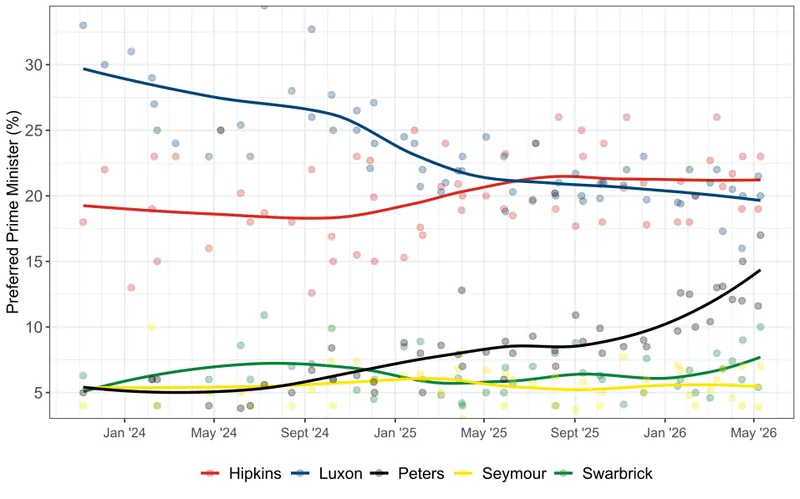
Some left wing voters have found it frustrating, feeling that Labour is not sufficiently standing up for them. Others just feel bored and uninspired. Labour’s polling has been stagnant for months. Hipkins’ preferred prime minister rating is lower than it was in 2023 and remains within the margin of error of Luxon’s, despite the prime minister almost being rolled twice by his own party. And yet, according to prediction markets, Hipkins is now the odds-on favourite to become prime minister after the election.
It’s often said that being the leader of the opposition is the worst job in politics. In his time in parliament, Hipkins has seen several opposition leaders self-immolate by overreaching on esoteric issues. Think David Shearer holding up two dead fish or Simon Bridges screaming about slushies.
In politics, much like cricket, you have to play to the conditions. When Hipkins became leader of the Labour Party, he stepped onto a pitch that was cracking like a dry river bed. The economy was deteriorating, inflation was high, and incumbent parties were being turfed out around the world. To make matters worse, the bulk of Labour’s top performers had thrown their wickets away. Jacinda Ardern stepped down; Grant Robertson, Andrew Little and David Parker bolted for the exit; and Michael Wood, Kiri Allan and Stuart Nash self-destructed. Hipkins was left out there alone as the last genuine batter before the tail-enders.
After being unceremoniously dumped into opposition in 2023, the only chance of revival was for Hipkins to dig in, play conservatively, and hope against hope that he could hold on to his wicket until the final session. If he could make it that far then maybe, just maybe, Labour would have a chance in 2026.
It was a long shot, but Labour got lucky. The economy hasn’t turned around as much as the government would have hoped, Act and NZ First have stoked unpopular culture wars, and Luxon has made a series of unforced errors. All the while, Hipkins has been there, plodding away, defending his crease.
But while Hipkins has managed to stay in, he hasn’t been scoring runs. He’s been so focused on negating the case against Labour that he never built a cohesive argument for Labour.
Labour’s policy agenda is as boring and low-risk as possible. The biggest change, the capital gains tax, was essentially forced on the party by grassroots members who were fed up with the timidity of leaders who kept rejecting it. And even then, it was carefully designed to neutralise risk – limited in scope, and paired with a universal entitlement of three GP visits, which may or may not be sufficiently funded through the tax but are nonetheless difficult for anyone to argue against.
With Labour batting for the draw, the responsibility of playing for the win (and proposing an actual alternative policy suite) has fallen to its potential coalition partners. Opportunity has been picking up disaffected National voters in recent polling, the Greens are rallying progressives, and Te Pāti Māori’s overhang strategy is tilting the maths in the left bloc’s favour. Labour is just…. there.
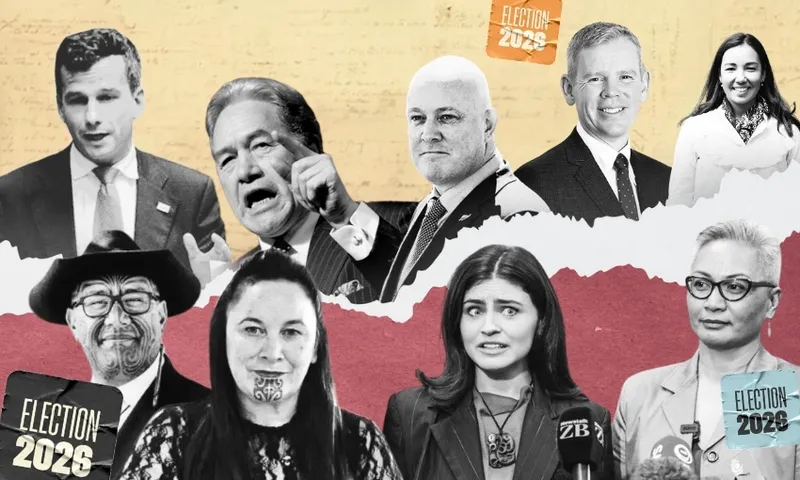
Given the dearth of proposals from Labour, National has been trying its best to tie Hipkins to the ideas of the minor parties, and Hipkins has been busy insisting that he doesn’t actually want to do anything and anyone who suggests otherwise is a damn dirty liar. To some extent, these attacks have been misleading and unfair. But they’re hardly unpredictable.
Nature abhors a vacuum. If you aren’t offering anything new, someone else will step into your place. The downside for Labour is that they could end up in the same trap as National, with minor coalition parties setting the agenda because they’re the only ones who have one.
If the left bloc manages to form a government after this election, it will be because Hipkins played a heroically disciplined innings. Labour could snatch a draw from the jaws of defeat. But that may be all it is – a draw. When you take the reins of government without any plan for what you’ll do, is that really a victory at all?

Joel MacManus
Joel MacManus is a senior writer for The Spinoff. He previously worked at RNZ and Stuff, and began his career at Critic Te Ārohi. His writing explores the political, economic and cultural systems that underpin modern New Zealand. He won the 2025 Voyager Media Award for Best Columnist, Opinion or Critique.


