From anti-gay to anti-trans: rhetoric’s the same, 40 years after homosexual law reform

Left: Gay Liberation Movement demonstrates in Wellington in 1974 (Evening Post/Alexander Turnbull Library). Right: Transgender rights rally, Wellington, 2021 (Getty)
July 9 marks 40 years since gay sex was decriminalised, but the scare tactics used as the Homosexual Law Reform Bill worked its way through parliament in the 1980s are still being used now. This time, they’re focused on transgender people.
In 1985, Norman Jones predicted that if the Homosexual Law Reform Bill passed, more New Zealanders would die of Aids in the next 10 years “than would die of a nuclear explosion”. Making it clear the Cold War wasn’t the only thing on his mind, the MP for Invercargill later reflected in parliament that “if the good Lord wanted us to procreate the race through the rear he would have put the womb down there”.
During the same debate, Hauraki MP Graeme Lee asked if parents were “satisfied with the knowledge that their son, at the age of 16 years, could be approached and recruited by the homosexual community”, while Winston Peters, then National’s MP for Tauranga, emphasised the potential for a plague-like catastrophe of biblical proportions: “New Zealand has the capacity to escape the scourge of Aids, but will not do so if the bill is passed.”
For 16 months the private member’s bill introduced by Labour’s Fran Wilde, which sought to decriminalise sex between consenting men, was fiercely debated in parliament. The arguments in opposition were not based on evidence, but on fear for the very foundations of society.
Back then, MPs deployed extreme scenarios as scare tactics, positing that they had a responsibility to establish societal norms and standards, and argued that homosexuality needed to be controlled.
Despite vigorous opposition, the bill passed into law on July 9, 1986. Now, 40 years later, New Zealand is caught in a similarly loud public argument, this time about gender and whose existence counts as a “threat” to society. That debate now includes a member’s bill before parliament seeking to legally define “man” and “woman”.
If today’s anti-trans talking points feel strangely familiar, it is because we have heard them before. A trawl through the parliament’s debate archive, Hansard, shows just how unrestrained the rhetoric once was – pages and pages of speeches that ranged from the merely confused to the outright unhinged.
Swap yesterday’s key words and phrases (sodomy, decadence, moral decay) for today’s (biological reality, fairness in sport, ideology in schools) and voilà: the choreography is near identical. Some (but not all) of the names have changed and technologies have evolved (hello social media), but the strategy remains consistent: brand a minority as a danger to society, nay a civilisation-ending hazard, and sell tickets to salvation.
In the 70s and 80s, understanding the causes of queerness was a key preoccupation among MPs, who routinely framed sexual orientation as a learned behaviour that needed to be corrected. “Homosexuality is a result of conditioning, of bad family experiences. Perhaps it is the result of peer pressure [or a] result of the environment in which a person is nurtured,” Timaru MP Maurice McTigue suggested in 1985.
Sound familiar? The idea that gender identity is taught or learned is the focus today, with NZ First and other groups claiming schools are “indoctrinating” children with “gender ideology”. Last year, the government saw the removal of the Ministry of Education’s relationships and sexuality education guidance that included gender diversity. What was once blamed on overbearing mothers and aberrant environments is now blamed on teachers and curriculum writers. The pattern is unmistakable.
Given the high status accorded the medical profession, in the 1980s, MPs like Labour’s Geoffrey Braybrooke deferred readily to biomedical authority, expressing unwavering faith that science would eventually fix the “problem” of queerness: “Homosexuals need both medical and psychological treatment. They do not need a change in the law,” the Napier MP argued in 1985.
Braybrooke didn’t spell out what he meant by “treatment”, but internationally that phrase had covered a horror-show menu: electroconvulsive therapy, chemical castration, hormonal tinkering, masturbatory reconditioning – even lobotomies. New Zealand never went that far, but the thinking was imported wholesale.
In 2021 when legislation to ban conversion therapy was introduced into parliament, opposition to the bill came from MPs worried young people would take puberty blockers without proper consultation and that the new law would criminalise parents. Then National MP Simon O’Connor (now with conservative Christian lobby group Family First) even raised concerns on behalf of his gay and lesbian friends.
Outside parliament, Family First claimed that banning conversion therapy would criminalise parents “for affirming that their sons are boys and their daughters are girls” and would lock children into “transgenderism” (a word that LGBTQ advocacy group GLAAD says is used by opponents of trans rights to imply that being trans is a political ideology, rather than an authentic aspect of one’s personhood). The Conversion Practices Prohibition Legislation Act passed into law the following year, but the rhetoric continues.

In 2024, ahead of a protest at Christchurch medical centre Te Tahi Youth – which, among other things, helps young people access gender-affirming healthcare – Destiny Church leader Brian Tamaki claimed puberty blockers caused “irreversible destruction” to young people. At the protest, his supporters described gender-affirming care as “child abuse”.
Today, instead of demanding that queer people be medically corrected, opponents argue that medical care for queer and trans youth must be denied.
Four decades ago, it wasn’t just the homosexuals themselves that MPs were worried about. Maurice McTigue feared a law change would compromise the traditional family unit, resulting in antisocial behaviours like “orgies, prostitution, pornography, polygamy, adultery, incest, sodomy of animals, drug abuse, and so on”.
Another familiar trope shared in parliament was that homosexuality would spread. “It opens the floodgates for all males to commit these indecent acts,” Tauranga MP Keith Allen argued in 1975. Following this logic, if homosexuality were to be legalised, it could follow that humans would stop procreating. “It would threaten the future of the race,” former prime minister Sir John Marshall said in the same year.
This contagion narrative persists. In the 1980s Norman Jones said, “Homosexuality will not stop at the age of 16 but will spread to 10-year-olds and 12-year-olds”. Today, Family First describes gender diversity as a “trend” or “social contagion”, claiming children are being swept up in a harmful ideological wave.
The perennial cry to “protect the children” also persists. Graeme Lee’s warning in 1985 that homosexuals would “approach and recruit” youth is mirrored by Tamaki’s allegation that children are being “molested mentally and emotionally” by gender-affirming education or events, while targeting centres where trans rangatahi access care.

Last year on social media, Peters described non-binary Green MP Benjamin Doyle as “the guy who wants to provide puberty blockers on demand and surgery for children”, adding that “Doyle has been placed in parliament to sabotage ethical beliefs our society stands for”.
Today the danger is said to be to women too. In 2024, the Fair Access to Bathrooms Bill was introduced by then NZ First MP Tanya Unkovich. The member’s bill proposed fines for “anyone who uses a single-sex toilet and is not of the sex for which that toilet has been designated”. Its explanatory note read: “It goes against logic and common sense for a government to allow biological men to access women or girl’s restrooms, changing rooms, and other safe spaces. It is essential that the government protect women’s spaces.”
On social media, NZ First leader Winston Peters, who was also deputy prime minister at the time, shared the phrase “Woman = Adult. Human. Female”, a dog whistle associated with anti-trans movements.
Last year, upon introducing a member’s bill to legally define biological sex, Peters called gender recognition policy “cancerous social engineering” pushed by a “woke minority”, which undermined the “protection, progression, and safety of women”. He insisted the country must “fight back” to save society. When pressed on the machinations of the legislation’s enforcement, Peters stated trans women would be subjected to a biological test.
As with past moral panics, the stakes aren’t just rhetorical. Law doesn’t simply describe identity – it helps produce it. The Cold War language may have faded since the 80s, but the underlying assumption is constant: queer and trans people pose a danger that must be contained.
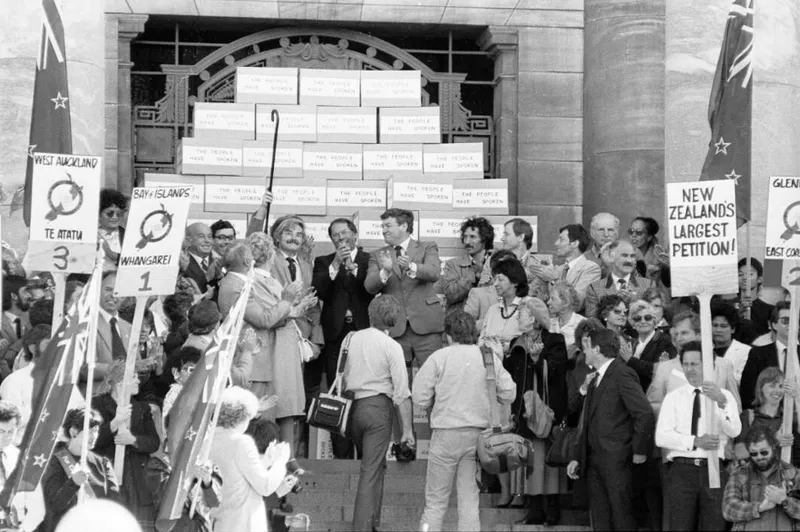
In the 80s it was “moral missionaries” like the Salvation Army marching vast petitions up parliament’s steps in a drama resembling a Nuremberg cosplay. Today Destiny Church, in particular, has turned moral panic into a hyper-masculine visual brand: coordinated T-shirts, slick slogans, stylised haka, and high-visibility protest choreography. The group has a long history of confrontational public activism, reviving the same Old Testament fear mongering we saw in Hansard transcripts from decades ago, just with new fonts and a livestream.
The tragedy is that many Māori and Pasifika feature prominently in these protests, and those same communities include trans and non-binary youth who, according to The Counting Ourselves 2022 survey, face severe mental health inequities.
In the 1980s, MPs wielded pseudoscience with total confidence and absolutely no understanding of empirical sexological research. For many MPs of that era, homosexuality was a disease, a pathology, a psychological malfunction caused by bad parenting or insufficient exposure to rugby.
Anniversaries like the homosexual law reform milestone matter because they remind us progress isn’t just legal, it conditions the lives we live. Aotearoa in 2026 is a different place: we can celebrate marriage equality, human rights protections, conversion therapy bans, and expanding recognition of gender diversity. And we are better at calling out the nonsense.

Quentin Allan
Dr Quentin Allan is a senior lecturer at Auckland University of Technology and works as a learning advisor within Te Mātāpuna Library and Learning Services. His background is in applied linguistics and academic literacies, with a focus on how language shapes knowledge, identity, and participation in education. He has published on a range of subjects, including disclosure, stigma, and the social contexts in which sexual identity is negotiated.


