How Ruth Richardson tested Reserve Bank independence with ‘red alert’ to Don Brash

Don Brash, governor of the Reserve Bank, and Ruth Richardson, finance minister. Photos: Getty
Exclusive: In the year of the ‘mother of all budgets’, the finance minister sent an ’emissary’ to the governor, she reveals.
The concept of Reserve Bank independence has attracted a good wash of spotlight in 2025, with the prime minister moving to clarify that on monetary policy, the bank’s operational independence is “sacrosanct”. But one of the staunchest advocates of that independence, and one of the first finance ministers in office after its introduction, has revealed she went “close to the line” on the principle.
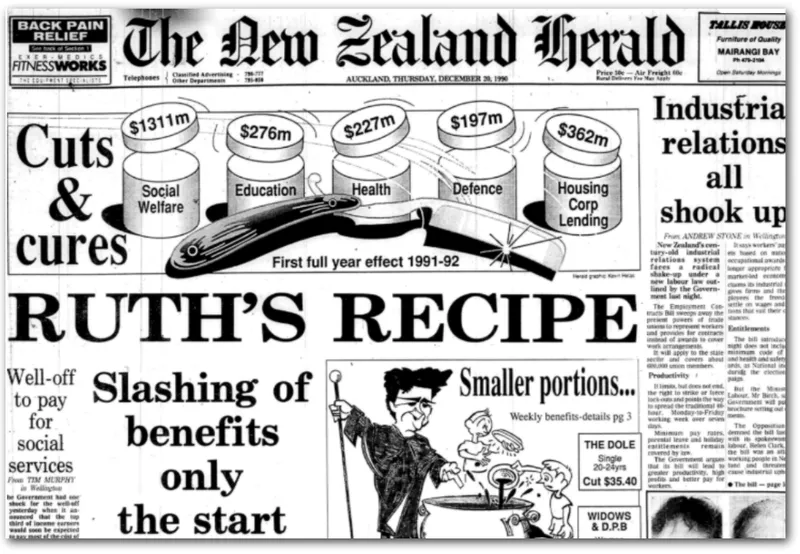
In the new season of Juggernaut 2: The Story of the Fourth National Government, Ruth Richardson says that the sense of urgency around kickstarting the economy after the controversial “mother of all budgets” in 1991 prompted her to send a messenger to Don Brash, the governor of the Reserve Bank, underlining the urgency of the situation.
“I signalled through an emissary to Don Brash it was red alert,” she said on Juggernaut 2. “He had better start to reflect in the monetary policy settings what we were doing on the fiscal side.” She did so in the knowledge that Brash was philosophically aligned. “Don, as much as I was, was fully invested in the integrity of the reforms,” she said. “Don and I had a very good understanding. But I thought he should know.”
The essence of the message was that were action not taken that led to a fall in interest rates and growth in the economy, the wider reform programme was “in jeopardy, at risk”. It was true, she accepted, that “it’s close to the line for me to send an emissary to say ‘red alert’.”
When we put the comment to Brash, he said: “I do recall a message from Ruth at some stage … that things were a bit tense, and she hoped monetary policy wouldn’t be too long in getting some stimulus into the economy.”
But, he added, there were mechanisms in place that would have made it hard for him to bow to political pressure. “The Reserve Bank publishes, and has done for a long time, quarterly assessments of the inflation outlook, and it’s very hard to do those in a way which justifies an easing if the whole market can’t see that evidence,” he said. “It really is a system which makes it difficult for hanky-panky, if you like, for political influence on the bank. And that’s the way it was designed … It would have been difficult for me to say, ‘goodness, Ruth is worried, I better start easing policy,’ unless I could demonstrate plausibly that the inflation output really was coming into line. And of course, fortunately, it was.”
The official cash rate was not introduced until the end of the 90s but at the time the Reserve Bank, with its remit to achieve price stability as measured in an inflation rate between 0% and 2%, had a range of monetary tools at its disposal that in turn impacted interest rates. And its independence from the influence of politicians was for Richardson of critical importance – so important that she had previously staked her job on the principle.
In the second term of the fourth Labour government, Roger Douglas had advanced what he regarded as a defining piece of legislation, the Reserve Bank Act. The 1989 statute – which inspired lawmakers around many parts of the world – established the central bank as an autonomous institution, tasked with keeping a lid on inflation.
With memories of the highly interventionist rule of Rob Muldoon, who was simultaneously prime minister and finance minister, still fresh in minds, this would “make it certain that no future politician can interfere with the bank’s primary objective”, said Douglas.
Ruth Richardson, then National’s finance spokesperson, had to stare down her colleagues to get National MPs to vote in its favour. Muldoon – whom Richardson had entered parliament determined to “bury”, she told the Juggernaut podcast – was the most vigorously opposed. He said at the time that Richardson’s position showed she was “still in the economic kindergarten”. Jim Bolger, Bill Birch and Winston Peters were also reluctant to back the bill, Richardson said.
The bill was a matter of such principle, she said, that she staked her position on it. Had the caucus not supported the legislation, “I would have resigned my finance portfolio, and I would have conducted a major public campaign against Bolger and Birch.”
In August 2025, Christopher Luxon clarified comments around airing his perspectives on monetary policy by saying he spoke regularly with the governor, but while they “share our respective observations and views on the economy … I want to be under no illusions. I do not direct the Reserve Bank. Its independence is sacrosanct.”
Arthur Grimes, who worked at the Reserve Bank at the time and was involved in monetary policy decision-making, said he was unaware of any “red alert” warning, “so Don must have kept it to himself”. Grimes, who later became chair of the bank, told The Spinoff via email: “I doubt he would have taken it on board so it didn’t affect decisions. While unusual, there is no restriction on ministers stating their views, but the bank is free to ignore those views completely and Don obviously did.”
Listen to Juggernaut 2 – the story of the fourth National government on Apple Podcasts, Spotify and all other podcast apps.

Toby Manhire
Toby Manhire is editor-at-large at The Spinoff. He loves to cast a pod, whether it's Gone By Lunchtime, At Large or Juggernaut. He is a former editor of The Spinoff and has worked as a journalist in NZ and the UK since the last millennium.


