


Inside a public meeting on Wellington’s Moa Point disaster, locals spent more time shouting than trying to find a solution to all the poo in the sea.
Let’s set the scene in Shitsville, NZ. Nearly two weeks have passed since Wellington’s Moa Point wastewater facility began spilling millions of litres of untreated sewage into the sea, at a rate that made at least one commentator say “holy cow, so much poo is spilling into the sea”. While the odours have mostly subsided and the coasts seem clearer, locals still face a pretty stink truth: this shitshow will take months to fix, and someone’s going to be stuck with a big bill.
Understandably, those in eastern Wellington – where Moa Point is found, just around the coast from Lyall Bay and behind the airport – are pretty pissed. They’ve got reasonable questions, like what is this going to do to my rates? How about the environment? Or my business? And holy cow, when will all this poo stop spilling into the sea?

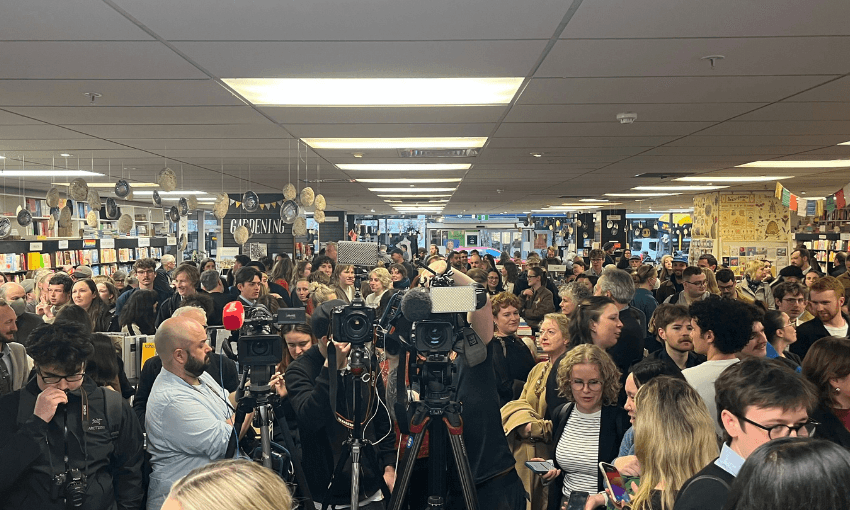
To provide answers, Julie Anne Genter, MP for Rongotai, where Moa Point is, and Wellington Central MP Tamatha Paul co-hosted a public meeting on Monday night. Their eight-person panel included mayor Andrew Little and Wellington Water chief operating officer Charles Barker. Wellington Water’s chief executive Pat Dougherty was supposed to be there, but the capital’s wild weather kept him stuck in Nelson.
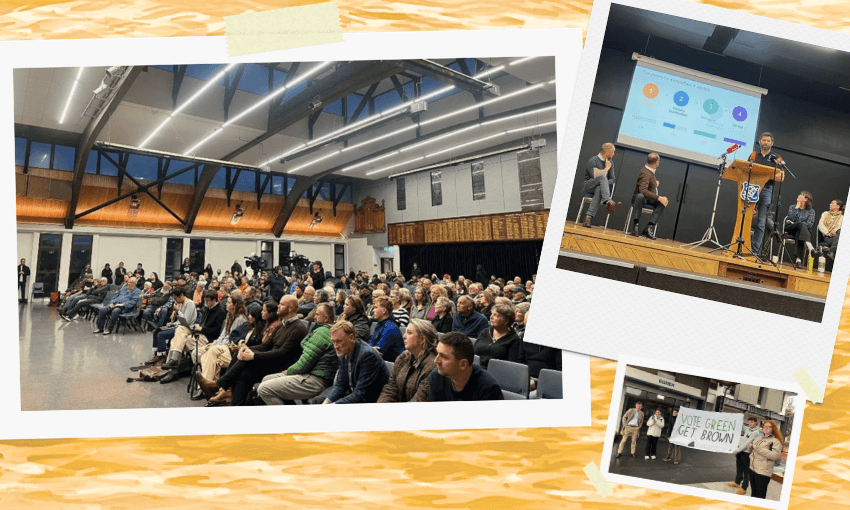
Speaking of the weather, St Patrick’s College was lashed by it from every side as locals trudged their way to the campus’s performing arts centre where the meeting was held. Those gathered here were either grey-haired or university-aged, a city councillor of past or present, Wellington Live’s Graham Bloxham or an elderly man who hissed every time Veolia, the French company that owns Moa Point, was mentioned.
Outside, the student-led tax-conscious group Generation Screwed (a subsidiary of the Taxpayers’ Union) braved the chill to hold up a sign. “Vote Green, Get Brown,” it read, next to an artful drawing of a piece of a poo. It’s an obvious nod to the shit Paul’s been copping by virtue of being a former city councillor.
A middle-aged woman tried to remind the youths of the days of former mayor Kerry Prendergast and the decades of underinvestment in Wellington’s infrastructure. “You’re too young to remember the past,” she told them. One of the pipsqueaks piped up: “But it’s our future.”

Indoors, one particularly stroppy man got in Little’s face. “We’ve got shit on our beaches,” he told the mayor over and over, until Genter came in. Then he moved onto cycleways, and Covid, and thought it a good idea to berate a pair from parliamentary security. He gave up on his argy-bargy after 10 minutes, but his booming voice shouted complaints and conspiracies from the back of the room all night.
After the crowd was warmed up by a random man in a cowboy hat preaching the spiritual benefits of sunlight, the meeting kicked off. Opening statements made by Little and Barker were sombre but light on detail as to the cause of the “catastrophe”, given local government minister Simon Watts had announced an independent review into the disaster earlier that day. The good news? Wellington Water is about “95%” of the way through fixing the stink, Barker said, with “odour scouts” on the ground every day hunting down any lasting pongs.
“Wastewater is a passion of mine,” panellist David Romilly, chief engineer at Lutra, told the crowd. His powerpoint on how wastewater systems work, and how those cute little water bear things help break up sewage, was a more effective form of solace. Romilly ended with a good reminder: nothing should go down the loo except for poo, pee and paper. “I’ve got heaps more information,” he said. “I could geek out all night if you need.”

After 40 minutes, the question and answer portion of the night began. One older gentleman was laughed back down to his seat after sharing his “observations” on the disaster, but a young woman’s question as to what the disaster will do to the environment earned some thoughtful feedback from panellist Andrew Stewart, Te Papa’s resident fish expert.
More good news: all that stormy weather outside will be breaking up the sewage in the bays, meaning that the water at least looks cleaner. It would have been a “total unmitigated disaster” if this had happened in the harbour, but the forces of the Cook Strait, Tasman Sea and Pacific Ocean will provide “massive dilution” to all the waste.
“This is ghastly,” Stewart said, “but I don’t believe it’s going to have a long-term damaging effect.”
It was a gradual descent into chaos after that, with shouting a constant fixture at the back of the hall. One man was concerned how “already smashed to death” ratepayers would fare, leading Little to promise no emergency rate hikes as a result. One of the Gen Screwed protesters prodded the panel for an apology, before he was interrupted by a man who had some good takes about colonised water systems, but his mumbling of the message meant the point got lost along the way. Another called for the nationalisation of Wellington as a city. Someone accused someone else of being a paedophile.
Every now and then a group of men had to try to calm down the man from earlier in the night, the one in Little’s face. When Tamatha Paul attempted to remind the crowd of the importance of fighting through disinformation, he started sounding off about cycleways again. “Just like that,” Paul replied.
Regional councillor Yadana Shaw had to demand shouters “let me finish” as she called on locals to change “our relationship to water”. Which means, yeah, you’ll probably have to pay more rates. “We either pay for it as ratepayers, or pay for it as taxpayers, or we change our behaviour,” she said.

“More excuses,” a member mumbled.
Panellist Eugene Doyle, a former member of the mayoral task force on three waters, attempted to ease the tension. “You should feel let down by Veolia and other private suppliers – we have not been served well in this city,” he told the crowd, and his call for a public inquiry was backed in nods by Paul.
“Transparency is really essential here, and the great danger is that we have a review, and we end up with a bunch of terrific recommendations … which are ignored or watered down,” Doyle said.
The takeaway from the night? That a storm-soaked public meeting was mostly cold comfort for those who may have expected people to act normal and figure out a solution to this shitshow. It’s doubly hard getting the message across when important information is suppressed by a forthcoming independent inquiry, or when the people you’re trying to preach to don’t actually want to hear what you have to say.
It’s a pretty shit mess to be stuck in four months into your mayoralty. Asked by The Spinoff after the meeting whether he reckoned he’s gotten the shit end of the stick, Little laughed. “You know, public office has its challenges,” he said. “You don’t have a choice. I just have to deal with it.”