Fortnightly rubbish collection in Auckland: The great idea that almost everyone absolutely hates

Staff said extra waste will go to landfill as a result of councillors’ decision on Tuesday.
It would save 25,000 tonnes of carbon emissions a year and reduce the amount of waste going to landfill by half. There’s just one issue.
Justine Haves sat in front of Auckland’s councillors on Tuesday and tried to explain what sounded like a amazing idea. The council’s waste services general manager said moving from weekly to fortnightly rubbish collections would reduce the amount of trash going to landfill by half and cut carbon emissions by 25,000 tonnes per year. Not only that, it would lower the number of trucks on our roads and ease the financial burden being borne by ratepayers. Failing to implement the scheme would almost certainly see the council failing to meet its own target of a 30% reduction in kerbside waste by 2030. “We are unlikely to meet our adopted kerbside waste reduction targets with no alternative approved pathway to reduce this waste stream,” she said.
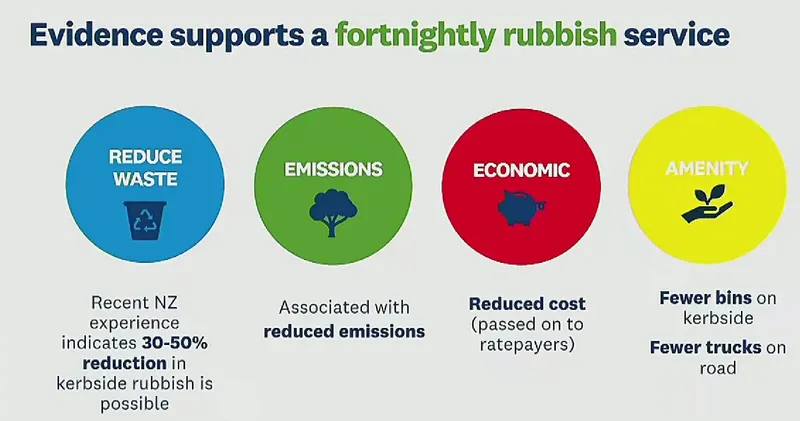
All Haves and her team wanted was a trial of the fortnightly collection; a chance to test it with the public and iron out any potential issues. The vast bulk of the evidence was on her side. The council’s existing environmental plans were too. There was just one problem: most councillors and nearly all their constituents thought the plan sucked shit.
The message came through loud and clear. One councillor after another used their speaking time to decry the idea of a less regular rubbish collection. They were informed by public consultation carried out during the election campaign, which showed 78% opposition to the idea. Though council officers recommended going ahead with the fortnightly trial anyway, Waitematā’s Mike Lee said that would be a betrayal of the will of the people. “It’s important for us to act as if democracy doesn’t end with elections. It’s something we continue on through the work of this council,” he said. “We have to decide whether we support the public or [council] management in this particular case and in a proper democracy, the wishes of the public so decisively expressed are sovereign.”
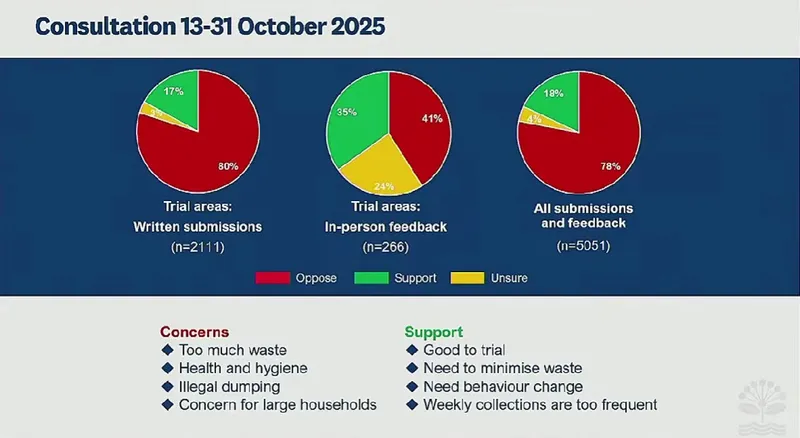
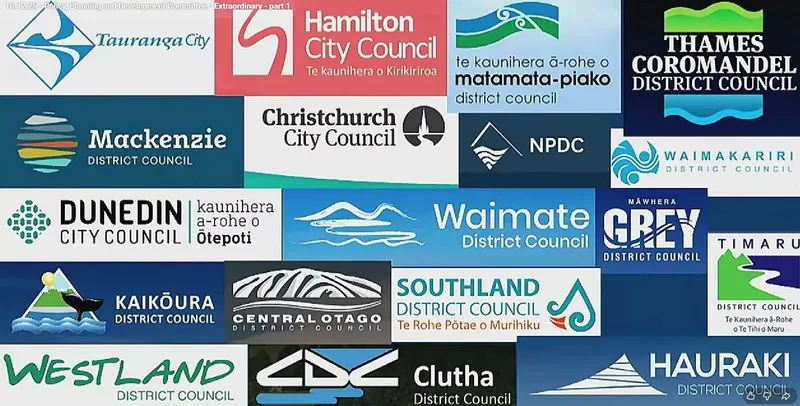
But what if the public’s wishes are under-informed, misinformed or just plain dumb? In this case, most of the concerns raised in consultation had been debunked or at least mitigated. Much opposition centred on the possibility of an increase in illegal dumping. But 18 councils across New Zealand have already implemented fortnightly rubbish collections. Hamilton and Tauranga put their schemes in place in 2020 and 2021 respectively with no associated increase in dumping. Christchurch has been doing it for more than 15 years.
Other respondents raised the prospect of streets lined with stinking, overflowing bins. Again, there was reason to believe the fears weren’t grounded in fact. Waste audits show most rubbish bins are already only half-full and around 60% of their contents can be diverted to recycling or food scraps anyway. Experience from other cities shows people generally ward off an issue with overfilling by making more use of their other bins. As a backstop, Auckland Council was also offering to upgrade people to a bigger bin for free under any fortnightly scheme, said Haves.
On RNZ’s Morning Report on Wednesday, planning committee chairman Richard Hills said some of the opposition stemmed from communication problems. “Once you talk to people one on one, they realise ‘oh, I can get a bigger bin’, or ‘I can use the food scraps [bin] weekly so it wouldn’t have been in my big bin and wouldn’t have smelled’.” Consultation was also run close to the election period and candidates jumped on it as a campaign issue, he said. “There was a lot of opposition, a lot of political manoeuvring.”
Albert-Eden-Puketāpapa councillor Julie Fairey took issue with Lee claiming the debate came down to “management versus the public”. “This is actually about evidence versus social licence,” she said. “Those things are both legitimate.” She didn’t like the scheme being dismissed as if it was being put in place by disconnected ivory tower bureaucrats. “These are staff members who care passionately about getting our waste down and they’ve been working towards this for years. They’re not ticking a box somewhere and I really feel for them in this.”
Fairey knew she was onto a losing cause. It didn’t matter what people said, the fortnightly trial was getting shot down. Auckland Council isn’t alone in discarding evidence in favour of political palatability. New Zealand is about to fail its targets under the Paris Agreement in part because the things we need to do to meet them are expensive, unpopular or just a bit divisive. For years, everyone from the Green Party to their close ideological allies at the International Monetary Fund have been calling on New Zealand to sort out the imbalances in its system and tax capital like it does income. Most political parties have responded, to paraphrase, “ner ner ner ner ner, you can’t make me”, before running off into a dense thicket of their own investment properties.
They’ve gained votes. But it’s come at a cost. Toward the end of the debate on Tuesday, Franklin councillor Andy Baker launched into an impassioned speech. A dairy farmer from Whitford, he’s not necessarily who you’d expect to be delivering fiery environmental monologues. But he noted the fortnightly trial was about reducing waste going to landfill and Auckland’s two solid waste landfills are located in his district and Rodney. The other councillors wouldn’t have to deal with the consequences of their decisions in the form of extra waste being trucked into their backyard. His constituents would. “We talk about stopping inappropriate land use. I can think of no more inappropriate land use for our rural land than a landfill,” he said.
Baker thought it was patronising to tell communities they couldn’t change their behaviour and reduce the amount they put in their rubbish bins. He told his colleagues they should show some leadership and follow through on their commitments to reduce waste even if the solutions weren’t immediately popular. But he knew that was unlikely. “We’re not trying to change anything. We’re going to continue to do the same thing, and continue to get the same result.”
Soon after, the meeting ended. A group of councillors who had come dressed in Christmas colours posed for a photo. Haves and her staff were sent away to find some other way of meeting the council’s waste reduction targets besides the obvious one on offer. They looked a bit disconsolate. Their bosses were going on holiday, but they had their work cut out for them.

Hayden Donnell
Hayden Donnell is a senior writer for The Spinoff. He previously worked at RNZ, TVNZ and the New Zealand Herald, alongside other media companies that have since closed down or been renamed. His primary passions are local politics and the Big Fresh animatronic fruit and veggies.


