What the election slogans say – and what they whisper

The big words. Images from the parties’ social media
It is slogan season in election year – and the party choices are evocative, in more ways than one.
Boiled to their bones, elections ask a simple question: more of the same or something else? The parties’ slogans – the big parties, at least – usually seek to translate that sentiment into just a few words. Change versus Carry on (aka don’t risk changing).
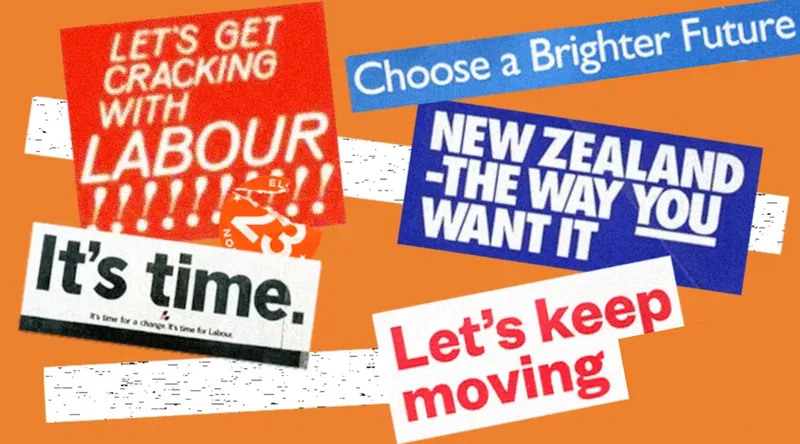
In the leadup to the 1972 election, Labour leader Norman Kirk was presented with “It’s time for change” by his campaign creatives. He chose to cut that back to simply It’s time – the change was implicit, after all.
Thirty-five years later, When Jacinda Ardern took over the Labour leadership at the 11th hour, A fresh approach, as promised by Andrew Little, was torn down (literally – the billboards were already on show) in favour of Let’s do this.
Ardern had “angsted” over the slogan, worrying they’d be “selling ourselves short with so few syllables”. Learning that Kirk had run with “It’s time” was part of what convinced her Let’s do this would do the job, that it would “capture urgency of what we had in front of us, but also the huge potential”.
It worked, really, because – like Kirk’s slogan, like Obama’s Yes we can – it signalled change, it signalled optimism, and beyond that meant pretty much whatever you wanted it to.
The line proved so successful it spawned a sequel for Labour in 2020 – upholstered into Let’s keep moving.
Those -ing words (that one is a gerund, I think, but present participles are just as common) have become a routine feature of slogans for parties seeking to be hold on to office. Bill English in 2017 was Delivering for all New Zealanders. John Key before him was Building a brighter future – another evolution of an earlier, wordier exhortation, from opposition in 2008: It’s time to change. Party Vote National and Choose a Brighter Future.
In 1975, the governing party said Trust Labour. It’s working. Rob Muldoon said it wasn’t, and he won, with a nationalist slogan – New Zealand, the way you want it. Muldoon agreed to the line only on the condition the you was underlined. The dancing cossacks helped, too. Roll around 1984, and Muldoon announced New Zealand, you’re winning, to which New Zealand responded: you’re not.
The proclamations can prove hostages to fortune. In 1990, Jim Bolger chose A decent society. It was “much more than a slogan”, he told the Spinoff 35 years later. “It was me capturing what I sensed New Zealanders wanted.”
There was change embedded in the idea – change from the breakneck, market-led reforms and broken promises of the fourth Labour government. Before long, however, Bolger’s government was leading upheavals of its own. Is this, critics would soon ask, really the decent society you promised?
They doth also, from time to time, protest too much. In 2020, National went with Strong Team. More Jobs. Better Economy. Up against Jacinda Ardern at her peak Covid-response popularity and submerged in pools of blue blood, it was hardly a time to focus on a single leader. That point was unhelpfully underlined when the leader of the team, Todd Muller, resigned at the start of the campaign, to be replaced by Judith Collins, who in turn replaced the slogan with Your economy. Your future.
In 2023, Labour went with In it for you – hoping to conjure the inference that the alternative were not. The trouble for Chris Hipkins, whose short time as prime minister was disrupted by a series of scandals centred on his own ministers, by the time they launched that slogan, he would later acknowledge, “many voters were already feeling anything but our priority”.
National’s was more direct. Get NZ back on track was the slogan as it first appeared, though it was quickly tweaked in an effort to add a lick of inclusivity: Get our country back on track.
Which brings us to 2026. It’s a tricky time, after one term – that change-versus-continuity contest is less easily defined. That’s made harder when you have Chris against Chris, round 2, with two historically unpopular leaders, leading two historically unpopular parties.
Chris Hipkins can hardly stand up and declare it’s time for change – wasn’t he the prime minister just 10 minutes ago? Can his party really say they bear no responsibility for the economic doldrums of the last three years?
The brains trust meeting, I imagine, went something like: well, we can say we can make things better, right? What about, “We can do better”? Sounds a bit like a self-admonition. “A better tomorrow?” Nope, that’s a John Woo movie packed with violence and vengeance. So they landed on Better starts now, which hardly rolls off the tongue, even if it could make a decent motto for an early childcare centre, or a thundering instruction to Liam Lawson.
National, meanwhile, faced a dilemma of their own. They wanted to send the incumbent’s preferred message: Keep going with what’s working; don’t risk what we’ve achieved. The trouble being that there is hardly an abundance of things that are manifestly working or achievements chalked up.
The slogan committee accordingly landed on a kind of fudge. Not one but two present participles. Fixing the basics and building the future. It’s a mouthful, almost a tongue-twister, but it is determined not to come across as complacent. The tone here, instead, is something like an electrician, upon being asked why the job is going into a third day, grimacing and saying, look, I don’t know who wired up this place but it needed a complete overhaul, all the way to the switchboard, OK?
Arguably what National would prefer you hear is the more abrasive, pithy line of recent, lifted from the lips of George Bush Sr: No new taxes. But as for the slogans proper, the two big parties are giving us the minimalist interpretation of the old duel: cautious change versus cautious continuity.
At least they’ve avoided mashing them up. The slogan binary was caricatured on TV in 2015 for the fourth season of Veep. Julia Louis-Dreyfus’s satirical president, Selina Meyer, ran under the mantra Continuity with Change. Absurd, clearly.
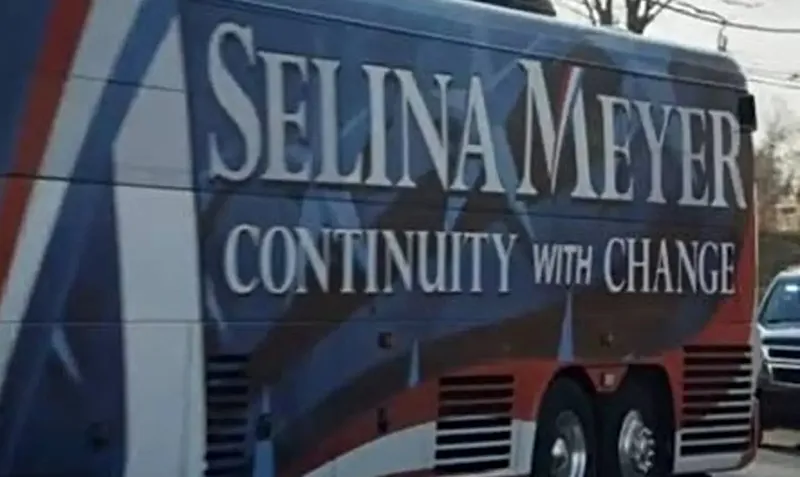
About a year later, in a forewarning of the many ways in which the world was about to make Veep seem like a timid documentary, Malcolm Turnbull launched his bid for re-election as Australian prime minister. He went for the slogan Continuity and Change.

Toby Manhire
Toby Manhire is editor-at-large at The Spinoff. He loves to cast a pod, whether it's Gone By Lunchtime, At Large or Juggernaut. He is a former editor of The Spinoff and has worked as a journalist in NZ and the UK since the last millennium.


