Is it too late now to say sorry? A new theatre show says ‘no’

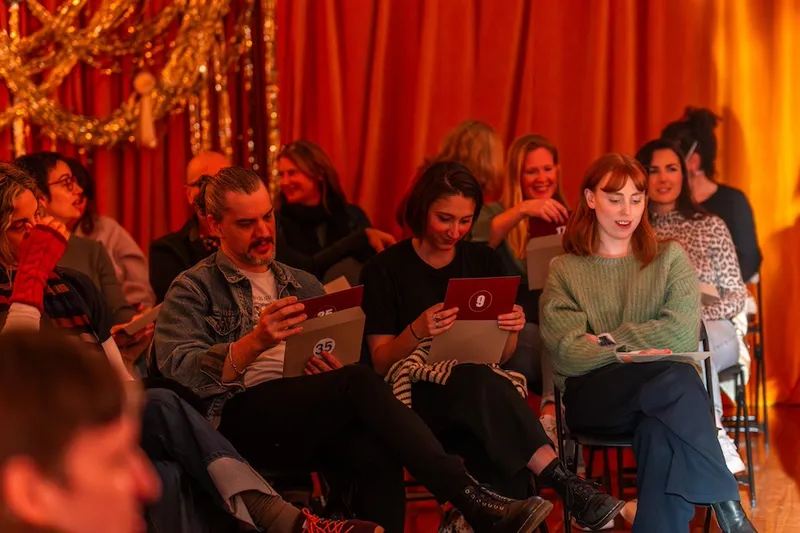
An audience member participating in Sincere Apologies (Photo: Lucy Parakhina / Supplied)
Ahead of the Auckland run of part theatrical ritual, part social experiment Sincere Apologies, the show’s creator explains why he chose to dive into the power of apologising.
David Williams begins his interview with The Spinoff with an apology. “I’m sorry,” the Australian artist says as he gets comfortable in his seat at Melbourne Airport, having been momentarily delayed while passing through airport security on his way to catch a flight. It’s a fitting start for an interview that’s all about the power of saying sorry, as Williams’ theatre show Sincere Apologies makes its New Zealand premiere at Te Ahurei Toi o Tāmaki Auckland Arts Festival next week.
A show about expressing remorse might seem a little unusual, but Sincere Apologies is all about the ways in which apologies have infiltrated our lives – and how sometimes, sorry really does seem to be the hardest word to say. Sincere Apologies is part theatrical ritual, part social experiment, a show that asks its audience to follow a set of instructions that involve different expressions of regret and contrition. For those of us nervous about interactive theatre, Williams is quick to point out that there’s no need to worry. Participating in Sincere Apologies is voluntary, and Williams says there’s nothing scary about these apologies.
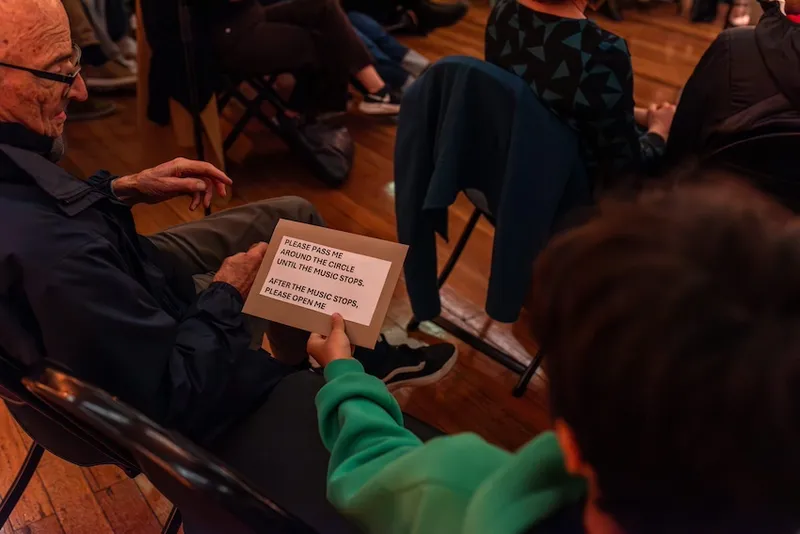
Sincere Apologies kicks off with an audience game of “pass the envelope” – the audience member holding the envelope when the music stops is invited to read the letter inside aloud. That first envelope contains a light, playful apology, which Williams says sets the tone of the entire show. Over the next hour, the audience will open 50 more envelopes containing 50 more apologies from real people – some famous, some deeply personal, some with a New Zealand context. There’s even some imagined apologies from the future for things that haven’t happened yet, but each apology aims to make the audience reflect on moments from their own lives when they too have needed to say sorry.
“People do get very emotional in the show. People laugh a lot, but they also cry, and so it is a very powerful, emotional experience,” says Williams. That emotion builds from the way the show is carefully sculpted to take the audience on a journey through different kinds of ways of saying sorry. The apologies grow more serious as the show unfolds, but by the time the tone shifts from light to heavier apologies, Williams says the audience is already invested in the game.
“The audiences really look after each other, so there’s this beautiful, delightful, shared experience that develops,” he says. “There really is a sense that audiences make a community while they’re doing this show.”
The idea for Sincere Apologies came from an experience that Williams and fellow freelance artist Roslyn Oades had in 2018, when they were unable to teach the first week of a class about verbatim and documentary theory practices at Melbourne’s Victoria College of the Arts Institute. Rather than give up the entire course (and with a small class of only nine students), they wrote a lecture that the students would perform in their teachers’ absence. “We started, of course, by apologising for not being there,” Williams recalls. The rest of the lecture focused on different registers of real-life, well-known apologies, from Australian cricket captain Steve Smith’s apology for a ball tampering scandal to former Australian prime minister Kevin Rudd’s apology for the Stolen Generations.
That lecture – where Williams and Oades didn’t step foot in the class – turned out to be the students’ favourite of the entire course. “They were convinced that we were there and watching them,” Williams chuckles. The concept of “performance by proxy” was the spark for Williams to adapt the format into a theatre show, and he and Oades began to collect different examples of apologies from the world around them. “Once you see them, they’re everywhere. You become very obsessive,” Williams says.
Williams teamed up with artists Dan Koop and Jamie Lewis to create Sincere Apologies, which premiered in Adelaide during the Covid-19 pandemic. Williams was unable to attend due to Melbourne’s strict lockdowns – he sent his apologies, of course – and since then, the show has performed around Australia nearly 30 times.
Sincere Apologies considers the different ways that people can heal to build a better future, and to Williams, the best way to do that is confront issues around racism, colonial legacies and environmental destruction. The show is full of apologies about these topics, but there is, of course, an artform to saying sorry, and Williams has many examples of partial or insincere apologies in his ever-growing library of remorse. “There are lots of ‘I’m sorry if you were offended’, which is very much a conditional apology,” he says, pointing out that often people apologise not because they want to make things better, but because they want the problem to go away.
Why, then, is sorry such a hard word to say? What does an apology really mean in today’s world of bureaucratic crisis management and endless “sorry for not replying to your email” platitudes? To Williams, the power of the apology lies in making ourselves vulnerable, and in the ways that the apology-maker needs to be willing to make a change. “Can you trust an apology?” Williams wonders, as he prepares to catch his plane. “I’m not always sure, but that doesn’t mean that an apology is not a good thing.”
While Sincere Apologies wants the audience to reflect on the emotional force of a genuine expression of remorse, Williams admits he went through some cynical territory while creating the show. Luckily, he continues to be inspired by the sincere efforts of each audience to make the 51 apologies they read aloud feel genuine – even those older members of the crowd who don’t know who Taylor Swift or Kanye West is. He hopes that New Zealand audiences, too, will embrace the experience of simply saying sorry.
“There’s an extraordinary power to repeating these expressions of ‘I’m sorry, please forgive me,’ – not just to move on, but to actually, genuinely build something better.”
Sincere Apologies runs from March 19-22 at Q Theatre, as part of Te Ahurei Toi o Tāmaki Auckland Arts Festival.

Tara Ward
Tara Ward has written about television and culture for The Spinoff for several years. She lives in Ōtepoti Dunedin, where she tries to avoid walking up hills.


