
After living in Aotearoa for 30 years, Brit Bunkley still doesn’t understand why every house and venue is kept at arctic temperatures.
My wife and I have a small ritual. When New Zealand friends come over in winter, we quietly turn the heating down before they arrive. It feels polite. Otherwise, they comment that it’s too warm.
But it’s not too warm. I told two friends I was writing an essay about New Zealand’s cold houses. One glared. The other asked if I was taking the piss. I hadn’t even started yet. This is a sore subject that has gotten me in trouble time and again, including being thrown out of a film club for telling the club head that she was a human thermometer for flicking the heat on and off with a switch. I thought I was being humorous. She didn’t. It was as if it were a declaration of war. I was the entitled American making fun of an entire nation and its chilly culture.
A few years later, I carried a thermometer into the same theatre (now with a new heater) during a film festival to see how it was faring. Afterwards, I checked the thermometer. It was 19 degrees. I told one of the film people there that the World Health Organisation recommends keeping temperatures above 20 degrees for those over 65, the audience demographic. He shot me that sort of look everyone does when I mention temperature, kind of a cross between discomfort and pity, then quickly changed the subject. He was the public health doctor for our city.
After 30 years here, I’ve never quite acclimated. My son blended in perfectly. My wife has better people skills than I do. American friends of mine tell me New Zealanders are famous for walking around in the snow with their shorts, and take pride in it. These friends say it not as an insult but as an observation of the cultural differences – a mixture of bemusement and admiration. We are seen as extremely hardy in New Zealand. I see blokes eating outside in shorts in Wellington at 8°C without batting an eye, yet if the indoor temperature in the shade falls below 20° for me, with three layers on, I start shivering violently.
That is very common for most North Americans and Northern Europeans. We’re used to the houses being heated to around 21°C.
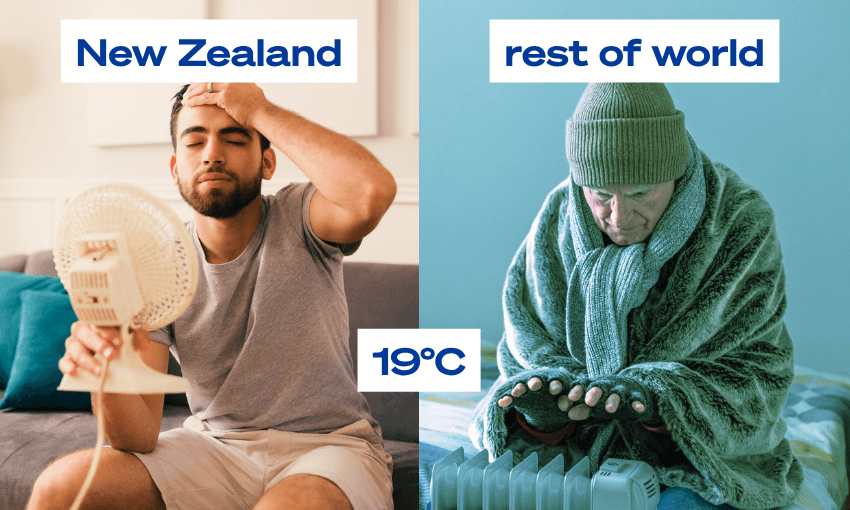
On a summer bus trip to Gibbs Farm years ago, half the passengers – mostly Europeans and Americans – were asking the driver to turn the air conditioning down. The other half – mostly New Zealanders – wanted it colder. Many New Zealand offices are cooled to as low as 18°C in the summer. Spain’s public limit for air conditioning is no lower than 27°C. Same species, same bodies. Very different expectations.
So what does the science say?
For nearly half a century, the World Health Organisation has recommended a minimum indoor temperature of 18°C, rising to 20–21° for older people and the very young. These are not arbitrary numbers. They are based on decades of peer-reviewed research linking cold indoor environments to increased blood pressure, respiratory stress, cardiovascular strain and higher rates of illness.
It’s not smoking-level risk, but it’s real. Cold doesn’t always feel dangerous. People adapt. But adaptation can mask harm.
New Zealand has long lagged behind these recommendations. Research from the University of Otago about a decade ago found average indoor winter temperatures around 16°C, with bedrooms often significantly colder. That figure has become something of a benchmark in discussions about housing here.
There have been improvements. The Healthy Homes Standards have pushed landlords to install fixed heating and improve insulation. Heat pumps are now common in living rooms. But heating remains patchy – often confined to one space, switched on and off to save money, rather than maintaining a consistent whole-house temperature.
In Vancouver, Canada (whose “moderate oceanic climate” is similar to much of New Zealand), the bylaws state that residential rental living spaces must “be maintained at a temperature of 22°C”. Germany (with laws like those of much of northern Europe) maintains a legal minimum winter indoor temperature for tenants at 22°C during the day, 18°C at night. These are laws with teeth, with fines for landlords, while our Healthy Homes Guarantee Bill is aspirational at best – with no protection to tenants, other than an option to pay extra for their own heat.
Southern Europe presents a more complicated picture. Countries like Italy and Spain – similar in their winter climates and economic structures to New Zealand – often lack strict minimum-temperature laws. Yet many buildings there are equipped with central heating systems that warm entire apartments. When the heating is on, the baseline comfort level is often higher than in New Zealand homes, where warmth is typically localised and transient.
There is a pattern here. In colder climates, laws enforce minimum standards. In milder climates, governments assume people will cope. New Zealand sits awkwardly in that second category. The climate is temperate, but the housing stock, particularly older homes, is often poorly insulated, minimally heated and lightly built. The result is indoor environments that are colder than both the climate and the standards of comparable countries would suggest.
And so we adapt. We put on another jersey. We heat one room. We accept condensation on windows and cold rooms as part of winter. Over time, that becomes normal.
I know how I sound. I’m the American with the thermometer. The one who got thrown out of a film club over a wall toggle. The one who can’t mention indoor temperature without someone rolling their eyes.
But the science doesn’t care about my accent –16°C is too cold for human bodies, whether those bodies grew up in Aramoho or Brooklyn, NY. The World Health Organisation didn’t set its guidelines to make New Zealanders feel bad. It set them up because cold homes make people sick – quietly, invisibly, and especially as we age.
I told two friends I was writing this essay. One glared. The other asked if I was taking the piss. I hadn’t even started yet. Now I have. And I suspect this room just got a little colder.