What I learned at a singing course for the shy and shamed-out

Nikki Berry runs Reclaim Your Voice. (Photo: Gary Easterbrook, additional design by Tina Tiller)
Can Alex Casey survive the wholesome community course that believes everyone can sing?
I’ll never forget the day that I was told I sang flat. It was kapa haka practice in the school hall, lunchtime, 2002. Our leader, a girl named Olivia with the voice of an angel, was off sick so the teacher asked me to lead us into ‘E Te Iwi E’. Why he chose the girl as chronically silent and translucent white as an axolotl to save the day became even more mystifying after I warbled my way through the opening lines of the song, only for him to stop strumming his guitar abruptly.
“Do it again, you were flat.”
I did it again.
“You’re still flat.”
And again.
“Still flat.”
It was like a scene straight out of Whiplash, except I was just a child doing some lunchtime kapa haka with my friends, rather than an aspiring professional jazz drummer being Oscar-winningly berated by J.K. Simmons. Beet red and on the cusp of tears, I was forced to sing the line a couple more times, each with steamroller vs pancake levels of flatness, until the teacher stormed furiously out of the hall and left me standing in front of the group in silence.
The impact of that humiliating childhood interaction cannot be overstated, even more than two decades later. I went home that day and chained myself to my stereo for weeks, singing along over and over again to my favourite album of the time, Good Charlotte’s Lifestyles of the Rich and the Famous (told you I was white). I stopped singing in the choir, I started mouthing ‘Happy Birthday’ at parties, I lived in constant fear that Olivia would be off sick again.
My chronic paranoia around singing flat has led to a lifetime of panicked, bold attempts to harmonise rather than risk bumming the actual note, seeing me soar unnecessarily to Barry Gibb heights or plummet down to Alan Partridge baritone, often over the course of a single chorus. And no matter how many times I do karaoke or sing waiata at work, I still can’t shake the image of that teacher shaking his head and leaving me alone, quivering, in that draughty hall.
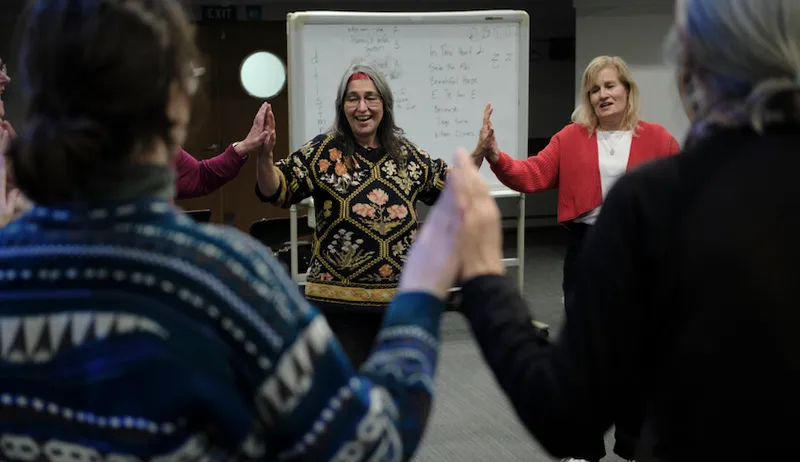
Nikki Berry, manager for The Muse Community Music Trust, has a similar story. “I was always making up little songs all the time and singing to myself,” she says. “It was a really strong part of my identity.” But at the age of 14, a new music teacher asked her to sing something much higher than she had ever sung before. “I clearly didn’t have a good enough classical tone for her, because she said to me, ‘you might as well give up, Nikki. You’ll never be a singer’.”
Berry didn’t take the advice onboard – “I couldn’t actually give up because music was the foundation of who I was” – but the moment did inform her teaching practices decades down the line. Having run community choirs and accessible singing lessons in Christchurch for over 30 years, including the Rockers of Ages choir established in the aftermath of the earthquakes, her mission is to connect with all those people who have “unjustly” been told they cannot sing.
“I’ve actually never met anyone that can’t sing,” she explains. “So many aspects of music are a learned skill, and I just don’t understand why anyone would think singing is any different to learning to ride a motorcycle, or play tennis, or go scuba diving – they’re all learned skills.”
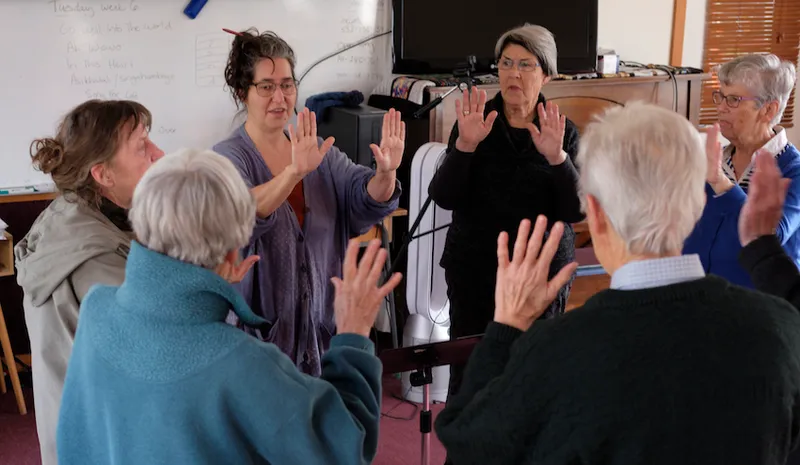
I tried to keep this advice front of mind as I walked into Reclaim Your Voice last month, Berry’s community course specifically designed “for people who think they can’t sing, people labelled tone deaf and very shy singers” (there’s one coming to Auckland mid-August). It was a miserable, drizzly day outside and yet every cell in my body was screaming to flee the warmth of the Christchurch Multicultural and Recreation Centre and do absolutely anything else. “Singing in the rain, eh?!” I barked to nobody in particular, already in fight or flight.
The group of 16 or so reluctant singers, mostly women and mostly over 40, soon stood in a circle to stretch our bodies, loosen our mouths like we were chewing toffees, and yawn loudly like elderly cats. To shake off any lingering heebie-jeebies, Berry split us in two and challenged each group to sing ‘Happy Birthday’ to each other as fiercely out of tune as we possibly could. Before long, everyone was cackling as we launched into a series of singing games, including clapping our hands like primary school school kids to the nursery rhyme ‘Pease Porridge Hot’ (why anyone would prefer it cold, let alone nine days old, is beyond me).
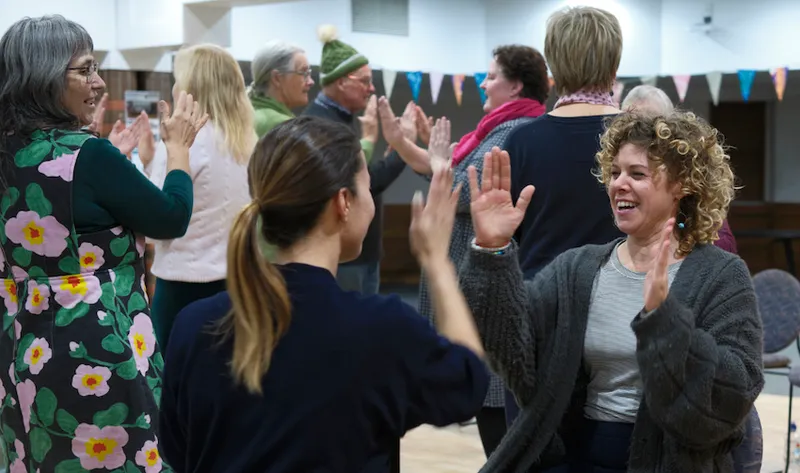
It was a welcome relief to briefly leave the hellscape of algorithms and climate catastrophe for a delightful sing-song land of seashells, porridge, and shining moons. Keeping things playful and full of laughter is essential when it comes to learning, said Berry. “Try to create a relaxed, kind environment inside your own head. Because if you are haranguing yourself, how are you ever going to learn?” I tried to tell myself this while cracking a high on ‘Twinkle, Twinkle, Little Star’.
That’s not to say it was all “double, double, this, that” games. One by one, we went around in a circle and shared the often childhood-related trauma that had brought us there. “You are not in that situation now, you are an adult,” Berry nodded sagely. “When this process is not disrupted by humiliation, it is really straightforward.”
There was also plenty of technical information to absorb about aspirate vs glottal onset and thickfolds vs thinfolds. But when you are learning the techniques by meowing like a cat, or yelling “YAA” like a fishmonger, it doesn’t really feel like work. By the end of the day we were belting out ‘Amazing Grace’ and anchoring against each other to reach the more challenging notes, everyone looking quietly chuffed with themselves.
Hugely satisfying progress, yes, but Berry was quick to remind us that singing is a lifelong journey with much psychological work to be done. In fact, she reckons learning to receive a song is as important as delivering a song, which is how I ended the day sobbing rivers of tears, snot dripping around my chin, as the group sang Kavisha Mazella‘s ‘We Are Angels’ at every person, one by one. We washed it down with ‘Let It Be’ and I went home to sleep for a week.
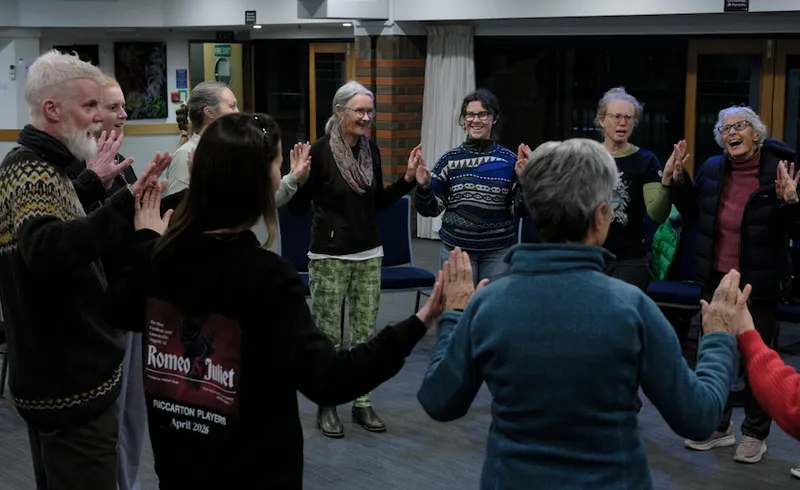
As we all arrived back the next weekend for the second and final day of the course, everyone was much looser, louder, chattier. We marched around singing a warm-up ditty about apples on the farm, before settling in to learn all about crotchets and semi-quavers and the notes of the diatonic scale. Think Julie Andrews doing ‘Do-Re-Mi’ in the Sound of Music, but with a slightly more romantic twist: “ti kisses do,” said Berry, salaciously. “And fa kisses mi.” Ooh la la.
At lunchtime I asked Berry something I’ve always wondered about those with an ear for singing – can she tell how good a person is at singing from their speaking voice, or at least what vocal range they sit in? “No, but come with me,” she replied, leading me over to the piano. Within moments, I was pitch-matching her keys like a sleazy lounge singer, delighted to soon have a new category with which to define myself. Alex. Virgo. Team Edward. Alto.
Catching myself swaggering around the piano like Liza Minnelli, I realised just how much had already changed within me, and my classmates, in less than two days. It wasn’t just about learning new techniques, but the mere act of trying something new, something scary, that had bonded this group of total strangers. “One needs to naturalise the experience of just trying something,” said Berry. “And develop a resilience for not always getting it right all the time.”
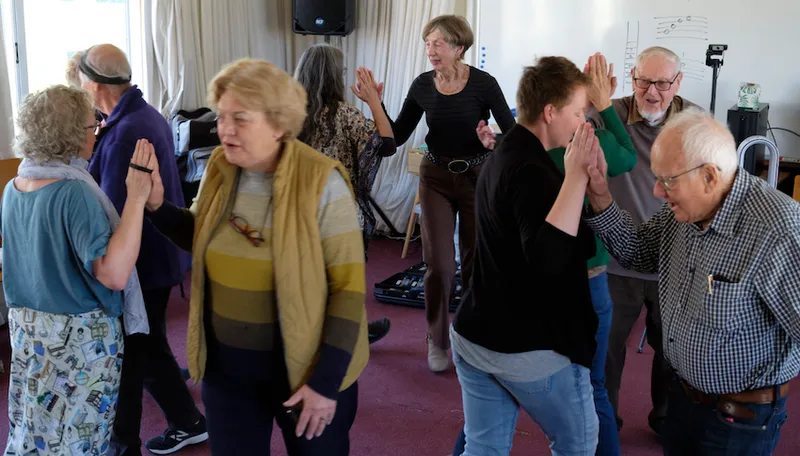
The specific health benefits of singing in a group are also widely-documented, from reducing cortisol levels, to strengthening your immune system, to connecting people so deeply that their heartbeats can even sync up. A Canterbury District Health Board study on Berry’s own Rockers of Ages choir found 66.7% of members increased their time spent with others through choir, and two thirds felt they had increased their overall wellbeing through singing in a choir.
And while it is profoundly satisfying to hear the harmonies of ‘E Tū Kahikatea’, there is something even more urgent about coming together IRL in 2026. “We live in a very challenging time for a lot of people, and I believe the only way humanity is going to survive is for us to build our communities in a really strong way,” said Berry. “We have to have hope that humans can keep organising themselves to connect and cooperate and share art like this.”
Back in the room, as we launched into the biggest challenge of the course – singing solo – I was less concerned with how collective singing could save the world and more concerned that I might actually soil myself. We had learned the basics of sight-reading, and now were being tasked with singing two lines in front of everyone, one at a time. “This can feel humiliating and almost life-threatening,” said Berry. “But remember: I am a grown-up and I am in control.”
Reader, I was not in control. Wedged in the middle of the group, my palms started to drip with sweat and angry red hives spread across my neck as each person sang their ‘mi’s and their ‘do’s with aplomb, each met with rapturous applause. By the time it had got to the more nervous half of the class (curiously starting with moi), Berry instructed the rest of the group to lead in each singer by giving them the opening ‘do’ note to ease them into it.
Immediately, my hellbent-on-harmony lizard brain took over and I Barry Gibb-ed it, careening in with a random high note that launched a subsequent cascade of equally random bum notes. I stopped myself. I was 12 years old again, shaking in the school hall, convinced the teacher was about to storm out on me. “It’s OK,” Berry said gently. “Try again.” This time I stood up, closed my eyes, took a deep breath and focussed. I am a grown-up, and I am in control.
I couldn’t tell you exactly what sounds I next emitted out of my mouth but, when I opened my eyes, Berry was still standing in front me, smiling and nodding warmly.
“That was perfect,” she said.

Alex Casey
Alex Casey is a senior writer at The Spinoff with over a decade of experience writing about popular culture and social issues in Aotearoa. She lives in Ōtautahi and likes watching reality TV and walking the dog, occasionally at the same time.


