‘It’s been relentless’: Locals patrol Auckland rockpools to stop ‘bucket people’

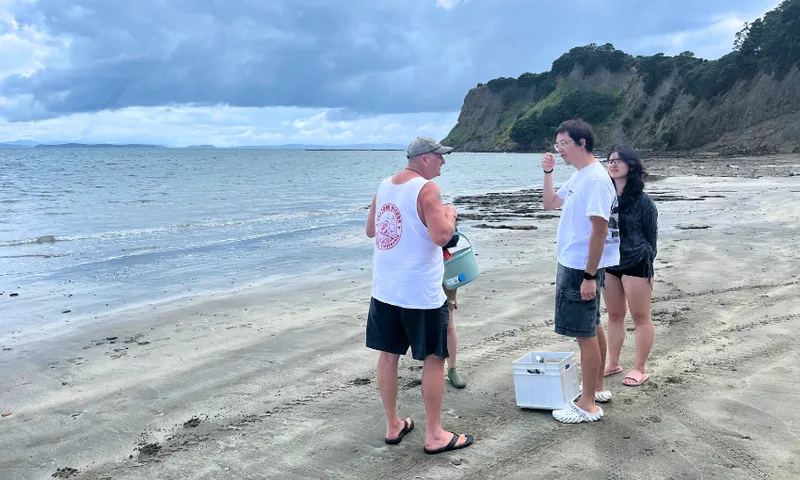
Robert Maas keeps an eye on gatherers returning at Army Bay, Whangaparāoa. (Image: Liam Rātana).
A volunteer group on Whangaparāoa says social media-fuelled foraging is stripping the coast bare – and someone has to intervene.
“Where I come from in China, we don’t have anything,” the man tells me.
It’s 11am on an overcast Wednesday morning. We’re standing at the bottom of the boat ramp at Army Bay, at the end of Whangaparāoa Peninsula, just up from Auckland’s North Shore. Behind us, the tide is starting to come in.
Dressed in swimming shorts, a grey, lightweight T-shirt and black slides, the man looks no older than 25. In one hand he’s carrying a small bucket – an Auckland Council food scraps bin – with a pink glove stashed inside. In his other, is his phone, which he is using to help translate the conversation he’s having with Mark Lenton, co-ordinator of the Protect Whangaparāoa Rockpools group.
“You can’t take these. Well you can, but only if you have to,” Lenton says.
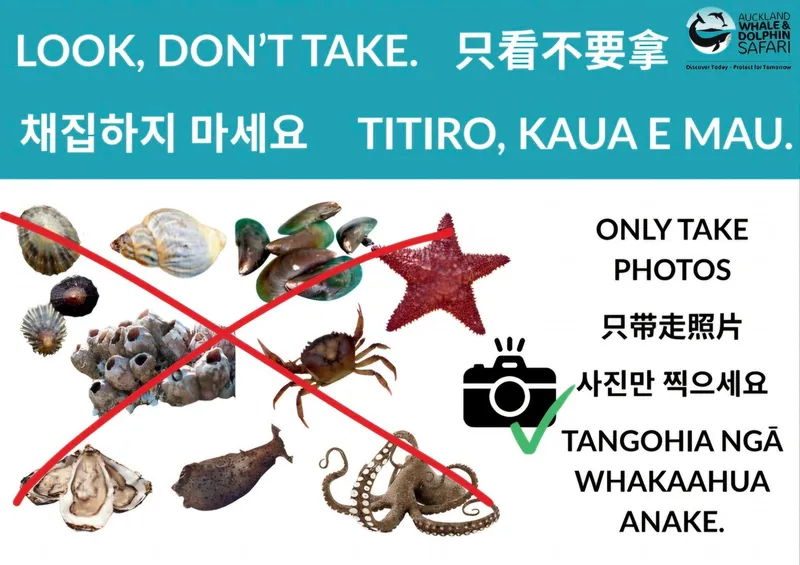
He has a laminated A4 piece of paper he’s pointing to. On it, there are photos of starfish, hermit crabs, limpets, and sea anemones – all crossed out. “Look, don’t take” is written at the top of the sheet, along with te reo Māori and Mandarin translations.
The man says he arrived in New Zealand from China’s northeast a few months ago. His partner, who is standing next to him, has been here for 10 months. They say they’ve never collected seafood in New Zealand before, but were inspired to travel to Army Bay after watching influencers on Chinese social media platform RedNote visit the area. They assure Lenton they’re just here for sea urchins.
“We were told there would be people like you here to help share the knowledge,” the man says.
Lenton – who has a day job in a senior lead role of a New Zealand bank – is skeptical about the group’s intentions but he wishes them well as they walk off down the beach towards the rockpools.
“It’s been relentless,” Lenton says.
He’s referring to a recent influx of what members of his group call “bucket people”. Over the last two years, Lenton says the number of migrant populations travelling from outside the area to forage for seafood from the intertidal zone of the peninsula has skyrocketed – and they’re not just looking for the usual cockles or kina. Lenton estimates around 10,000 buckets full of precious intertidal species are taken weekly around the Auckland region.
Over the phone, the CEO of Ngāti Manuhiri Settlement Trust, Nicola MacDonald, tells me she’s concerned. “Those types of intertidal species, which are so important for the infrastructure of the marine environment, are historically not normally taken for eating purposes. But that’s what we’ve seen, and we’ve received information from alarmed communities saying we need to do something.”
“We know that those types of species are the engineers of a healthy marine system, and without them, the marine system collapses,” MacDonald says.
MacDonald and Lenton say the issue isn’t a new one, or exclusive to Whangaparāoa, but it has worsened in recent years. On one day in November 2024, Lenton says he counted more than 200 gatherers at a single beach. Between them, they could have legally gathered 10,000 “other” (not mussels, scallops, kina, pāua, pipi, or tuatua) species of shellfish in a single day. That day gave Lenton the impetus to begin monitoring what people were taking from the beach, and creating the Protect Whangaparāoa Rockpools Facebook group, aiming to help coordinate efforts among similarly concerned residents. In just over five months, the group has amassed 4,300 followers.
“Since creating the group, I’ve realised that this isn’t just an issue specific to us here in Whangaparāoa, it’s a national one. We’ve got people up and down the country telling us their rockpools are being stripped clean,” Lenton says.
Lenton thinks the proliferation of social media influencers sharing locations for gathering has led to the influx. He says many of the gatherers are young and unaware of the impact on the local ecosystem. According to Lenton, some young Chinese members of the Protect Whangaparāoa Rockpools group have shared messages on platforms such as RedNote and TikTok, but have faced backlash from their communities.
Back at the beach, semi-retired Robert Maas, a member of Protect Whangaparāoa Rockpools and self-proclaimed “coastie”, drives down the boat ramp in his old white ute. He’s wearing a white surf singlet, dark boardshorts, and a hat with a tattered brim.
He greets Lenton and they start discussing what other members have shared in the Facebook group this morning. There are gatherers at nearby Tindalls Bay, one already around the rocks here at Army Bay, and another group out at Little Manly. According to Lenton, it’s like this every day, but, he says, there are usually more gatherers on weekends when the weather is fine and the tides are right. Two more members of the group arrive, both praising Lenton for the work he’s doing.
Soon enough, a new group of gatherers appear. They have also seen a video on RedNote so travelled from Albany. They’re carrying a bucket, chisel and hammer. Initially, they can’t say what their target species is, but, like the group earlier in the day, they eventually land on kina. Lenton informs them that while they have to be careful harvesting kina, and they won’t need to use a hammer or a chisel. One of the ladies offers to return the tools to the car, before the group sets off around the rocks.
“Have a bit of respect for other sea life,” Maas says as they depart.
Lenton says there is a growing awareness among gatherers that there are people patrolling the beaches now. “They’re telling each other on social media to tell us they’re only here for kina, because they know there’s a problem with kina barrens.” Kina barrens are areas depleted of sea life other than kina and the proliferation of kina can strip reefs. Lenton claims that beneath a layer of kina on top of gatherers’ buckets, there’ll often be a raft of intertidal species.
Although he appreciates that most of the time, the gatherers are simply looking for a fun day out, Lenton says their general lack of awareness of sustainable harvesting or conservation practices tends to mean gatherers will take whatever they can.
“Because it’s not illegal, because the government says they can, then they see no problem with what they’re doing.”
Lenton says confronting people can be dangerous. He says he’s twice had a knife pulled on him, but he still continues his patrols.
But accusations of aggression go the other way too. One gatherer posted on social media saying they’d been abused for gathering cockles at nearby Te Haruhi Bay. “I am a local too, even though I don’t look like a Kiwi. I am very respectful of this land,” the post read. The post said a family, who had a Christmas tradition of gathering, were out and had only gathered their legal entitlement, when they were abused.
Legally, people are entitled to gather 50 cockles each in the Auckland-Coromandel area. For shellfish and other sealife normally found in rockpools, there is a limit of 50 per gatherer.
Or at least that’s the legal situation for now. The Ngāti Manuhiri Iwi Settlement Trust has made an application for Temporary Closure under section 186A of the Fisheries Act 1996. If successful, this would prohibit the taking of intertidal species – excluding kina – from the rohe of Ngāti Manuhiri, extending from Te Arai in the north to Whangaparāoa in the south. The application is the first of its kind and is currently with minister for oceans and fisheries Shane Jones for consideration.
Lenton wants the government to take a multi-agency approach that includes educating immigrants, teaching sustainable harvesting practices in school, and monitoring by the Ministry for Primary Industries. Currently, the wider Auckland compliance team only has 21 fishery officers to monitor hundreds of thousands of fishers and gatherers throughout the region. He also wants stronger penalties for rulebreakers, saying the current level of fines – usually between $200-$500 for taking more than the daily limit – is inadequate.
Regardless of whether the government takes more action or the Ngāti Manuhiri Iwi Settlement Trust succeeds in its closure application, Lenton says he’ll keep on patrolling, and shouting about the issue – including at a protest set for the Army Bay boat ramp tomorrow.
“The effect of us doing nothing is that we lose everything,” Lenton says. He’s fighting back tears looking around at Army Bay. “It’s a spiritual place. It means a heck of a lot to many of us up here.”

Liam Rātana
Liam Rātana (Ngāti Wairupe/Ngāti Kurī) is editor of The Spinoff's Ātea section. He is passionate about indigenous and minority issues. Liam enjoys cooking, poetry, photography, and exploring the outdoors.


