The latest social media trend asks AI to make a caricature based on what it knows about us, but what it reveals is so much more.
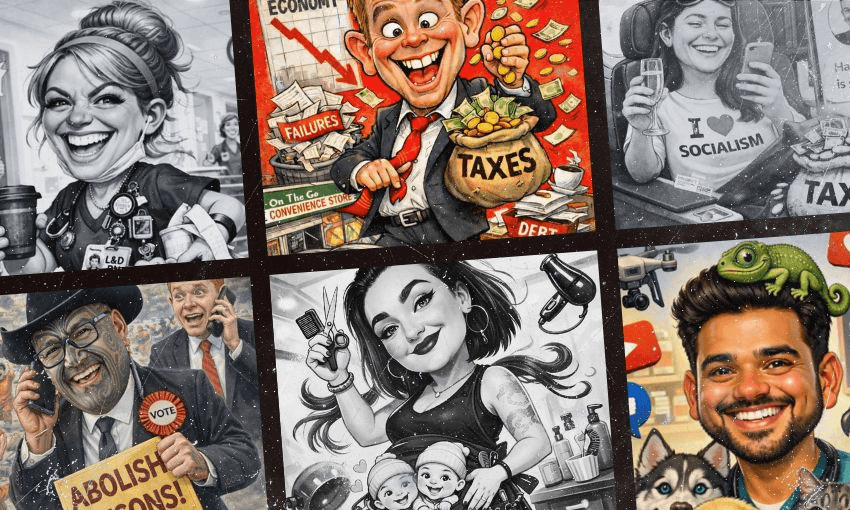
For the last couple of weeks, social media has been chocka with assorted lifestyle influencers, bored boomers and governing parties of Aotearoa jumping on the AI caricature trend. The result of the ChatGPT prompt “create a caricature of me and my job based off what you know about me”, their scarily sterile cartoon posts all boast the same giant heads, bulbous eyes, and grinning clown mouths. For the PR girlies, the AI chucked in a few smartphones and coffees. For the gym bros, a groundbreaking addition of kettle bells and protein shakes.
Every few months something like this washes on up our feeds, be it turning yourself into a packaged action figurine or a Studio Ghibli character. But what makes this latest trend different is that it highlights the personal information that AI holds about us, making it an odd point of pride or status to be “seen” by AI in the same way that one might be “seen” by a psychic or a romance scammer. Those who haven’t fed enough of themselves into Chat GPT are encouraged in how-to guides to give more detail about their personal and professional lives.

Joshua Yuvaraj is a senior lecturer in law at the University of Auckland, and is interested in the intersections of AI with intellectual property and creativity. He says the trend reveals just how much information we’ve become comfortable with sharing online. “We’re only at this stage with AI because we’ve been so well-trained by the social media age that our personal information and privacy doesn’t really matter to us any more,” he says. “The risks of that are considerable, and I don’t know whether people are giving those risks the attention they deserve.”
Yuvaraj explains that uploading personal information and photographs to public-facing models like ChatGPT means that data could be used in other ways in future. “For example, you upload an image onto ChatGPT, that image may well then be used to train the model,” he says. And for those who use AI as a form of therapy and a place to spill personal secrets? “There’s a risk, however minuscule, that with the right prompt, someone could extract that information and that would breach your privacy as well.”

There are also environmental considerations when it comes to these harmless-looking trends – AI data centres require enormous amounts of land, power and water for cooling. “One of the issues is that when we see a ChatGPT screen, you think, ‘oh, this is magic. I can just do whatever I want on it,’ but we don’t actually think enough about the resources being used.” Yuvaraj encourages people to ask one question of themselves before using AI: “Is the gain of this worth the cost that it’s going to have on the environment?”
Along with the environment, the value of human creativity is another consideration when jumping on AI trends. “Every use like this pushes us further down a path where it is likely that people will feel even less empowered to create anything when things can be done for a fraction of the cost and a fraction of the time,” Yuvaraj says. “What will we lose when that happens?”
Someone else who has been mulling over the creative impact of AI caricatures is artist Darren Blomfield, a third-generation published cartoonist who has been running his own caricature business for over a decade. He’s been hired to do live caricatures of everyone and everything from 300 wedding guests, to Google conference attendees, to a new line of Dolce and Gabbana sunglasses. His style is as traditional as his grandfather and great-grandfather’s were – easel, paper, black ink – and each caricature takes him around five minutes to draw.

“That five minutes of intimate one-on-one time is really special,” Blomfield says. “People love it, they laugh, they cry, they can’t get over what I’ve drawn. In actual fact, that’s why I love it so much. It’s not so much me drawing, it’s the engagement with the people that makes it very, very special.”
But like many creative professions, Blomfield has seen the encroachment of AI on his craft over the last year. For example, his clients occasionally ask for their cartoons to be colourised, which costs “quite a bit of money” to have done digitally by another designer. When his friend, a builder, caught wind of the additional cost, he offered to do it himself with AI. Blomfield was impressed with the results, but didn’t like the hollow feeling it left behind. “I just thought, ‘man, what a sterile way to do art.’ It’s just not me, it’s just not how us creative people work.”
And while Blomfield admits it “blows my mind” to see caricatures rendered so quickly with AI, it leaves him with a similar feeling. “A computer will make it perfect, but it won’t have emotion. It won’t have that feeling that only a human can give it,” he says. “I’’ll take my hat off, AI is absolutely incredible, but culturally, when we start to lose people who are creative artists, we’re losing our soul, we’re losing a very special part of human nature that you just can’t replicate. We have to hold onto that, otherwise we’re all just robots walking around, aren’t we?”
Blomfield’s hope is that AI will actually help his business in the long run by allowing him to carve out more of a niche as an artisan. “I think the fact that I am engaging in this tactile process will only make it more unique,” he says, adding that he already gets approached by young people who can’t believe that he is drawing with his hands. “AI is going to blitz us in the mechanical process, but in terms of reflecting the human part of the story, it’ll miss it every time,” he says. “What’s cool about my work is I’m drawing it in real time, and it’s not perfect.
“That imperfection is what’s awesome, because we’re in an imperfect world.”