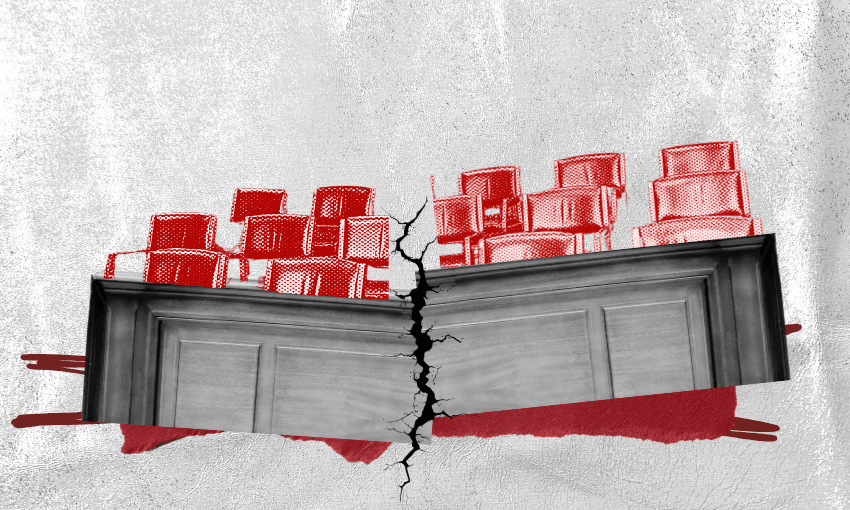

Most jurors act in good faith, but they bring their mental shortcuts into court with them.
A rape trial in Nelson collapsed recently because of questions asked by the jury. Not questions about DNA evidence, timelines or witness statements, but ones about the complainant’s underwear and her sexual history.
Those questions were never intended for public consumption. Jurors submitted them in writing, as juries often do during trials. But what they revealed was enough for Judge Bill Hastings to stop the trial entirely. The questions, he ruled, showed jurors were engaging in impermissible reasoning, or assumptions about sexual behaviour that the law specifically prohibits.
It was a rare moment where we got to glimpse the thinking that happens behind the closed door of a jury room, and it told us something uncomfortable. When people are asked to decide whether a sexual assault occurred, some instinctively reach for familiar narratives about how sex and consent are supposed to look – what someone was wearing and whether they had sex before.
Those questions may feel intuitive, but legally and evidentially, they are irrelevant. New Zealand courts tightly restrict evidence about a complainant’s sexual history for precisely this reason. Decades of research have shown that some juries can treat sexual history as a proxy for credibility or consent, even though it tells us nothing reliable about what happened during a particular encounter. In other words, these are not harmless curiosities; they are reasoning traps.
Sexual assault trials are already difficult. They often involve intoxication, fragmented memory and events that take place behind closed doors. There may be little physical evidence and only two competing accounts of what happened. In that vacuum, stereotypes can become powerful.
The law tries to manage this problem through evidential rules and judicial directions. Judges routinely remind juries that victims do not have a single predictable way of behaving and that clothing, drinking or sexual history cannot be used to infer consent.
In the Nelson case, however, the written questions suggested those assumptions were already embedded. Judge Hastings concluded that even strong directions might not undo them, so he discharged the jury and restarted the trial with a new one. The second jury found the defendant guilty.
In one sense, the system worked exactly as it should: a potential miscarriage of justice was avoided. But the episode also leaves us with a revealing question: if those assumptions were present in one jury room, how often are they present in others, only invisible?
Most jurors act in good faith. They are trying to understand difficult evidence and make sense of deeply uncomfortable events, but the mental shortcuts people bring with them into court don’t disappear when a jury is sworn in. The Nelson trial briefly pulled the curtain back on those assumptions. What it showed was that the justice system can sometimes catch bias when it surfaces. Changing the thinking that produces it in the first place is a much bigger challenge.