
Thursday’s GDP figures were disappointing enough on their own. Against the backdrop of an escalating fuel crisis, they could be the calm before the storm, writes Catherine McGregor in today’s excerpt from The Bulletin.
To receive The Bulletin in full each weekday, sign up here.
‘Hope is not a plan’
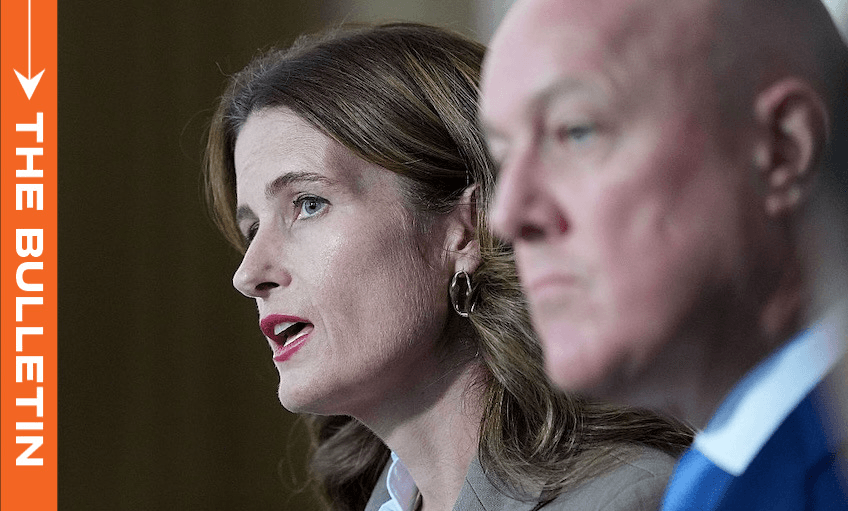
For most of the week, the government’s message on the fuel crisis was steady: supplies are adequate, Level 1 is where we are, there’s no need to panic. On Thursday, Christopher Luxon changed his tune. At a press conference, he acknowledged what he called a “big shift” in the government’s messaging on the fuel crisis, warning that “things could get worse before they actually get better”. New Zealand still has around seven weeks’ worth of fuel either in the country or on its way, and remains at level one of the four-level National Fuel Plan, with no restrictions yet in force. But Luxon was direct about the supply threat New Zealanders faced: “Hope is not a plan. And so we are preparing for the worst-case scenario where the conflict is prolonged.”
Targeted help on the way
With petrol passing $3.15 in some parts of the country and many households already under strain, Willis announced she has instructed Inland Revenue and Treasury to work up a targeted support package for working families, likely to arrive before May’s budget. Stuff’s Jenna Lynch reports that a blanket fuel tax cut has been ruled out as too blunt; instead, the most likely distribution mechanism is Working for Families. Anna Whyte at Interest.co.nz spoke with economic inequality researcher Max Rashbrooke, who said many families are already “at breaking point” with “absolutely no resilience against this kind of shock”. While he often disagrees with Willis, Rashbrooke said she was “right on this one”: targeted welfare support makes more sense than cutting fuel tax, which would disproportionately benefit high-income households who drive more.
Westpac chief economist Kelly Eckhold made a similar point: cutting the price of fuel would simply boost demand, which is “counterproductive for what the Government probably ideally wants to achieve right now.”
An anaemic recovery
Thursday also brought the December-quarter GDP figures and they were, as Infometrics chief forecaster Gareth Kiernan put it, “disappointing”. Economic activity grew just 0.2% in the quarter, at the lower end of market expectations and well below the Reserve Bank’s forecast of 0.5%. Liam Dann, writing in the Herald (paywalled), notes that central government spending was “one of the few areas of strength” – up 2.5% – while construction fell 1.4% and households pulled back on spending for the first time since September 2024.
Luke Malpass, in The Press, is blunt: “Well that wasn’t great.” Per person, he notes, the economy basically stood still. For 2025 as a whole, New Zealand grew at just 1.3% — half the rate of Australia, and the same as Britain under Keir Starmer, whose support has fallen off a cliff. Malpass says voter expectations have added to this government’s woes. “[Their] original political mistake … was giving the impression that it would all be sorted – and quickly,” Malpass writes. “But these things are hard and that has clearly not occurred.”
Prepare for the worst
The December quarter figures cover the period before Iran effectively closed the Strait of Hormuz – meaning the worst is still to come. Former RBNZ and Treasury economist Michael Reddell, writing in The Post (paywalled), notes it “wouldn’t be surprising at all to see GDP fall in the June quarter, perhaps quite severely so if there are actual supply disruptions.” Rising fuel costs will squeeze household budgets and ripple through the wider economy via higher prices on groceries, freight and airfares. “Even now, you have to wonder … how many people will be reassessing plans for overseas travel (inward or outward), or reluctant to book given the uncertainties about possible flight cancellations,” Reddell writes.
Kiwibank economist Jarrod Kerr summed up the muted reception to the GDP figures like this: “As good economists we should point out that New Zealand’s December quarter GDP data is out this Thursday,” he wrote in an update.
“But to be honest, we don’t really care. The data is more than three months old, and dated. In light of everything offshore, the outlook is clouded and simply darker.”