

After one of the worst flooding events in the region’s recent history, forecasters warn even short bursts of rain could cause fresh havoc, writes Catherine McGregor in today’s excerpt from The Bulletin.
To receive The Bulletin in full each weekday, sign up here.
Even more rain on its way
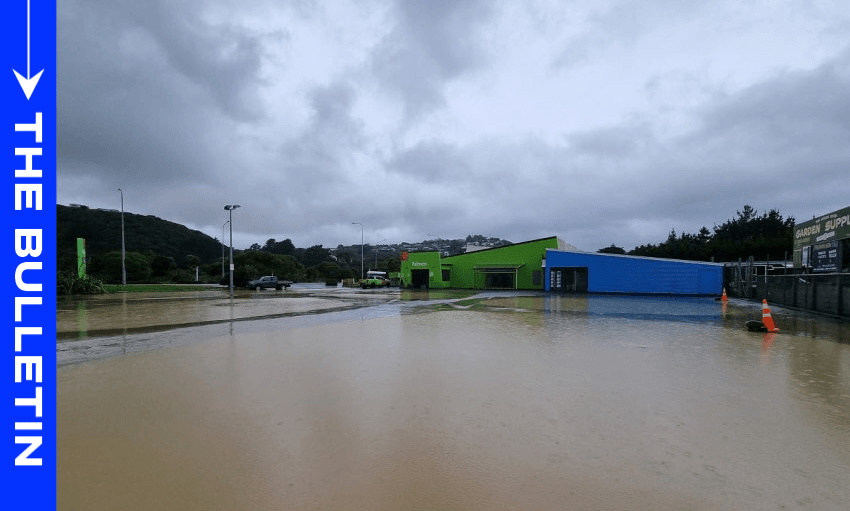
Wellington is bracing for another day of heavy rain after Monday’s extreme rainfall caused havoc across the region, where a state of emergency remains in place. A red heavy rain warning carrying a “threat to life” is in effect for Wellington until 6pm and Wairarapa until midnight Tuesday. With the ground already saturated, MetService meteorologist Katie Lyon told the NZ Herald’s Zeb Tupa’i it would “only take a couple of heavier bursts of rain to trigger flooding, even in places that haven’t seen impacts yet”. Meaningful improvement is still days away – Lyon said it was “not really until Thursday that we get a proper clearing of this rain and people can really begin the clean-up process”. Overnight, more than 400 Powerco customers lost power across Wairarapa, Taranaki, Manawatū-Whanganui and Bay of Plenty.
Mother on a shelf
Of the many day-one stories, the tale recounted by The Post’s Amy Ridout has to be the most remarkable. In Berhampore, one of the hardest-hit suburbs, a blocked stormwater drain sent water surging through a family home where resident Zena was woken not by the rain but by her dog, Mash, jumping on the bed. She waded to her 87-year-old mother’s room, forcing open the door against the rising water; the two women retreated to Zena’s room, where they soon found themselves treading water. She helped her mother climb into a gap at the top of a built-in wardrobe and floated beside her, near the ceiling, before her brother-in-law and a police officer waded through the dark to reach them. A muddy tide mark, over two metres high, was visible along the walls on Monday afternoon.
Why so little warning?
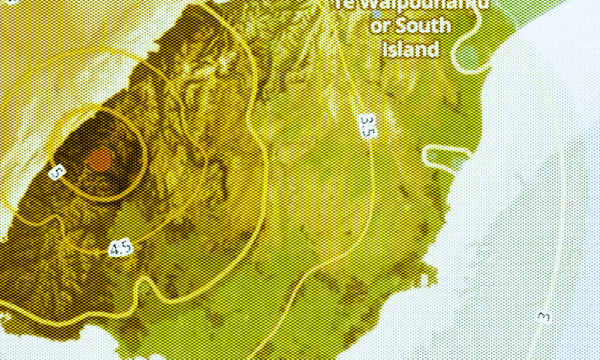
The question many are asking is why did the region get so little warning, just a week after days of advance alerts for Cyclone Vaianu? The answer, as Stuff’s Rachel Moore reports, comes down to scale. MetService meteorologist Katie Lyons explained that Cyclone Vaianu covered hundreds of kilometres; by contrast, the band of rain that hit Wellington’s southern suburbs on Monday was “a span of about 10km across of width – you’re talking many magnitudes of size difference”. Wellington Civil Defence acknowledged “concerns raised about whether yesterday’s weather warnings fully reflected the intensity of what communities ultimately experienced” – but said thunderstorms could develop within as little as 30 minutes, making suburb-specific advance alerts essentially impossible.
Dr Sally Potter, a warnings consultant, said it was like popcorn: “You can have all these kernels in the pot, but you don’t know which one’s going to pop first, and it can be a bit like that with these thunderstorms and downpours. You can see that somewhere in the area it’s probably going to happen, but you don’t know exactly where.” She believed MetService had issued all the warnings it could.
This is what climate change looks like
The climate science is unambiguous, says James Renwick, professor of climate science at Victoria University of Wellington. He told the Science Media Centre that 77mm of rain in one hour was “truly tropical and would be extreme even in the tropics” and the consequence of a warmer atmosphere holding more moisture and delivering more intense storms. Dr Emily Lane of Earth Sciences NZ noted that short, localised, intense events were “the type of event expected to increase the most with climate change”, with extreme rainfall expected to rise by around 14% for every additional degree of warming.
For writer Emily Writes, who has spent the last two nights monitoring the flooding around her Wellington home, the feeling is both exhaustion and anger. “I don’t want to fear the sound of rain,” she wrote. “And I don’t want my children to fear the sound of rain. I’m sick of hearing that every flood or storm is a ‘1 in 100 year event’ as we’re hit again and again.” Her message for November is direct: vote for parties that commit to moving away from fossil fuels and reducing emissions. “Voting for each other to survive the climate crisis might be the most important thing we do.”