I lost my kid in New Plymouth. The Wind Wand showed him the way home

A terrifying few hours searching for his missing son taught Dan Keane a valuable lesson in landmarks and third spaces.
Did you see my 10-year-old son in your feed on Monday last week, right around lunchtime? We lost him for three wild hours while on holiday in New Plymouth. The police put out an amber alert – blonde curls, camo hoodie – and for a hot minute there it seemed all of New Zealand was looking for him. He’s fine, I’m glad to report! We had lost him, but little dude was never lost himself. He simply walked three kilometres north to the motel we’d just left in Fitzroy Beach. The Wind Wand showed him the way.
You know it? The Wind Wand is an iconic New Plymouth local landmark, a 45m pole-vaulter’s stick designed to bend in the gusts off the Tasman Sea. The Wind Wand is now my favourite public sculpture in the entire universe. It’s also proof to my joyous but traumatised dad heart that we don’t need to strap our kids in tracking devices like checked luggage. If the landmarks are alright, the kids will be alright too.
Here’s how we lost him. My son and daughter were making funny faces in the mirrored facade of the Len Lye Gallery on Queen Street. (Len Lye, as it happens, is the late New Zealand artist who designed the Wind Wand.) My wife, my daughter and I stepped inside the gallery’s not-so-obvious entrance, which looks like it belongs to the un-mirrored building next door. The frosted glass doors slid closed behind us. When my son looked up from the mirrors, we’d simply vanished.
We’d been in town about 40 hours by that point. He barely knows the place, we told the police. Here’s how he found himself, in his own words. “I walked to the end of the block, then I ran off in a random direction.” He grins at this part. The random sprint was half panic, half head-clearing reset. “Then,” he says, “I saw the Wind Wand.”
We’d walked past the wand twice already that weekend. On one of our passings I’d mentioned to the kids that we were standing on the city’s famous Coastal Walkway, and if you were to follow the walkway all the way down to the right, you’d eventually reach our motel in Fitzroy Beach.
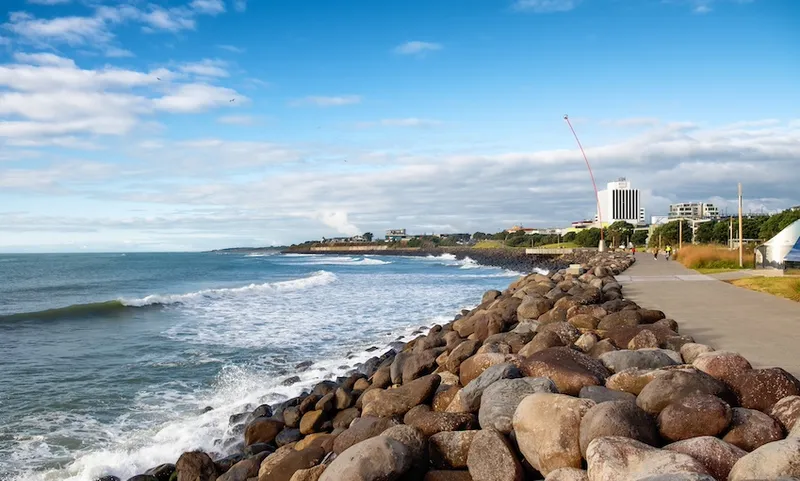
My son remembered this, bless him. He walked to the Wind Wand, turned right and kept going. Rain blew in from the sea. Three kilometres later he was watching Netflix in the still-unlocked motel room we’d checked out of that morning. The motel owner, already alerted by police, spotted his sneakers outside the door.
The happy ending turned our nightmare into what seems at first like a tidy zero-sum game. If we’d tracked our kid with an air-tag bracelet or one of those dumbphone watches, we’d have spared ourselves an excruciating three hours. But to have dialled our son up via a personal surveillance device would have denied him the frankly life-changing triumph of crossing a strange city on his own.
But here’s the thing. My son’s 3km odyssey wasn’t him versus New Plymouth. My son saved himself by navigating a city built to be navigated in precisely the way he did.
The Wind Wand and Coastal Walkway are prominent and beautiful enough that we’d introduced them to our kids first thing upon arrival. I mean, if you don’t visit the Wind Wand and the Coastal Walkway, have you really been to New Plymouth? To walk down to the wand and take a hike on the walkway is the most New Plymouth thing my son could’ve done.
Both are also free third spaces, open to all. During the search the cops asked us what sort of things our son “was into”. A good and necessary question – but one that oddly reduced getting lost to a set of potential consumer choices. He likes books, so we checked bookstores. He likes bubble tea, so we checked the bubble tea shop. But he had no money in his pockets. He wasn’t shopping. He was trying to get home.
I’m sure I’ve lost some parents here. Every family will weigh their own tolerance for risk. Tracking devices aren’t evil, they’re just a limiting convenience. Like the now omnipresent Google Maps, they give us an approximation of safety in exchange for the assumption that our human default is to be lost – and that our cities are empty voids we can only get lost in. That little blue dot is both comfort and curse. Teach your kid to see past it, and you just might save their life.
But that’s a classically neoliberal, family-first scold. We don’t just need to make complicated personal choices about tech. We also need big, generous public landmarks to remind us that we can guide ourselves. We need the Wind Wand with its big red ball on top that lights up at night, a public YOU ARE HERE where the YOU is all of us at once.
For much of the search, my wife and I took turns standing by our parked car in case our son came back there. The cops told us to. This made perfect sense to my wife and me, the adults who paid for our sturdy but utterly nondescript 2016 Mazda Premacy. But as the hours wore on the emptiness of our post gnawed at me. I drive that grey minivan every day and still lose it in parking lots. Why would a lost child choose an anonymous piece of mass-produced tech over the Wind Wand? Why do we so quickly assume they should?
When we pulled up at the motel our son was sitting out front, eating cookies with a cop. He ran up to the car, made familiar once more by our faces inside. He’d hopped inside before I’d even unbuckled my seatbelt. “I’m so glad to see you!” he said as I wrapped him up in a hug, and the crumbs fell all over the seat.

Dan Keane
Dan Keane is a writer living in the Wairarapa, and currently a PhD candidate at the International Institute of Modern Letters. He writes the newsletter american.nz.


