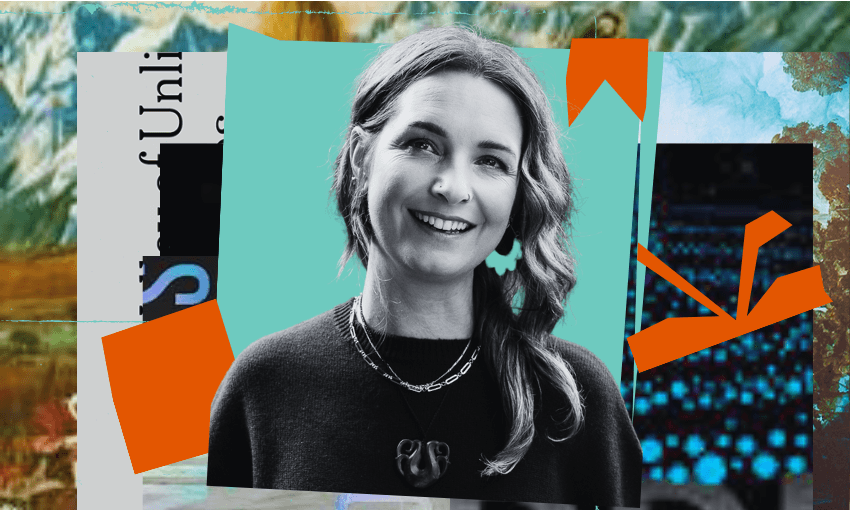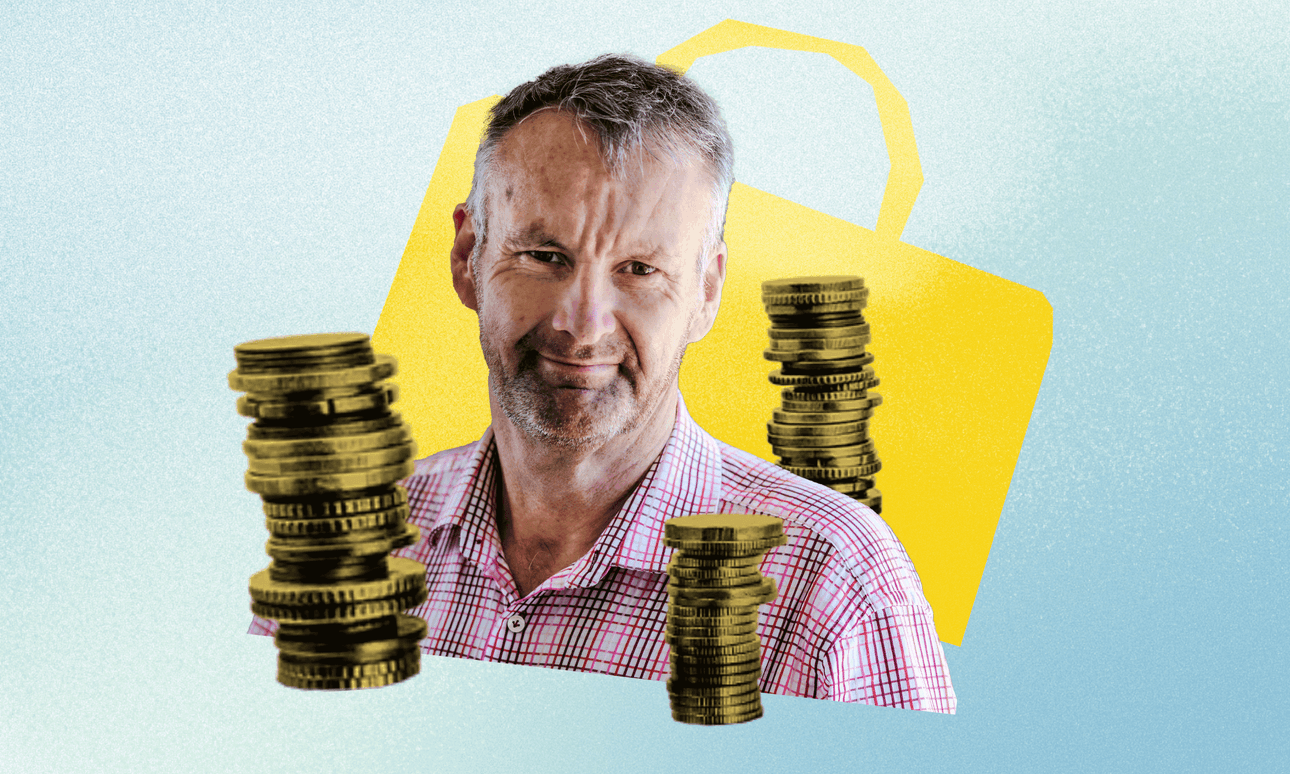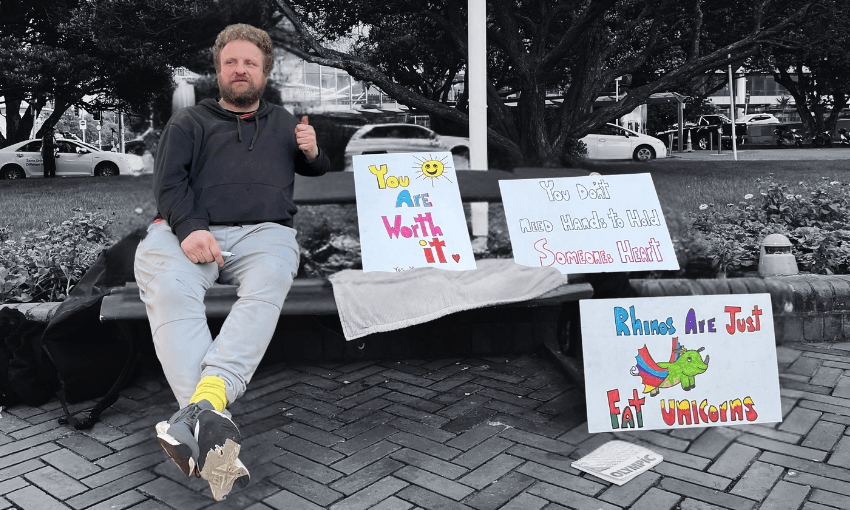
Between a traumatic cliff fall and a stint in a Thai prison, Simon Sherlock has been to some dark places. Now, he’s won over Wellington by spreading the love.
It’s 7am, Friday, and not as chilly as the capital usually gets on a June morning. As commuters step out of Wellington Central station, there’s a makeshift art gallery lined up along the walkway leading to Bunny Street. This exhibition is like if Banksy met your mum’s Pinterest board and conceived a child while tripping on LSD – a hodgepodge of colour, crude illustrations and quotes which stop you in your tracks and invite a smile.
They’re the works of Simon Sherlock, whose hands are rainbow stained from the markers used to craft his creations. In a hoodie and sweats, Sherlock almost fades into the dark of the winter Wellington morning, if not for the fact his outline is emphasised by two whiteboards packed with colour on either side of him.
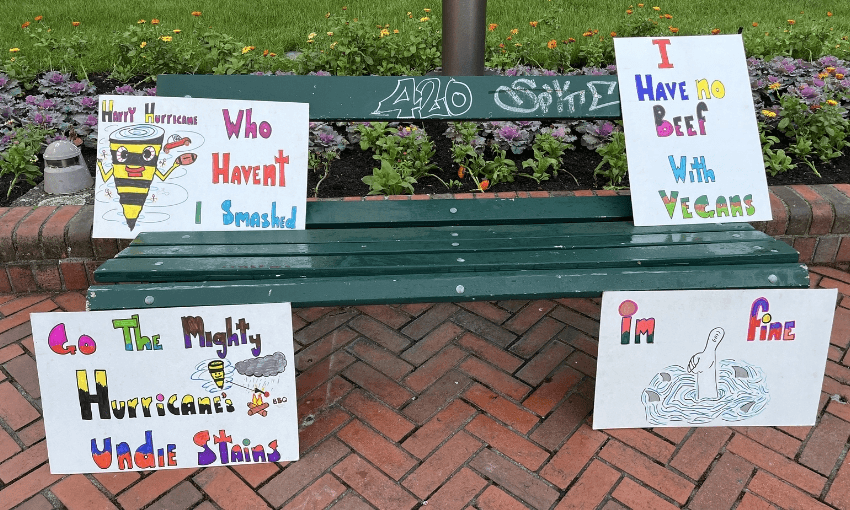
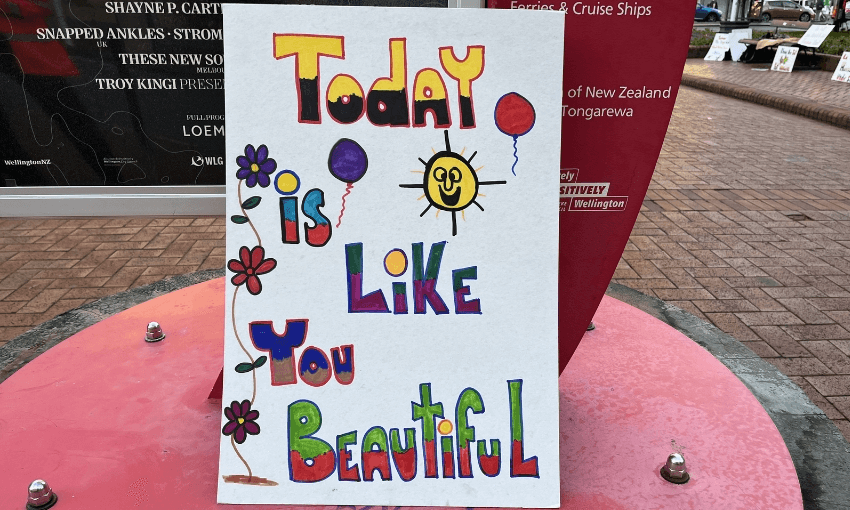
The signs he’s become world famous in Wellington for range from inspirational quotes (“today is like you, beautiful”), comedic (“that stripper doesn’t love you”), political (“I’m not old school, I am the school”, alongside a photo of Winston Peters), and punny (“goosebumps”, next to an illustration of geese fist-bumping). The uniformed school kids who skip past seem enchanted by the art installation in front of them. Some of the workers walking past muster up a smile and a “morning, brother”. If everyone leaving the station this morning took the time to stop and talk to Sherlock, they’d find his life has been just as colourful as his signs.
He’s often mistaken for a streetie, but Sherlock has accommodation with a close friend. What prevents him from living like those across the road in the Beehive, however, is the amount of debt the 51-year-old has accumulated after living overseas and serving in a Thai prison. That, and the fact his quality of life changed dramatically when he suffered a traumatic head injury after falling off a cliff.
Maybe it’ll be easier if we start at the beginning. Sherlock is a Wellingtonian by birth, an Island Bay boy who grew up working in his father’s “shit cafe” at a truck stop. In his mid 20s in the early 2000s, he crossed the ditch to pursue cheffing, and would travel back and forth before he settled in Australia as a 30-year-old in 2006. He met his ex-partner there, a Welsh woman, who returned to her home country to give birth to their daughter. He hoped his daughter would eventually live in New Zealand with him, but that didn’t happen. These days, Sherlock says he’s close with the 17-year-old, who still lives in Wales and whom he affectionately calls a “little shit”. Asked whether he has any ambitions for the future, Sherlock’s answer is simple: “I don’t want a big house… Just for my daughter to be happy.”
For over a decade, Sherlock was based in Australia, because “that’s where the good money is”. Things were going OK for a while, and by 2018 he was working as a chef on Rottnest Island – a “rich person’s playground” off the coast of Western Australia. But a visit to The Basin, a popular beach on the island, would change his life forever after he lost his footing on a loose rock and went head-first over a cliff.

He returned to work only two days after the fall. “I was all right at the start, then a week later everything went pear-shaped on me,” he says. “I’m better now. Sometimes I’ll get, like, anxiety … I used to laugh at people over things like that. Then a whack on the head, it changed everything.” Small things that didn’t previously bother him would now trigger his anxiety. “A woman screaming used to just fucking freak me out,” Sherlock says. “I’d just kind of disappear [into myself].”
Sherlock developed post-concussion syndrome and his mental health worsened. Following an admission to a hospital in Perth, he bounced from shelter to shelter before he ended up living on the streets. He spent months begging on St Georges Terrace, the main street of Perth’s business district, when he realised the disgruntled workers who threw change at him probably just needed a pick-me-up.
And that was the beginning of Sherlock’s sign-making endeavours, an attempt to earn smiles as well as cash. After nearly two years of rough sleeping and sign writing in Perth, Sherlock revived his cheffing career with a job in the Northern Territory. That lasted a wee while, until one day, after a heavy drinking session in Darwin, he says he woke up on a plane headed to Singapore. “I was like, ‘for fuck’s sake’.”
From there, Sherlock made a little bit of money and travelled to Malaysia. Then he caught the cheapest flight to Krabi in Thailand, and stayed there for six weeks. That’s when things took a turn. In a dark and dramatic episode, he fell out with a local and set their bike on fire, he explains. “About half an hour later, I was in handcuffs.” He was charged with damage to property and sent to prison, where, after being convicted, he stayed for a year. While there was some initial contact with the New Zealand embassy, Sherlock is critical of what he sees as a lack of communication or support. “My passport’s not worth the ink it’s written on,” he says.
All in all, “the jail was all right” – he says the guards, as well as some pretty serious criminals, showed him more empathy than officials had. When he was released, Sherlock says he spent eight days in a Thai immigration detention centre, which he describes as needing “charges brought against them by the Human Rights Commission”, before being deported.
When he arrived back in Auckland, Sherlock was subject to probation conditions for six months and lived in a halfway house for deportees (the other residents were mainly 501s) run by resettlement service Te Pā. He says a call from the Ministry of Social Development let him know the $12,000 student loan he had left Aotearoa with had ballooned to $44,000. It seemed like things were only getting worse, but, as Sherlock muses, “you can’t break a man who’s not afraid to eat alone”.

He worked for a stint in Whangamatā and then the Chatham Islands, but eventually wound up back in Wellington. “I sat in [Shortland] Park for two days feeling sorry for myself,” Sherlock says. “Then I came out of it like, fuck it, I’m going to start drawing.” So, on Boxing Day 2024, Sherlock revived his past passion project of illustrating signs and selling them at $20 – though he does have a deal that kids and anyone crying in public can get one for free. He’s been lining his artworks up outside Wellington Station, along Lambton Quay and Cuba Street ever since, and has also designed signs for multiple businesses around the city.
In our conversation, it’s hard to gauge how heavily the events of the last decade weigh on him. From the cliff fall that changed his life to the prison sentence that broke his faith in authority, there’s plenty for Sherlock to be mad about. Despite it all, he views himself as “free”, and lives by a simple motto: do what makes you happy (“If you wanna smoke some weed, fucking smoke some weed.”) Spreading joy and promoting positive mental health give him enough peace.
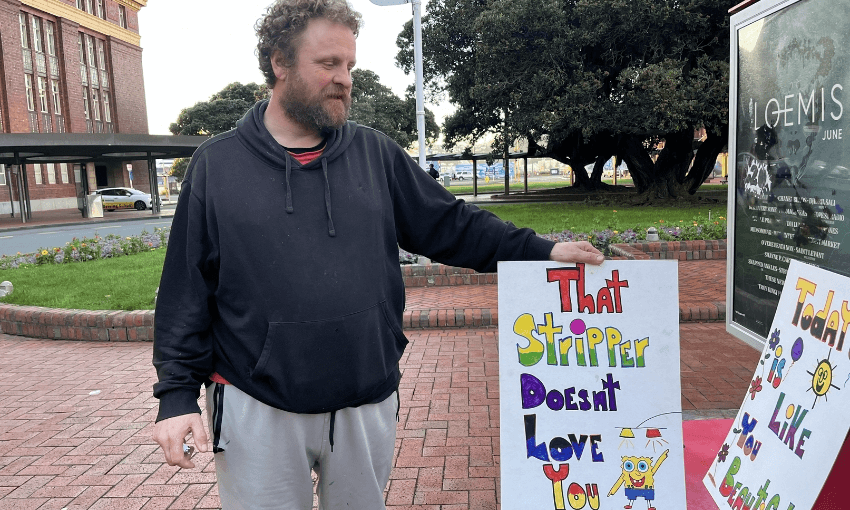
For the Wellingtonians who bump into Sherlock, the feeling is reciprocal. He’s so good at comforting upset locals who come to him for a smile that he reckons the neighbourhood police have told him he’s “got more people skills than some of the officers”. He says they sided with him after a prominent local businessman allegedly tried to have him removed from hanging around outside a building he owned. “The cops showed up and went, mate, he’s got nowhere to go and he’s not hurting anyone – so what’s the big deal?”
Today, there’s no drama from passersby as the morning opens up from the darkness to a bright blue sky. The air feels crisp as a council worker at stops for a chat and a smile. A mum and her young daughter share a laugh. Phones are whipped out to capture the colour. For what he lacks in resources, Sherlock makes up for in shared joy. “Don’t feel sorry for me,” he smiles. “Feel sorry for yourself that you’re feeling sorry for me.”