Why Wellington’s Gordon Wilson flats won’t go down until 2027

Wellington’s most controversial apartment block isn’t going down quietly – or quickly.
Chris Bishop was planning to have swung into the decrepit building via wrecking ball by now. What’s the hold-up?
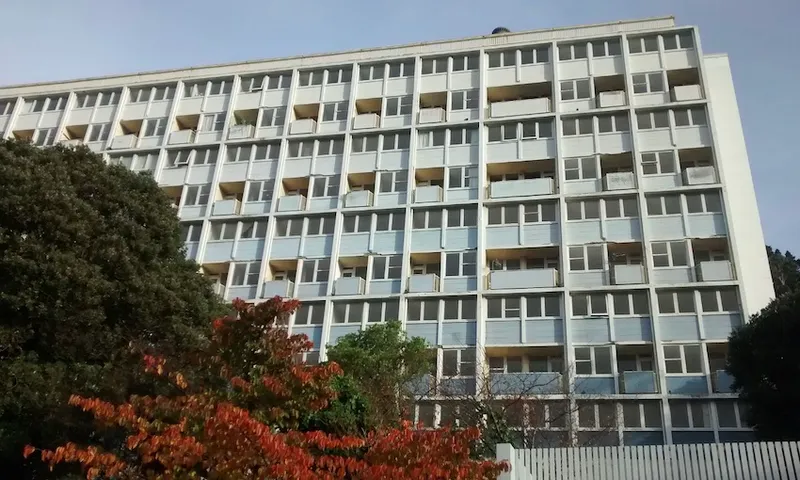
“Goneburger” was the battle cry made by Chris Bishop last July as he signed the death warrant for one of the capital’s most infamous buildings. The housing minister had gone to what one commentator described as hilariously petty levels to remove the heritage status from Wellington’s controversial Gordon Wilson flats, thereby ushering in a new age of accommodation and putting to bed a decade-long debacle. But, despite predictions the flats would be knocked down by the new year, the earthquake-prone building, which has been empty since 2012, is still hereburger.
In early December, Victoria University of Wellington – which owns the 1950s-era building – confirmed plans to demolish it in a press statement, anticipating works to begin that month. But as it turns out, getting rid of an 11-storey, 87-unit complex takes a bit of time and planning. A spokesperson for the university told The Spinoff the demolition project was still on track, with the initial phases due to begin in February.
Rather than taking a wrecking ball or a stick of dynamite to the building, the process will be a gradual dismantling over a year-long period. “Ceres, our demolition contractor, has started site establishment works and the programme is estimated to take around 12 months,” a spokesperson for the university said. “The building will be carefully deconstructed in phases, with initial phases focused on the removal of hazardous materials.”
In December, Bishop told The Spinoff he was looking forward to pressing a button on an iPad and watching the building go boom. But controlled implosive demolitions, especially those for large-scale buildings in urban areas, are a heavily regulated practice in New Zealand. Since New Zealand’s first implosive demolition of a large-scale building in 2012, only one similar building has been imploded.
That first implosion 14 years ago, of Christchurch’s 14-storey Radio Network House, was a trial run for further implosive demolitions following the 2011 earthquake. Only one other implosion has occurred in Aotearoa since then: the 2015 demolition of the Christchurch Central Police Station, a 15-storey high-rise.
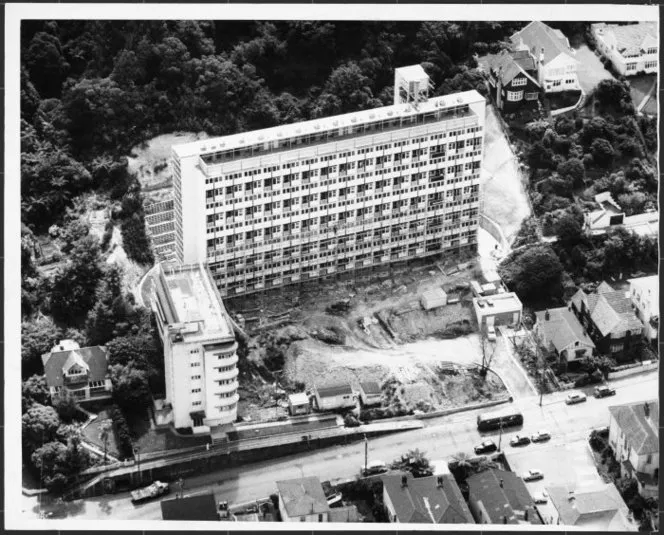
Given it’s in the middle of a residential area on The Terrace, planning an implosion of the Gordon Wilson flats would likely have contractors encountering red tape over exclusion zones, as well as traffic and environmental management. Instead, the “deconstruction” of the building may look similar to that of Wellington’s former Civic Administration and Municipal Office buildings – the latter of which was built in the same decade as the Gordon Wilson flats – with demolition work running from March 2024 to February 2025.
Bishop had only four words for The Spinoff in response to the headway made on the building’s demolition: “good progress, crack on”. The minister has previously labelled the building an “eyesore” and “ugly scar”, and celebrated the move to remove its heritage protections with an image of himself riding a wrecking ball into the building.

The modernist flats were built in the late 1950s, opened in 1959 and used as social housing until 2012. Housing New Zealand evacuated the building’s occupants in May of that year, citing concerns with structural integrity. How the asbestos-riddled building would handle earthquakes and strong winds was a worry, and in 2010, Housing NZ had received advice from engineering consultants raising concerns that a fall by a single “large person” could trigger its collapse. It was sold to Victoria University in 2014.
The flats were given protected heritage status in 1995 as a part of Wellington’s district plan and were listed as a category 1 historic place by Heritage New Zealand in 2021, alongside the neighbouring McLean Flats (also set for demolition). Heritage NZ has previously expressed its disappointment over VUW’s plans to demolish the site, having long called for a refurbishment, rather than a complete knock-down, of the building to retain the city’s architectural history.
Heritage NZ director Jamie Jacobs told The Spinoff there was now “no viable lever to compel Victoria University to reinvent this iconic building”. The cost and effort involved in this demolition would “undoubtedly slow the design, consenting, and construction process for any new building”, Jacobs said. The project would be “as far from a ‘green’ solution or approach to development that an owner can take: the embodied carbon in the building fabric will only be filling up the landfill”.
Jacobs pointed to the boarded-up Dixon St Flats, which have sat empty since November 2024, and efforts by a “creative owner to reinvent existing buildings, heritage or otherwise, and make them appealing to a new generation of the public”. The same fate could have been achieved with the Gordon Wilson flats, Jacobs argued, but “unfortunately a ‘demolition mindset’ prevented a more thoughtful process and approach.”
However, “like all Wellingtonians, we look forward to seeing how the university’s stated new residential development on the site comes to fruition as we are all acutely aware of Wellington’s ongoing housing crisis”, Jacobs said.
Tamatha Paul, Wellington Central MP and housing spokesperson for the Green Party, has long called for the flats to be replaced with affordable housing. Paul told The Spinoff she was “stoked” to see movement being made on the site after a decade. “Wellington and its universities have been plagued by a notorious reputation for poor-quality flats and ridiculously expensive rents,” Paul said.
“If universities want students and if city leaders want a vibe that only young people can bring, they need to put affordable student housing on the table.”
As the initial phases of the demolition get closer, VUW will be meeting with representatives from the Architectural Centre, longtime advocates of the building’s heritage status. The centre’s Stuart Niven told The Spinoff he hoped the university would be able to show the costing for the demolition, as “we couldn’t see that [the refurbishment] we’re proposing would be more expensive than pulling the building down and starting over again”.
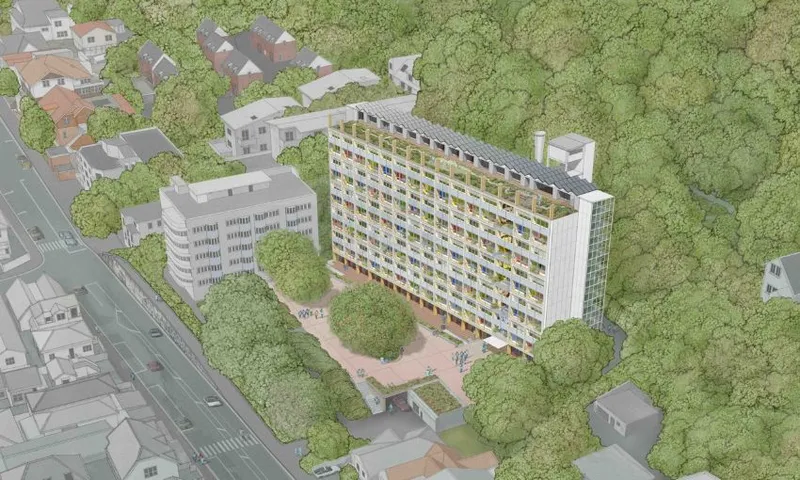
The centre has called for redevelopment of the site, keeping the building’s concrete structure and developing 100 refurbished apartments. Niven argued the building standards of the time the flats were constructed meant they would have “extremely strong” structural components, which is why the building would take so long to bring down.
“The university is crying poor in terms of their finances available to them and what they can borrow, and here they have a residential area that they could do cheaper than pulling it down and replacing it,” Niven said. “[It’s] staring them in the face, and they’re not prepared to take it seriously.”

Lyric Waiwiri-Smith
Lyric is an award-nominated politics reporter at The Spinoff. She covers parliament from the press gallery, pens the weekly column One MP, One Pint and is endlessly curious about what makes our decision-makers tick. Off the clock, Lyric loves a live gig, a cold brew, and being a Wellingtonian (on a good day).


