
Labour and Green MPs are accusing their government colleagues of negotiating in bad faith, while campaigners warn New Zealand is falling behind on recycling, writes Catherine McGregor in today’s extract from The Bulletin.
To receive The Bulletin in full each weekday, sign up here.
Right to repair bill on brink of failure
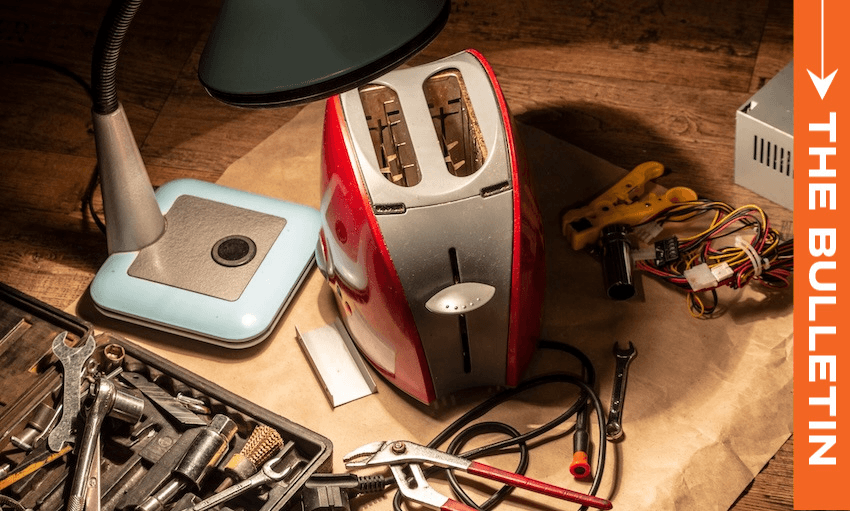
Green Party co-leader Marama Davidson’s Right to Repair Bill is unlikely to survive its second reading in Parliament, despite overwhelming public support. The bill, which sought to close a loophole in the Consumer Guarantees Act allowing manufacturers to opt out of repairs, would have compelled companies to provide spare parts, tools and repair information. Of the 1,250 submissions received, 95% backed the proposal. However, on Monday it emerged that Winston Peters had withdrawn NZ First’s support, describing the law as “unworkable and costly”. Speaking to Stuff’s Esther Taunton in February, Paul Smith of the Right to Repair Coalition Aotearoa strongly disputed that claim, noting there is no evidence from overseas that repair laws push up prices for businesses. “If you provide the parts, you don’t have to provide the entire product [as a replacement].”
Still, even after Davidson offered amendments to narrow the bill’s scope – it currently covers all consumer goods, which many agree is too broad – Smith conceded to Consumer NZ that “realistically there’s little to no hope” of its passage.
Concerns over select committee process
Labour and Green MPs say the bill has not just been defeated, but deliberately undermined during the select committee stage. As The Post’s Rob Stock reports (paywalled), the Economic Development, Science and Innovation Committee recommended that the bill not proceed, despite extensive cross-party workshopping of amendments designed to meet government members’ concerns. In a report released on Monday, the minority Labour and Green MPs recorded “serious concerns” with how the process was handled, noting that opposition members had engaged “in the reasonable expectation that such engagement was aimed at building genuine cross-party agreement”. Instead, they wrote, “the perception [is] that the process was used to keep the committee occupied rather than to improve the bill, at a cost to the public purse”.
Why repair matters
The impetus for Davidson’s bill is a global economy increasingly dependent on disposable goods. “Millions of appliances and electronic products are being dumped needlessly because they can’t be repaired,” says Consumer NZ’s Jon Duffy. “It’s costing us all, and it’s costing the planet.” Electronic waste is one of the fastest-growing waste streams worldwide, and without a right to repair, New Zealand risks becoming a dumping ground for poorly designed, short-lived products, Duffy says.
In Europe and the UK, right to repair laws already require manufacturers to provide spare parts for appliances for up to 10 years and ensure that repairs can be carried out with commonly available tools. Davidson’s bill would have followed a similar path, giving New Zealanders the right to demand repair instead of replacement. Supporters argue this would not only reduce waste and emissions but also help grow a repair economy that keeps money and skills local.
Another setback for recycling efforts
The bill’s likely demise marks the government’s latest retreat from waste-reduction initiatives. As RNZ’s Anneke Smith observes, since the coalition was elected, “the container-return scheme has been scrapped, plastic bans pared back, and product stewardship rules delayed.” In December, the government also quietly cancelled plans for mandatory kerbside composting and recycling in all urban areas, a move that Wellington City Councillor Iona Pannett said had pulled “the rug out from under” local waste strategies. The collapse of right to repair now leaves consumers with fewer options for extending the life of their products and adds to New Zealand’s already poor record on waste diversion.
Davidson insists she will not give up. “If the government is serious about protecting the rights of consumers, this bill can still be passed,” she says. But unless one of the coalition parties shifts its position, the chances of New Zealand joining the growing global repair movement remain remote.
More from The Spinoff
- An afternoon at the Repair Café, where everyday objects get a second life