Siouxsie Wiles: Why this giant worm should be crowned New Zealand’s best bug

Illustration: Toby Morris; photos: Mike Chillingworth CC BY-SA 4.0; design: Tina Tiller
It’s more than a metre long and can expel glowing yellow ooze from its anus. Doesn’t that sound like Bug of the Year material to you?
I can’t quite remember when I first became fascinated by bioluminescence, the light produced by living creatures. I certainly never thought I’d be able to turn that fascination into a career. Making nasty bacteria glow in the dark wasn’t something my careers counsellor mentioned at high school.
But decades later, here I am, heading up the Bioluminescent Superbugs Lab at Waipapa Taumata Rau, the University of Auckland. Put simply, my lab makes nasty bacteria glow, and because they only glow when alive, we can use their light to try to find new medicines, among other things.
Thanks to my PhD student Aymee Lewis (Ngāti Kahungunu ki Te Wairoa, Ngāti Rakaipaaka), I’ve recently learned that the word for bioluminescence in te reo Māori is hīnātore. In te ao Māori, Hīnātore is one of Te Whānau Mārama, who brings light into the world alongside her siblings Te Rā (the sun), Te Marama (the moon) and Ngā Whetū (the stars).
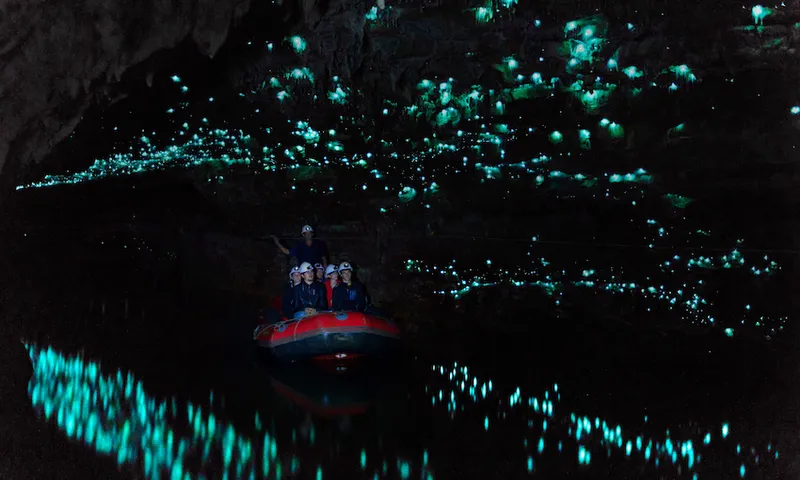
For years, the glow worm has been one of my favourite bioluminescent creatures. Technically, it’s not a worm at all: glow maggot would be a more accurate description, as it’s the larvae of a tiny fly called a fungus gnat. Its scientific name is Arachnocampa luminosa, which loosely translates to “glowing spiderbug” as it glows and spins silk to make its home and its fishing lines.
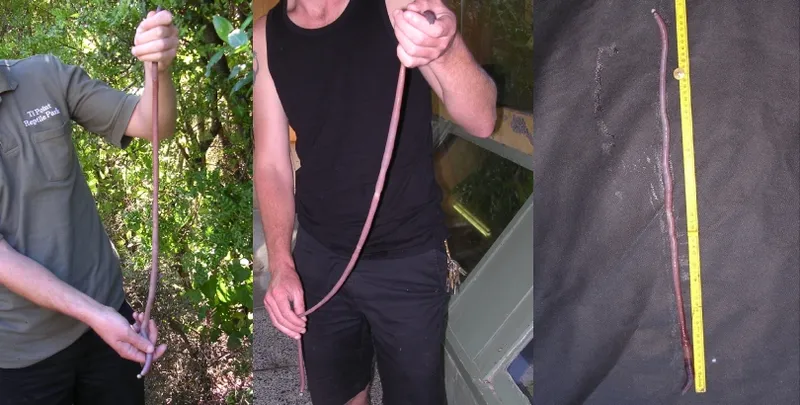
Anyway, enough about glow worms, because today I want to enthuse about real glowing worms. It turns out that worldwide there are nearly a hundred known species of bioluminescent earthworms. And we have at least two of them right here in Aotearoa New Zealand! Besides being bioluminescent, these are not your typical earthworms. They are long. And I mean really long. The New Zealand earthworm, Octochaetus multiporus, grows to about 30cm – the size of a ruler.
But that’s nothing compared to the North Auckland worm, Anisochaeta gigantea*. That one can reach 1.4 metres in length. Metres! That’s taller than a green wheelie bin! The North Auckland worm is also really hairy. Both live in soil metres below the surface so you have to do some serious digging to see them in the flesh.
What about their bioluminescence? Unlike our famous glowing maggots, whose bodies produce an ethereal blue light as a way of attracting a meal, our bioluminescent earthworms release a yellow glowing fluid when disturbed. It oozes from their pores and anus – like liquid gold, I’ve heard it described. Very little is known about why these earthworms glow, but it’s likely to be a form of defence. The glow probably distracts or even temporarily blinds any potential predator while the worm slithers off in the other direction.
Another cool thing I learned from Aymee and Te Reinga storyteller Richard Niania (Ngāi Kōhatu: Ngāti Ruapani, Ngāti Hinehika: Ngāti Kahungunu ki te Wairoa) is that Māori know bioluminescent earthworms as noke waiū and used them as bait to catch tuna (eels). They would thread the glowing worms onto harakeke muka (fibre) which was tied to a rod and hung into the water. Presumably tuna were attracted to the glowing worm and would take a bite, their teeth getting caught on the muka.
Many of our native earthworms are threatened by urbanisation, soil compaction, gardening practices, land-use change and climate change. And that’s bad because earthworms are an important food source for native birds and play an important role in soil health and nutrient recycling.
Right now, the North Auckland worm is one of the nominees for the Bug of the Year competition. Held each year by the Entomological Society of New Zealand, Bug of the Year celebrates Aotearoa’s most overlooked and extraordinary invertebrates. The North Auckland worm is a worthy nominee as we know very little about it. In fact, it’s listed on the IUCN Red List of Threatened Species as “data deficient”. Alongside this enormous glowing hairy noodle of a worm, there are 20 other nominees. And you don’t have to choose just one to vote for. You can pick three! Voting closes at midnight on Monday, February 16. So what are you waiting for? Head over to bugoftheyear.ento.org.nz and get voting.
*This one has had a few different names in the past so you might also see it referred to as Spenceriella gigantea and Celeriella gigantea.
**Full disclosure, I’m struggling to find confirmation that the North Auckland worm is actually bioluminescent. In contrast, there’s loads documented about the smaller but still pretty giant for an earthworm Octochaetus multiporus producing a bioluminescent goo. Which leads me to wonder if the trait has become attached to the North Auckland worm because of its size. Sightings are very rare so maybe this is a form of giant earthworm mistaken identity? Feel free to get in touch if you know of any sightings of bioluminescence from an earthworm that was longer than the size of a ruler!

Siouxsie Wiles
Dr Siouxsie Wiles is an Associate Professor and head of the Bioluminescent Superbugs Lab at the University of Auckland. She and her team make nasty bacteria glow in the dark to find new medicines and to study how bacteria evolve to cause disease. Siouxsie recently published her first book, Antibiotic Resistance: the End of Modern Medicine? She is also a keen blogger, tweeter and podcaster and is the 2021 Te Pou Whakarae o Aotearoa Kiwibank New Zealander of the Year.


