How a Māori-led space centre is rethinking Aotearoa’s place in the sky

The Tāwhaki National Aerospace Centre in Kaitorete (Photo: Supplied)
Tāwhaki isn’t chasing billionaire dreams of escape – it’s using space to heal whenua, bring whānau home, and rethink what responsibility beyond Earth really means. Mirjam Guesgen explains.
A Ngāi Tahu pūrākau tells of the demi-god Tāwhaki, who journeyed to the edge of the horizon, where the sky meets the land. There, he climbed the sacred vine – one end anchored to the Earth and the other to the sky – to reach the heavens and acquire knowledge.
The legend of Tāwhaki serves as the namesake and inspiration for one of New Zealand’s newest aerospace centres. Located in Kaitorete on the east coast of Canterbury, the Tāwhaki National Aerospace Centre is a collaboration between the rūnanga of the Ngāi Tahu hapū Te Taumutu and Wairewa and the Ministry of Business, Innovation and Employment (MBIE). Founded in 2021, it’s the latest in a growing Aotearoa aerospace industry – one that’s boomed 53% in value since 2019, to now be worth $2.68 billion (on par with seafood exports). Just last week, space minister Judith Collins launched a $1.8 million funding programme for space projects.
Tāwhaki is an outlier in the aerospace game. Instead of racing after innovation for the sake of disruption (moving fast and breaking things), Tāwhaki emphasises restoring the whenua of Kaitorete and its people. It’s a far cry from the billionaires trying to get off Earth as fast as possible.
“While there may be fellow humans that have great desires to go live on Mars, for those of us that are Ngāti Mako and Te Taumutu Rūnanga, our homeland is Taumutu, Wairewa and Kaitorete – and we’re not about to abandon that,” says David Perenara-O’Connell, chair of Tāwhaki.
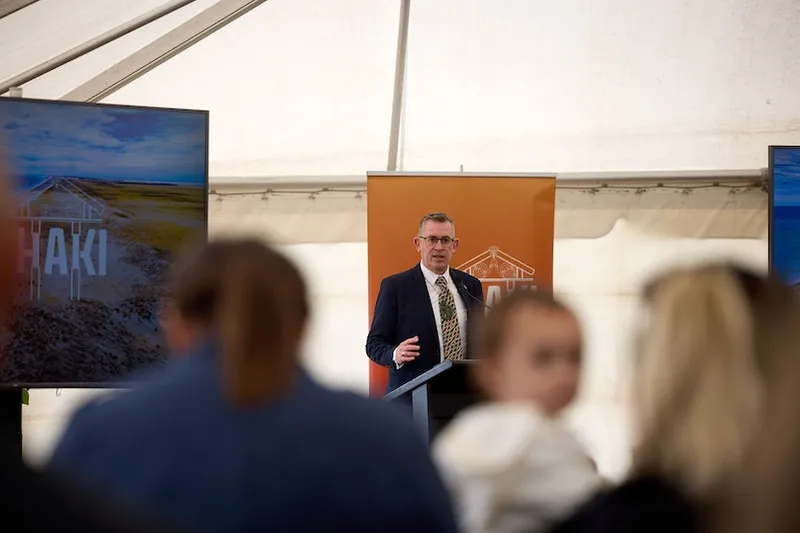
Scroll through the social accounts of Tāwhaki and you’ll see images of its sleek newly built hangar, or high-tech space planes circling the sky, right alongside photos of their staff planting harakeke. Restoring the once verdant spit – home to the planet’s only flightless moth and threatened endemic species of native plants – is one of the venture’s priorities, but so is making sure any of their future aerospace activities don’t cause new environmental problems. “Our value set is very different to other commercial ventures who just want to get stuff up there,” says Perenara-O’Connell.
It’s part of the reason Tāwhaki currently only does horizontal launches – sending off and relanding spaceplanes in the same way regular aircrafts take off and return to a runway. Although, according to Stan Topping, head of aerospace, they are “investigating what Tāwhaki can be in terms of vertical launch”.
One of Tāwhaki’s partners, Kea Aerospace, launches solar-powered aircraft from the centre. The plan is to eventually have them glide for months in the stratosphere, around 20 kilometres above the Earth, before landing again. They’re currently testing a version that flies for around 16 hours. This means these crafts aren’t adding to more than 8,000 tonnes of space junk circling the planet. Tāwhaki could at some point be keen to work with companies who want to declutter that debris.
With key priorities of rejuvenating the land and its people, then why aerospace? It’s an industry known for its polluting potential and one that Māori have historically been excluded from.
Perenara-O’Connell sees space as the perfect vantage point for resolving the challenges here on Earth. Just like Tāwhaki found knowledge on his ascent to the heavens, so will they. Another collaboration with Kea and Nasa plans to monitor from space and eventually improve water quality around Kaitorete. “It’s a bold step forward – where ancestral wisdom and modern science work in tandem to protect and restore the ecosystems we depend on,” Julian Phillips, head of whenua planning and rejuvenation at Tāwhaki, said in a recent press release.
Yet the very notion of humans entering the realm of atua seems at odds with the Māori worldview of space. “Thinking about that in a modern context does raise the question [of whether we belong there],” says Perenara-O’Connell.
“Going to space is not just a rite of passage, it comes with a huge responsibility to ensure that it’s looked after because our lives depend on it,” he says. It’s something Perenara-O’Connell means quite literally – one of the ultimate goals of Tāwhaki is to bring its people back home. “We were communities that were severely impoverished through colonisation. That meant our whānau were unable to stay within our traditional communities,” he says. The hope is that aerospace – through education and local employment – will bring people back.
The kaupapa of Tāwhaki and its aspirations are a far cry from other New Zealand-born space ventures. Take Rocket Lab (now American owned) for example, which came under fire for launching rockets for the US military. Some even accused the company of launching satellites that supply images to Israel to be used for strikes in Gaza. Perenara-O’Connell says that “kinetic, defence-related companies are off the table for us, but technologies that aid search and rescue, disaster response, supply and logistics and maritime surveillance have a role to play, including for New Zealand.”
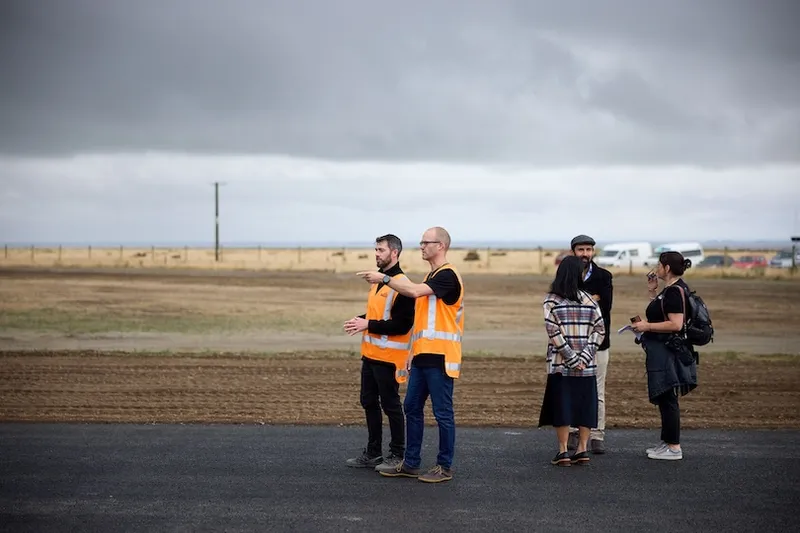
It’s still early days for the aerospace centre. A major win so far was, in 2021, acquiring roughly 1,000 hectares of land that the centre sits on through a government contribution of $16 million. Originally, only two small sections at either end of the long stretch were held by Te Taumutu Rūnanga, with the rest used for private, intensive farming. They opened their hangar in March this year. Then, just a few months later, secured permanent special use airspace – a vital regulatory step that allows Tāwhaki to manage aircraft in that area.
“We’re still in startup mode in some respects,” says Topping. “In the last four years, we’ve gone through the establishment and foundation stages. Now we get a lot more interest, we’ve got a lot more operations.” For now, Tāwhaki is waiting to see what needs their future clients have before committing to any particular infrastructure expansions.
Topping spent almost a decade working for aerospace giant Airbus, before helping set up autonomous aircraft company Wisk in Aotearoa. He says his biggest job is creating opportunities for the next generation. Early discussions with potential partners include talking about how to connect the company with rangatahi, be it through work experience, internships or inspiration.
Local students recently came to the hangar to create solar-powered mini aircraft. “By the end of it, they were properly buzzing. I didn’t realise how much that lands with me until then,” Topping says. He also vividly remembers when one girl finished her run in a flight simulator: “The smile on her face was huge. She stepped away and said she wanted to be the first Māori wahine in space.”
“Everything we do is less to do with the short term return and very much about setting this up so we can hand it off to the next generation,” Topping says. “Tawhaki is a forever project. It’s not going anywhere.”

Mirjam Guesgen
Mirjam Guesgen is a science journalist with an interest in stories that examine an issue from many angles: science, law, culture, psychology or philosophy. Her work has been published in The Globe and Mail, Motherboard, The Cut, Canadian Geographic, Aeon, Seeker, Maisonneuve, The Record, The New Zealand Herald, The New Zealand Listener and VetScript magazine. She also writes for the YouTube channels SciShow and Hot Mess as well as her own dedicated science channel ScienceWrapNZ.


