US-Israel attacks on Iran, and the NZ response: what we know so far

The site of a strike on a girls’ school in Minab, in Iran’s southern Hormozgan province, on February 28, 2026, This picture obtained from Iran’s ISNA news agency. (Photo by ALI NAJAFI / ISNA / AFP via Getty Images)
Explainer: the key events, background and reasons given for wide-ranging strikes that Trump says have killed supreme leader Khamenei.
What just happened?
Mid-morning on Saturday, missile strikes were felt across Iran after the US and Israel launched a vast coordinated attack. The operations – labelled “Epic Fury” by the Americans and “Roaring Lion” by Israel – targeted Iranian leaders, military installations and nuclear facilities. Within hours, Iran had launched retaliatory attacks on Israel and American bases across the Middle East, prompting fears it could spill into a wider regional conflict. Flights serving or travelling via the area have been cancelled or diverted.
Trump said the attack, which has no clear end-point, was undertaken to eliminate an “imminent threat”, an important criterion in any assessment of whether the action meets the requirements of international law (see below).
What is the imminent threat?
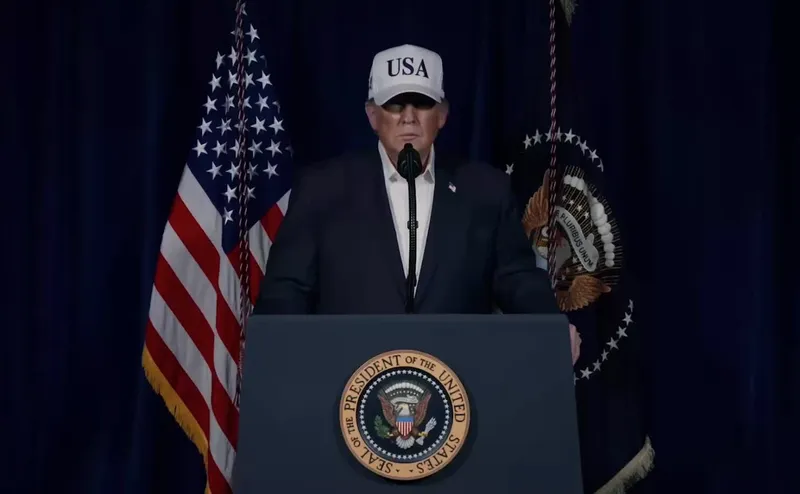
In a video posted to social media in the early hours of Saturday morning, US time, President Donald Trump said the goal was to “eliminate imminent threats from the Iranian regime, a vicious group of very hard, terrible people”. The operation had been designed to prevent Iran developing a nuclear weapon, “raze their missile industry to the ground”, “annihilate their navy”, hobble the proxy groups Hamas and Hezbollah, and to provide Iranian people with an opportunity to “take over your government”.
No evidence has been provided of any specific imminent threat to the US. Trump said that Iran was developing missiles that could strike Europe and “soon reach the American homeland”, though the latter claim is insubstantiated.
Is it about regime change?
That is clearly part of the motivation. Trump has announced that Ayatollah Ali Khamenei, supreme leader since 1989, was killed in the first wave of attacks, with an online post declaring: “Khamenei, one of the most evil people in History, is dead.” According to reports, the attack was brought forward and, exceptionally, launched in daylight, after an opportunity was seized with several regime leaders gathering together. Trump told NBC: “The people that make all the decisions, most of them are gone.”
The US president urged Iranians to “seize control of your destiny and to unleash the prosperous and glorious future that is close within your reach”. Recent history, including in Iraq and Afghanistan, points to innumerable and profound perils along that path. At the same time, the Iranian regime is both brutal and unbeloved. A number of media outlets have reported that there have been scenes of celebration in Tehran at the news of Khamenei’s assassination. Tens of thousands of Iranians are estimated to have been killed in a crackdown on protests against the regime in recent months.
According to Iranian state media, hundreds of civilians have been killed in the attacks. After initial denials, reports of Khamenei’s death have now been confirmed.
Haven’t Iran and the US just been engaged in talks?
A third round of talks had concluded on Thursday in Geneva. The foreign minister of Oman, who brokered the talks, told US media that he believed a breakthrough had been achieved, with Tehran agreeing never to stockpile enriched uranium. He said he was confident the dispute could be resolved “amicably and comprehensively” within months.
That has prompted suspicion the talks were a facade and that Trump was persuaded by Israeli prime minister Benjamin Netanyahu that broader military action was necessary. One Trump official said he believed Iran had been engaged in “games, tricks, and stall tactics.” In his address announcing the strikes, Trump said: “they rejected every opportunity to renounce their nuclear ambitions, and we can’t take it any more.”
Didn’t Trump previously say they’d “obliterated” Iran’s nuclear programme?
In June 2025, Trump said that strikes on Iran in “Operation Midnight Hammer”, also carried out alongside Israel, had proved a “spectacular military success”, and that “Iran’s key nuclear enrichment facilities have been completely and totally obliterated.” Speaking last night, Trump said Iran had defied warnings “never to resume their malicious pursuit of nuclear weapons”.
How long is this likely to go on?
It is impossible to say, but it is highly likely the war will continue long beyond the “decapitation” operation in Venezuela which saw the removal of Nicolas Maduro – an episode which many believe emboldened Trump in pursuing the attack on Iran. As it stands, the conflict looks broad in scope and open-ended. There are fears of a prolonged conflict encompassing the region, as well as the risk around the world of cyberattacks and terrorist activity. In his statement, Trump warned: “the lives of courageous American heroes may be lost.”
Wasn’t Trump opposed to operations such as these?
Historically, Trump has railed against hawkish or neoconservative foreign policy approaches, urging that the US should avoid getting embroiled in protected military interventions. That opposition to “forever wars” is an article of faith for many in Trump’s Maga base.
Are these attacks consistent with international law?
The UN charter says force cannot be used against another state unless the UN security council approves it or when commenced in self-defence. According to some interpretations of the charter, pre-emptive self-defence is acceptable in the face of a clear and imminent threat, hence the use of “pre-emptive” and “imminent threat” in the language used by the US. In the absence of any clear evidence of the above, however, it would be a violation of international law.
It is also questionable whether the attacks are consistent with the US constitutional requirement that congress approve any decision to go to war. A number of congresspeople are demanding an urgent vote on a war powers resolution.
What is the New Zealand response?
A statement co-signed by prime minister Christopher Luxon and minister for foreign affairs Winston Peters begins by noting New Zealand’s consistent condemnation of Iran’s nuclear programme, “its destabilising activities in the region and elsewhere, and its repression of its own people”. The regime had long since lost the support of its people and therefore its legitimacy, they said.
“In this context, we acknowledge that the actions taken overnight by the US and Israel were designed to prevent Iran from continuing to threaten international peace and security.” The only military action expressly condemned by Luxon and Peters are “Iran’s indiscriminate retaliatory attacks on Qatar, the United Arab Emirates, Saudi Arabia, Kuwait, Bahrain, and Jordan. We cannot risk further regional escalation, and civilian life must be protected.”
They do go on to nod at the apparent breach of international law, saying: “We call for a resumption of negotiations and adherence to international law – and we urge the Iranian leadership to seek a negotiated solution that returns Iran to the community of nations.” They add that, “the Iranian people must be allowed to determine their future.”
New Zealand was not given any advance warning of the action, Peters subsequently told a media conference. He said: “Iran has been a promoter of terrorism in countless theatres for decades now. That’s not an excuse for what you’ve seen, but it is an explanation.”
(The Luxon/Peters statement – including advice for New Zealanders in the region – is printed in full at the foot of this post.)
Opposition parties?
In a statement on social media, Labour leader Chris Hipkins said the attacks and the retaliatory strikes both “undermine international peace and security and put civilian lives at risk”. Urging restraint and diplomatic solutions, he said: “We recognise the courage of Iranians who have taken to the streets demanding change, at enormous personal risk and we condemn the serious human rights violations that have been perpetrated against them. Military escalation does not produce the stability the region needs.
The Greens issued a full-throated denunciation. “Trump and Netanyahu’s unilateral attack on Iran must be condemned as an illegal and unprovoked act against the people of the region and any genuine pathway to peace,” said co-leader Marama Davidson in a statement. She said: “Luxon’s failure to condemn Trump’s illegal actions again demonstrates his lack of leadership or moral courage, and willingness to act against New Zealander’s values.”
And other international leaders?
The UN secretary general, António Guterres, said both the attacks and the retaliation “undermine international peace and security”. He called for an “immediate cessation of hostilities” to avert “a wider regional conflict with grave consequences for civilians and regional stability”.
A joint statement from French president Emmanuel Macron, Germany’s Chancellor Friedrich Merz and UK prime minister Keir Starmer, issued several hours ahead of New Zealand’s, similarly condemned the Iranian reprisals, its nuclear programme and suppression of the population. There was no criticism of the US-Israeli attacks, though confirmation that none of the three had participated, and an encouragement of a “negotiated settlement”.
The prime ministers of Australia and Canada were more explicit in saying they backed the US actions, despite not participating. “Canada supports the United States acting to prevent Iran from obtaining a nuclear weapon and to prevent its regime from further threatening international peace and security,” said Mark Carney. Anthony Albanese said: “We support the United States acting to prevent Iran from obtaining a nuclear weapon and to prevent Iran continuing to threaten international peace and security.”
Russia, an ally of Iran, condemned the US attacks. “The peacemaker once again showed his face. All negotiations with Iran are a cover operation,” said Dimitry Medvedev, deputy chairman of Russia’s security council. “No one doubted it. No one really wanted to negotiate anything.”
Luxon/Peters statement
New Zealand has consistently condemned Iran’s nuclear programme, its destabilising activities in the region and elsewhere, and its repression of its own people.
Iran has, for decades, defied the will and expectations of the international community. The legitimacy of a government rests on the support of its people. The Iranian regime has long since lost that support.
In this context, we acknowledge that the actions taken overnight by the US and Israel were designed to prevent Iran from continuing to threaten international peace and security.
We condemn in the strongest terms Iran’s indiscriminate retaliatory attacks on Qatar, the United Arab Emirates, Saudi Arabia, Kuwait, Bahrain, and Jordan. We cannot risk further regional escalation, and civilian life must be protected.
We join the international community in hoping this crisis ends as quickly as possible.
We call for a resumption of negotiations and adherence to international law – and we urge the Iranian leadership to seek a negotiated solution that returns Iran to the community of nations.
Our thoughts go out to all those affected by the conflict, and to the New Zealand families who are understandably worried about their loved ones in the region.
We recognise too the courage of the Iranian people who have taken to the streets in recent weeks to demand change, only to be met by violence and murder. The Iranian people must be allowed to determine their future.
New Zealand embassies in the region are closely monitoring the situation and will continue to provide support to New Zealanders. The Ministry of Foreign Affairs and Trade advises New Zealanders in the region to shelter in place. New Zealanders should follow the advice of local authorities and register on SafeTravel.
New Zealanders requiring urgent consular assistance should call the New Zealand 24/7 Consular Emergency Line on +64 99 20 20 20.

Toby Manhire
Toby Manhire is editor-at-large at The Spinoff. He loves to cast a pod, whether it's Gone By Lunchtime, At Large or Juggernaut. He is a former editor of The Spinoff and has worked as a journalist in NZ and the UK since the last millennium.


