Pay equity ‘select committee’ finds ‘flagrant and significant abuse of power’

Some of the members of the People’s Select Committee on Pay Equity, from left, Lianne Dalziel, Sue Bradford, Jo Hayes, Steve Chadwick Nanaia Mahuta and Marilyn Waring (Photos: Getty Images/Supplied; design The Spinoff)
A group of female former MPs took it upon themselves to subject the pay equity overhaul to the scrutiny it should have received before passing into law. Here’s what they found.
When the government’s surprise overhaul of the pay equity system was revealed in May last year and pushed through under urgency, sans the usual scrutiny, the reaction was immediate and intense. But alongside the attention-grabbing protests and c-bombs, a longer-term response was also announced: the establishment of a “people’s select committee”, set up to do what the government didn’t and “gather, review and evaluate evidence that should have been before parliament ahead of the legislation being proceeded with”. Today, its final report has been released.
The Equal Pay Amendment Bill 2025, which extinguished 33 active claims and made the criteria for bringing new ones much stricter, was passed on May 7, compressing a usually months-long process of scrutiny into a couple of days. Former National MP Marilyn Waring was so outraged by this lack of process that she recruited a bunch of other former MPs, all women, from across the political spectrum to give the legislation the thorough going-over that most bills get at the select committee stage. Joining Waring on the People’s Select Committee on Pay Equity (PSCPE) were fellow former National MPs Jackie Blue, Jo Hayes and Belinda Vernon, former Labour MPs Steve Chadwick, Lianne Dalziel, Nanaia Mahuta and Lynne Pillay, former NZ First MP Ria Bond and former Green MP Sue Bradford.
“The committee observed, as closely as possible, the rules and procedures of parliament,” explains the report. Submissions were called for from late May and 1,383 written ones (excluding duplicates, blank forms and the like) were received, with public hearings held in August, September and October for oral submissions from “171 people and one singing group”. All are publicly available here. In addition, the committee accessed “parliamentary debates, Official Information Act inquiries, press statements, and other relevant public materials, to better scope the issues”. Each member collated evidence and offered insights and conclusions on one or more specialty topics. Special advisers provided background papers.
So what did the report find? Here are some key takeaways from the 174-page document.
‘A radical departure from the rule of law’
The retrospective nature of the legislation that allowed those 33 live claims to be cancelled comes in for particular criticism. Brooke van Velden, the minister in charge of the bill, was advised by officials that “a retrospective application of legislation to current claims is rare and would need to be justified”, the report notes. Van Velden said the retrospectivity was “justified to meet the policy objectives of the new legislation”, but the majority of submitters argued that the true driver was saving money in advance of the government’s forthcoming budget.
“The submissions we received overwhelmingly agreed this was the real reason for the bill being passed under urgency, and an unacceptable reason for such a radical departure from the rule of law and due process,” notes the report. “Submitters asserted that retrospectivity should be reserved for the most exceptional of circumstances. The PSCPE agrees.”
The report assesses the law according to the recently passed and controversial Regulatory Standards Act (RSA), and finds it wanting. The RSA lists five points that define the rule of law, one of which is “The law should not adversely affect rights and liberties, or impose obligations, retrospectively.”
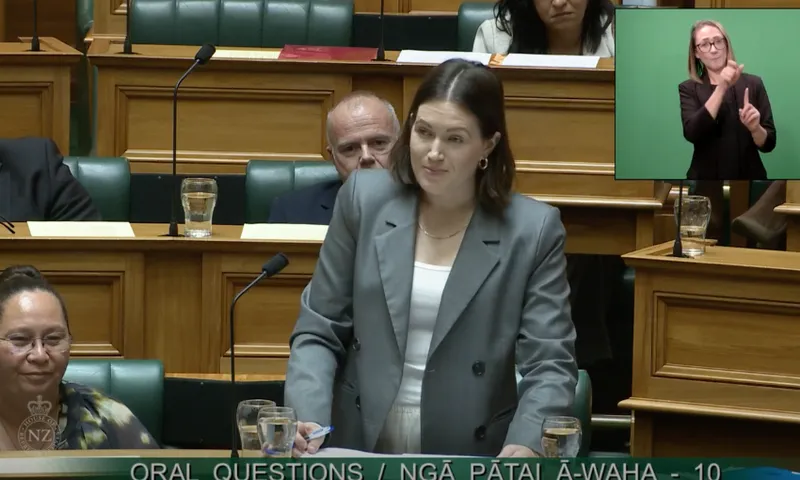
The lack of consultation undertaken before the pay equity overhaul was enacted also comes in for heavy criticism, with the report noting “the policy details were not even tested with the Ministry of Women, despite the bill proposing a fundamental change to a policy that was squarely within their remit”. As for the use of urgency and lack of select committee process, submitters pointed to “the way ministers used examples of comparators to mock the process, relying as they did on a lack of public knowledge of the actual process to downplay what had occurred… A select committee would have enabled all of this to have been exposed.”
The absence of a regulatory impact statement meant there was “literally no evidence” to support van Velden’s claims that the new framework was better than the existing pay equity system, which could “only be viewed as a fundamental breach of faith when the reason given is that there was insufficient time”, says the report. “The only time constraint was self-imposed and the only references to dates were those that required decisions to be made in time for the law to pass before the budget. Despite repeated attempts at denial, this remains the only explicitly identifiable reason why the amendment was pushed through parliament without due process and proper scrutiny.”
As for the minister’s claim that the changes would make the pay equity process “more workable and sustainable”, the report found no evidence of this. “They appear to make the process more time consuming, expensive and administratively complex, possibly to the extent of unworkability.”
‘Major impact on trust’
A detailed timeline of the government’s pay equity decision-making has the committee concluding that “employer groups and unions were essentially being strung along”. As was reported last year, documents released under the Official Information Act revealed the lengths to which the government went to keep the overhaul under wraps in advance of its announcement.
A submission from the Aged Care Association to the people’s select committee said that in the 12 months prior to the law being introduced, “employer parties and peak bodies in their sector would have spent close to or over half a million dollars gathering information for that claim, much of it at the request of government”. While they were doing that, however, “the government was already moving behind closed doors to get cabinet approval to end all current pay equity claims including ours”.
Just five days before the changes were announced, health minister Simeon Brown “met with employer groups to discuss three live claims without disclosing that cabinet had already decided to scrap them all”. The report concludes that “this has had a major impact on trust, something that is the hallmark of good government”. Asked for a response to this by The Spinoff, a spokesperson for Brown said “the minister respects the cabinet process, including not discussing decisions until they are announced”.
‘No one is ever required to read anything meaningful or comprehensive’
The report hints at a fundamental lack of understanding on the part of government ministers of the pay equity system and the human rights consequences of dismantling it. “Every piece of information is bite-sized, simplistic and undeveloped – a slide show,” its analysis of government documents notes. “No one is ever required to read anything meaningful or comprehensive. No one is advised that New Zealand’s pay equity regime is world-leading. Most readers relying on these papers for advice would fail a simple test on what pay equity means.”
The report details an email request from van Velden to the Ministry of Business, Innovation and Employment (MBIE) for a briefing on “pay parity” in late 2023. “Although the officials respond politely, it is clear that the minister is actually seeking information on pay equity and does not yet understand the distinction. In response, the minister is provided with a simplified slide presentation outlining the differences between equal pay, pay parity, and pay equity.”
Breaches galore
As well as breaching the Regulatory Standards Act principles, the Legislation Design and Advisory Committee Guidelines, the New Zealand Bill of Rights, the Human Rights Act and te Tiriti o Waitangi, the law is in breach of a number of international legal commitments, according to the report. Those include ILO Convention 100, the International Covenants on Civil and Political, and Economic and Social Rights, CEDAW, the UN Women’s Convention, and the Conventions on the Rights of People with Disabilities and the Elimination of All Forms of Racial Discrimination (ICERD).
Recommendations galore
The report makes many recommendations, with perhaps the least surprising being that the Equal Pay Amendment Act 2025 be repealed and provisions of the 2020 act it amended be reinstated. The committee also recommends some new processes, notably that the government establish and resource an independent pay equity unit that could “offer, free of charge, trained interviewers, assessors, and other experts in pay equity to assist or actively participate in a claim if needed and agreed by the parties”.
More broadly, it recommends big changes to the use of urgency in parliament: that legislation affecting fundamental rights be explicitly excluded except in cases of genuine emergency. It also advises recognising pay equity as a constitutional principle, which could be achieved either through entrenched legislation or through judicial development of pay equity as a recognised right under the New Zealand Bill of Rights Act 1990. Another recommendation is that any future employment law changes require minimum 90-day consultation periods, “including targeted engagement with affected communities, unions, employers, and Treaty partners”.
What next?
The committee members are heading to parliament to distribute the report to sitting MPs. Government ministers have repeatedly said they won’t be formally considering the report or making any changes to the Equal Pay Amendment Act 2025. Labour and the Greens have pledged to repeal the act if elected later this year.
*Update, 12pm, February 24: Brooke van Velden did not address The Spinoff’s specific questions but has provided this statement:
“Members of the public – including former MPs – are free to hold their own opinions and publish their own material. As I said at the time, equal pay is here to stay, and a pay equity system remains. The new system is already processing claims under the new law. The government has made the law simpler and more robust. The acting attorney-general concluded at the time that the Equal Pay Amendment Bill was justified and proportionate to the Bill of Rights Act.”

Alice Neville
Alice Neville is The Spinoff's deputy editor. Her interests include politics, food and data-driven deep dives of all kinds.


