How car parks became a new frontline in the intensification war

An obscure regulation that makes a surprisingly big difference to the future of New Zealand cities is now under review.
When the government announced in January that it would be reducing its ambitions for housing growth in Auckland, it was the first major policy backdown of the term. The headline number from the walkback was the zoned housing capacity dropping from 2 million to 1.6 million. But another less discussed but extremely important change is the apparent softening of rules around car parking minimums.
This proposed change is understood to stem from a conflict within the liberal and conservative wings of the National Party, personified by Simeon Brown and Chris Bishop. Brown celebrated the car parking review on social media: “Aucklanders have also raised concerns about new developments going up with nowhere to park, which was driven by Labour removing mandatory minimum car parking requirements. National has agreed to review those rules to ensure there is adequate provision of parking for Aucklanders who need to park their cars.”
When asked to expand on his views, Brown directed The Spinoff to his social media posts. Bishop is staying mum too, simply adding: “We are doing some work on car parking provision and management given concerns raised around cars filling suburban streets.”
But what exactly are car parking minimums and how did they become so controversial?
As Brown mentioned, the government policy around car parking minimums was changed by then housing minister Phil Twyford in 2020 under the last Labour government. Prior to this, many councils had rules that made new housing developments illegal unless they provided a certain number of off-street carparks, usually one per unit.
These were well-intentioned regulations to prevent streets from becoming clogged with parked cars. But they also added as much as $58,915 per unit to the cost of a standard eight-home townhouse development, according to Auckland Council valuations in 2021. Car parking minimums were one of many well-intentioned rules that added up to a gargantuan cluster of red tape that made it much harder and more expensive to build housing – part of the “culture of no” that Christopher Luxon famously derided.
Twyford’s decision to ban councils from imposing minimums was celebrated by Yimbys who hoped it would lead to more housing construction, environmentalists who wanted to encourage more transit-oriented developments, and libertarians who saw these regulations as an unreasonable restriction of the free market. Shouldn’t you be able to choose whether you pay for a car park or not, rather than being forced to?
Six years on, we are seeing the impact of Twyford’s decision. Lots of people who own or rent housing without car parks have instead opted to park their cars on the street. The increased competition makes it harder to find a spot, and angry neighbours start calling talkback radio and writing to the local MP. Newstalk ZB has run horror stories about cars almost-but-not-actually blocking someone’s driveway.
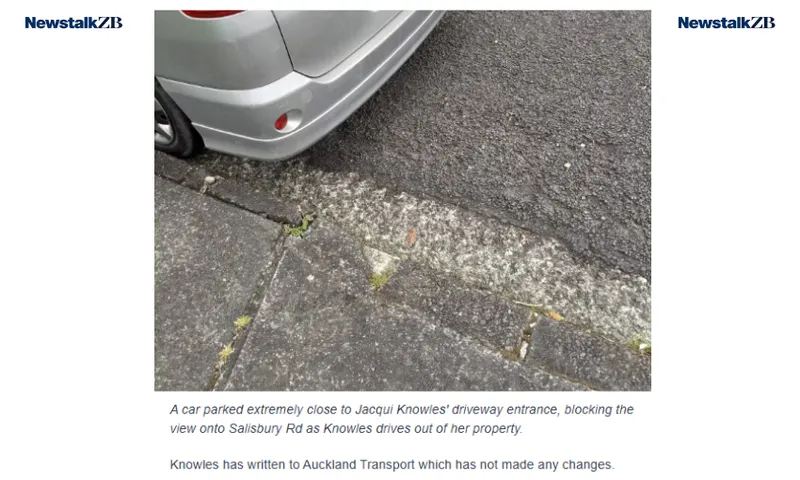
Auckland councillor Josephine Bartley has been particularly critical. After initially supporting the decision, she recently described it as “a mistake” that made some streets “dangerous for residents”.
It’s not that proponents of the policy didn’t see this coming. It’s a predictable outcome. In many cases they just think it’s preferable to the alternative, which is a housing crisis. However, the impact of the policy has been larger than expected in some areas – particularly Auckland’s outer suburbs – because it was compounded by other decisions.
New Zealand’s townhouse boom really started in 2016 when Auckland passed its Unitary Plan, enabling medium-density townhouses and apartments across the city… except in areas deemed to have “special character”, which just so happened to be most of the inner suburbs, where wealthy residents put up a fight against increased density.
The population graphs for most cities look like pyramids, with high density at the centre which gradually decreases as you get further out. Decisions in Auckland and Wellington (which also has inner-suburb character areas) have turned the cities into doughnuts, with low-density suburbia near the centre and higher density neighbourhoods jammed into the outskirts.
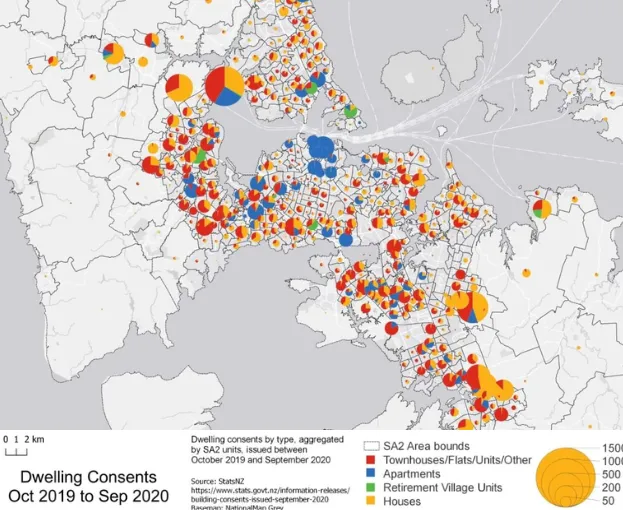
This issue will be partly addressed by Auckland’s upcoming Plan Change 120 which, even in its watered-down form, will enable higher levels of development near the city centre and around train lines. But that will do little to assuage the people who are currently mad about the cars on the street.
Of course, even if the government lifts the ban on car parking minimums, it wouldn’t automatically change anything. It would simply give councils the option. Many councils would choose to continue having no car parking minimums in order to address affordability, encourage greener living, or generate more revenue from development levies.
There are some middle-ground options too. Rather than imposing minimums citywide, they could be limited to far-flung, poorly connected areas. Auckland Council has proposed adopting lower-density rules in areas more than 10km from the city centre. These areas could also arguably be appropriate for car parking minimums.
In the long run, no solution is perfect. Whether the government brings back car parking minimums or not, New Zealand cities are going to continue to grow, there will be more cars on the street and more competition for space. We will need to have discussions about who gets to use public space to store their private vehicles.
Micro mobility advocate Oliver Bruce caused a stir in Wellington back in 2019 by arguing that residents’ parking permits needed to be more expensive to manage demand.
“If I had my way, there would be an auction system for car parks. You want to use a car park? Great. Pay what the market demands,” he told Stuff at the time.
On his blog Better Things Are Possible, Malcolm McCracken argued that New Zealand should establish “parking benefit districts”, where residents pay for parking permits but rather than the money going into the wider pool of council revenue, it is ring-fenced to be used on local improvements such as street trees, parks, playgrounds and bus shelters.
That won’t be a particularly fun conversation to have – no one likes the idea of paying extra fees for something they’re used to getting for free – but it may be necessary to ensure the continued growth of our cities without dragging development to a halt.

Joel MacManus
Joel MacManus is a senior writer for The Spinoff. He previously worked at RNZ and Stuff, and began his career at Critic Te Ārohi. His writing explores the political, economic and cultural systems that underpin modern New Zealand. He won the 2025 Voyager Media Award for Best Columnist, Opinion or Critique.


