Is New Zealand-made clothing hanging on by a thread?

How at risk is it?
Ongoing closures have rattled the New Zealand fashion industry. With skills disappearing and costs going up, what might the future look like?
Buying New Zealand-made clothes feels good. Patriotic even. Designers who produce here are explicit about it, so customers know their dollars are paying for high-quality garments and local jobs. Those come with a matching price tag, but there are cheaper alternatives too; look around your local op shop and you’ll still find tags that say “made in New Zealand”.
But that proud label is flimsier than it looks, according to some in the industry. “Everything feels quite fragile right now,” says Kate Megaw. She’s the designer and founder of Penny Sage, a fashion label based in Grey Lynn, Auckland, whose clothes are made in New Zealand. “So many brands have closed down and makers are closing their doors. It doesn’t feel very good.” While it’s never been easy to make clothing locally, she explains, it’s getting even harder to find people to make things and for businesses to absorb rising costs – both exacerbated by the shrinking manufacturing sector.
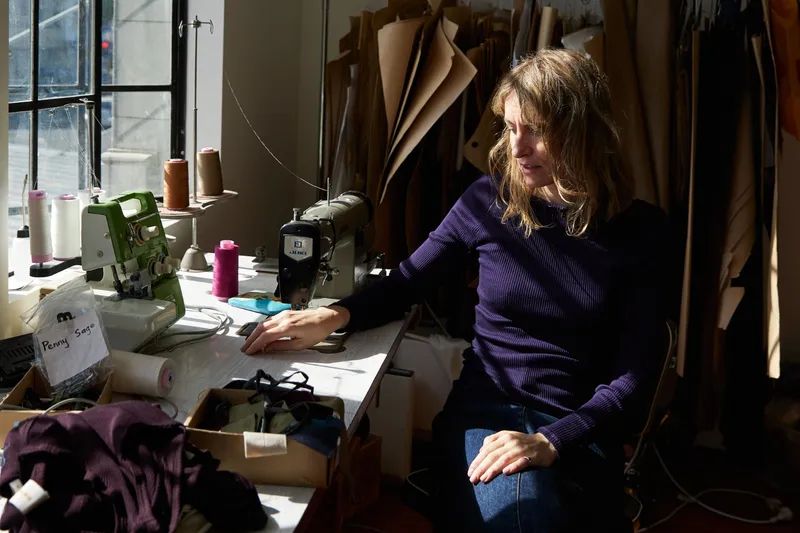
She’s not the only concerned designer. Juliette Hogan is worried that the “incredibly challenged” local industry is reaching a critical point. She describes it as “hanging on by a thread”. If one or two of the larger brands producing onshore stopped, she believes there may not be enough work left to sustain the industry’s remaining manufacturers and the brands that rely on them. “There’s no guarantee that in 20 years there is going to be a manufacturing industry here to work in.”
What it’s like to manufacture here now
A lot of hands touch something that’s made in New Zealand. Kate Megaw’s in the middle of production for her new collection and her Grey Lynn workroom is full of garments. Merino knitwear, velvet dresses and cotton trench coats are hanging behind her. She works with 20 different local businesses or contractors to get them all there. After sampling and patternmaking in house, production is spread around, most of it nearby in Auckland. There are pattern graders (who scale a pattern for different sizes) to visit, as well as cutters, production houses and machinists, finishers, washers and pressers. “I love being involved with actually making, it’s really personal,” explains Megaw. “Ultimately we are making what we think is worth making.”
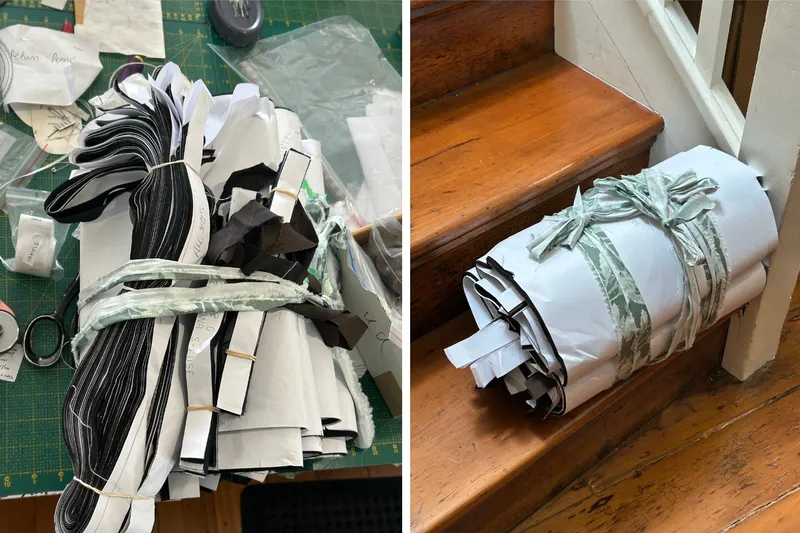
Localised production allows Penny Sage to produce small runs and be responsive; sometimes only 10 units of a special garment may be made. Relationships and access also inform the design process. “I think designers understand garments more deeply when they are involved in every stage of making them,” she explains. “The industry is full of incredibly talented and generous people who genuinely want to share their knowledge, and that exchange is really special.”
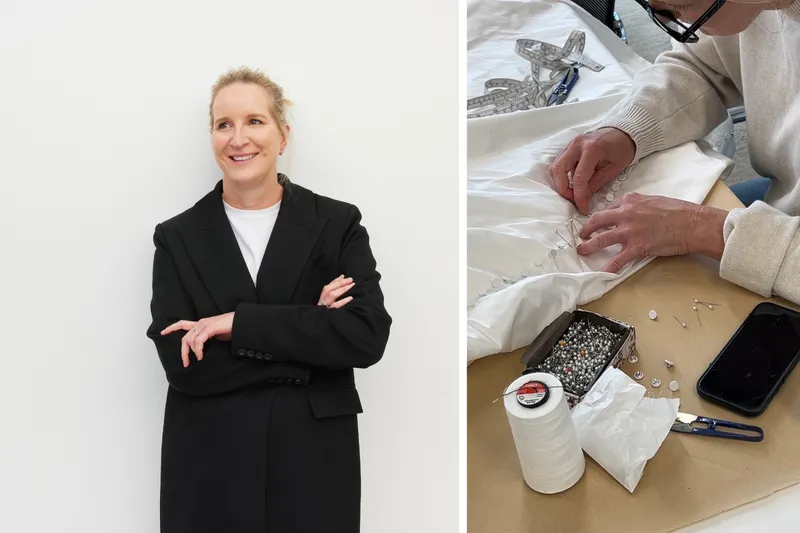
Like Penny Sage, manufacturing here allows Juliette Hogan to produce limited quantities, fast. “We can design, produce and put into store really quickly if we want to do it.” Her business is now one of the biggest local fashion producers in the country. She’s in the midst of production for the new season and working on the next one. Her headquarters in Auckland’s Avondale are busy with staff – including two in-house sample machinists – working on design, production and marketing. They’re the tip of the iceberg. “When people are purchasing Juliette Hogan, they’re not just supporting [us], they’re supporting up to 50 businesses in the background.”
‘Dropping like flies’
However, there are far fewer production businesses around than when she launched in 2004, particularly fabric suppliers. While certain Juliette Hogan items are made offshore (things that can’t be done here due to available technology or prohibitive costs), the majority of the brand’s clothing is produced locally, something Hogan’s committed to. “Would it be more financially beneficial for me to produce offshore? Quite possibly, but that’s not what I’m about.”
Most recently, factories have been “dropping like flies” again, says freelance production agent Melody Dagg. “I saw it in 2011 and now it’s like the next wave.” In the brutal wake of the global financial crisis, a number of high-volume local manufacturers shut down, shifting production overseas.
And this month, Stitch Perfect – which produced clothing for many local brands – shut down its Pakuranga factory after going into liquidation (those are at a 15-year high).
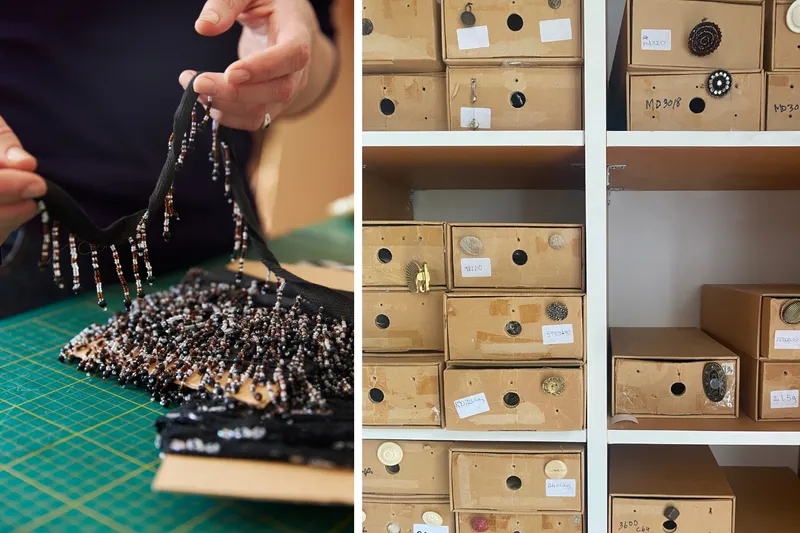
Materials are also becoming harder to get. Zips, for example, are no longer made in New Zealand since YKK shifted production offshore last year. The variety of components available – things like zips, buttons and trims – has reduced dramatically as suppliers struggle to meet minimums. Megaw says prices are poised to increase “majorly” over the next six months.
Brand closures also have a flow-on effect, meaning less work to go around. This year alone Wynn Hamlyn, Jimmy D, Rachel Mills and James Bush have all announced operational halts for various reasons. All produced goods locally.
It’s been a challenging year for the industry. Production has declined and apparel sales have too, with volumes down 7.8% on last year, according to Retail NZ.
The loss of knowledge and jobs
Outworkers (contractor machinists who work from home) are also feeling the crunch. “Because the industry is so sluggish at the moment, a lot of them aren’t working because the work isn’t there,” says Dagg, who facilitates jobs for outworkers and liaises with designers. She estimates that outworkers make up around 50% of the fashion apparel production happening in New Zealand these days. “Maybe even more, it’s very hard to tell.” Most are over 40 and the vast majority are women. Outworkers are paid per piece, rather than time. The eight to 10 she works with earn “basically” equivalent to a living wage. “The skill set needed to make these garments is not a minimum-wage skill.”
Specialty businesses disappearing has restricted what designers can do here. When a local pleating business stopped doing bulk lots it was huge blow for Juliette Hogan, who had to take that style offshore. The 2025 shutdown of a bespoke screenprinting business in Auckland impacted many brands, including Zambesi and Penny Sage. “We did stuff with them for years,” says Megaw. She was also “massively” affected by the closure of North Shore Dyers in 2021. Dyeing garments and fabric at a commercial scale is pretty much impossible now. Other than one business that specialises in protein fibres like silk, she doesn’t know of anyone still doing it.
What next
Hogan says it’s “significantly” more expensive to produce clothing in New Zealand now compared to a decade ago. While there are pockets of manufacturers and specialists left, the sector is fragmented, according to Fashion & Textiles New Zealand (Hogan is a founding member and chairs the board).
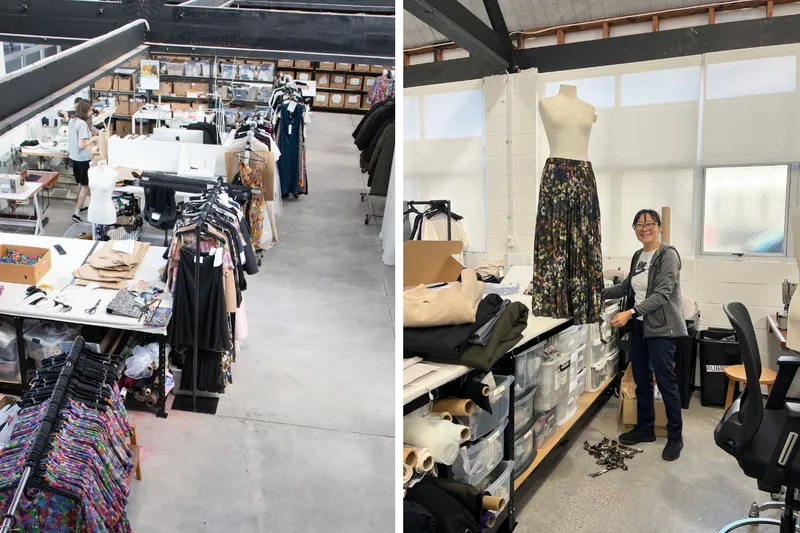
The group’s chief executive Jacinta FitzGerald warns there’s a “critical risk” of losing the skills needed to produce clothing and textiles locally. “Manufacturing locally requires the full ecosystem of skills, and when parts of that system disappear it becomes harder for brands to produce here even if they wanted to.” If one link in the chain disappeared everyone would feel it. Losing the handful of remaining cutters would, for example, affect the whole chain of production. Workforce succession planning is urgently needed if the industry is to survive, she explains; retiring workers aren’t being replaced and training programmes are limited or non-existent.
FitzGerald thinks that rather than trying to compete with offshore manufacturing, New Zealand should instead focus on things like quality, flexibility, transparency, provenance and innovation. “Areas we know we can compete in.” She believes investment is needed in future skills, like advanced manufacturing, digital enabled technical skills, repair and remanufacturing skills. FTNZ is currently working with EY on a strategy for the future of apparel and textile manufacturing here. “It’s not about recreating what we used to have,” explains FitzGerald. “It’s about building a future-fit manufacturing ecosystem.” It will be presented at the group’s Threads of Tomorrow Summit in June, attended by industry stakeholders and economic growth minister Nicola Willis. (FTNZ has received no government funding to date.)
Dagg hopes New Zealand’s “underground” network of small operators can keep going. But she paints a dystopian picture of an AI-fuelled future, predicting automated factories run by multinational companies making generic, replaceable clothing for a low price offshore. “If we don’t hold on to our manufacturing methods and skill sets, then that’s going to be our only option.”
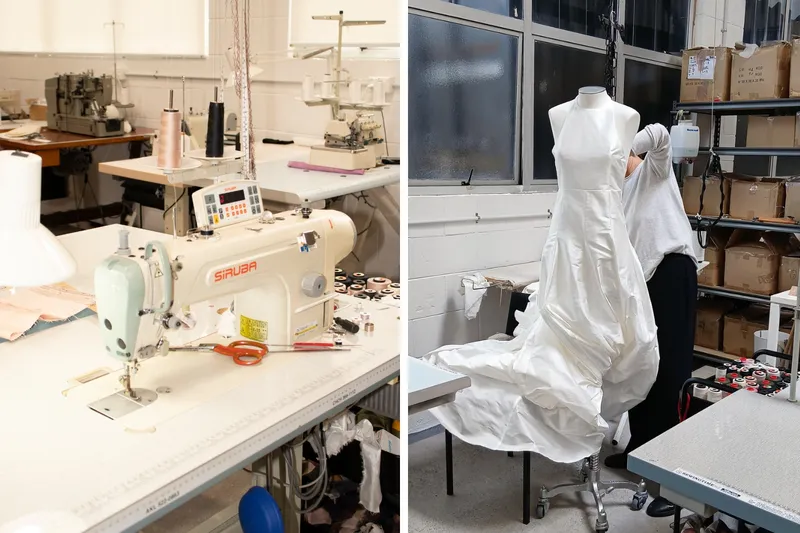
Hogan hopes to see training address the challenges of an ageing workforce. She also thinks procurement commitments by the government for the police or the defence force (something the US has had since 1941) would also help the sector.
Above all, Hogan wants to see investment in technology – modern machinery that can perform complicated production steps efficiently – which could help New Zealand compete with offshore manufacturers and retain some production on shore. That’s the best case scenario looking ahead five or 10 years, she predicts. The worst is that we lose the ability to produce clothes in New Zealand entirely. Right now local manufacturing is “definitely” close to the edge, and Hogan “lives in hope that we are not in a death spiral”. She stresses that New Zealand fashion reflects a national identity and we can’t lose the ability to design and make clothes here. “I care about this industry and I want to see it succeed. The way it’s going to succeed is if people support New Zealand businesses.”

Emma Gleason
Emma Gleason is a staff writer at The Spinoff and an award-winning fashion journalist. But it’s not just clothes that interest her, you’ll find her exploring tasty cheese, influenza outbreaks and more important things right here. She has experience with some of the country’s leading media outlets as well as the toaster in our kitchen.


