Not an election-year budget? Sure it was

Nicola Willis had words for coalition pals David Seymour and Winston Peters in unveiling the budget. Design: Tina Tiller
For all the anti-sugar talk, there were some granules deployed. The great coalition differentiation continued. And the volatile world kept rearing up.
A tough few days out there for candy rabbits crouched in headwear. References to sugar, lolly scrambles and rabbits in hats – or, specifically, assurances that these would not be found in yesterday’s budget – were everywhere.
So rampant was the cliche inflation, it was tempting to wonder whether Nicola Willis might be bluffing, under-promising only to over-deliver on budget day, scattering the election-year spoils. Nope. The watchwords rolled out yesterday were restraint, resilience, repair, recovery, responsibility; more Rs than a Southland hostelry.
It was all enough that the finance minister could deliver the news that New Zealand was on track to return to budget surplus in 2028-29, the first time out of the red ink for a decade, and a year earlier than last forecast.
Most of the savings had been spelled out well in advance. The public service has been instructed to shrink its headcount by 8,700. The rules for claiming accommodation support have been tightened, though not the state housing subsidies for politicians.
Other cuts were revealed earlier than intended, with one insider declaring three weeks ago on Newstalk ZB, “I’ll give you a budget leak right here, right now.” That leaker of secret information was, of course, Winston Peters, announcing on the fly that the fees-free year of tertiary study would be scrapped.
There was no lolly scramble. (And just as well: according to the official Spinoff history, this “chaotic ritual” is best understood as an activity in which “an adult releases a large amount of lollies into the air and a group of children go absolutely feral trying to pick up as many as they can.”)
But there were, let’s say, some judiciously apportioned parcels of confectionery. Some serious infrastructure investment, headed by a sweet $1.8bn to lengthen the Waikato Expressway. More than a billion for KiwiRail projects. A decent wad for education, including cash for high school students in trade training. More for defence. A handy $450m in the back pocket if needed for the fuel crisis. Extensions to postnatal care and bowel screening. There were cuts in many patches, and boosts in others. Or, if you’ll forgive me one final torture of this imagery, it wasn’t quite the myxomatosis budget.
Health saw the biggest boost on the day, with $5.8bn of new spending across four years. That is at once a large and insufficient number for a system creaking at the joints.
In the Ipsos Issues Monitor published this week, health was the second greatest concern to New Zealanders, after cost of living. Some 39% name it as a top issue, compared to 32% three years ago. It’s the biggest issue of all for older New Zealanders, with 60% of those 65 and over naming healthcare and hospitals as a top concern; 38% of respondents consider Labour best placed to respond to the issue, well ahead of National on 25%.
An editorial in the latest NZ Medical Journal, published this morning, points, to take one of many examples, to uneven, poorly measured and under-resourced trauma care across the country. In Christchurch, the authors write, the trauma facility is “a service under critical strain”, facing “alarming lack of medical resourcing” and “inadequate clinical staffing”.
An election beckons
If the mood of prudence ruled the day, this was an election-year budget in other ways.
The pre-budget photo-op saw David Seymour and Shane Jones squeeze into the frame, representing their coalition parties alongside Willis and Chris Bishop. The four of them proceeded to chomp down for a pastry lunch about as comfortably as an estranged family at Christmas.
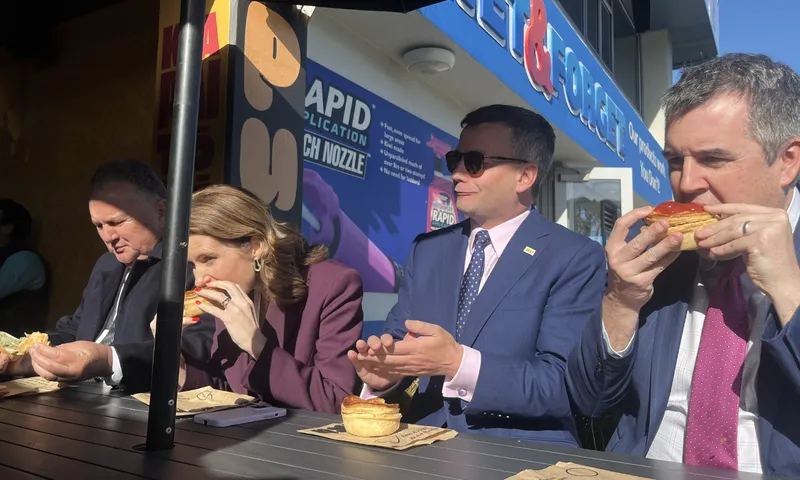
Seymour was quick to trumpet his party’s role in the budget, in demanding “the hard calls needed to restore discipline to Wellington”. It was the Act leader’s budget shorthand that stuck more than most – he’d dubbed it the “tough love budget”, a memorable, if somewhat illiberally paternalistic way of looking at it.
Peters, who has lifelong immunity to many political conventions, just came out and told reporters before the budget that he was a winner. Unlike the rest, Foreign Affairs had evaded the scalpel. Racing “is going to look great”. And rail, too, was “going to look great”, he said. It was only a surprise he didn’t add that the trains, unlike many areas, had met Christopher Luxon’s ambition to get back on track. He did say, “So three out of three ain’t bad.”
Willis, for her part, was keen to continue the fierce intra-coalition crossfire that followed Christopher Luxon calling a caucus vote in his own leadership. She made it very clear that the huge superannuation line in the budget was about to bloat even further in an ageing population, saying, “Parties who say they won’t do anything about it are prepared to rob everyone in this country under the age of 50 for their own political expediency.” That was aimed in part at Labour, but just as much at New Zealand First, whose deputy, Shane Jones, stood alongside the finance minister as she spoke, contorting his jaw.
Act got a shot across its own bow, albeit a gentler one. In announcing a levy on the banks, to pay for the institutions that provide their regulation, Willis acknowledged she’d have liked to have applied a deeper, wider levy, but “I haven’t been able to convince my coalition partners yet,” as a thought bubble of David Seymour surfaced above.
As for Labour, the stopwatch has begun for a substantial policy response. Every effort will be met with the challenge: we’ve brought the surplus forward. Are you pushing it back? It’s a fair bit of pressure. The strategy of saying as little as possible has had its boldest vindication in the last few days, when people heard what they were saying.
An insecure world and jam tomorrow
One year ago, we were inundated with “The Growth Budget”, a branding which accompanied every release and every speech. That was probably not the best choice of strapline. This time? “Securing New Zealand’s Future.”
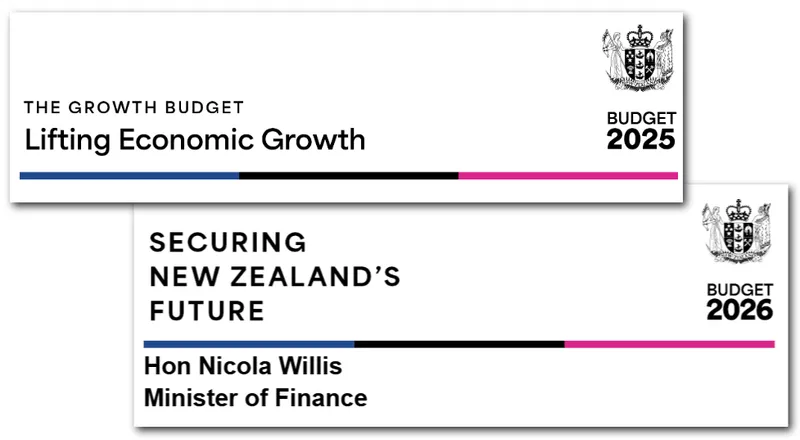
It’s no easy needle to thread. In the volatile world where Donald Trump looms everywhere, the message must switch to: We are doing what we can but we cannot stop the waves of the ocean. “I don’t have it within my power to sort out the dispute between the ayatollahs and Donald Trump,” Willis said last night. “What I can do is make really good choices about how I invest your money.”
The prime minister had laid it out a couple of weeks earlier in an address that caught many by surprise. After all, who would have suspected he’d deliver the best speech of his premiership in a workaday pre-budget appointment with a business audience? In that speech (titled “Securing New Zealand’s future in a more volatile world”) he wrapped together global, national and economic security, he alighted on “inflection points in history”, and he laid out the gravity of the geopolitical moment, while offering an ameliorating, even Ardernistic commitment to remaining “relentlessly optimistic”.
Optimism is a powerful currency in politics, especially in an election year. Some of that mood flows through into Treasury’s upbeat view of the years to come. Based on an assumption that “oil prices will evolve in line with prices in the oil futures market”, it reckoned the downstream disruption from a double-blockaded Strait of Hormuz would subside sooner rather than later, forecasting growth in the economy averaging 2.7% across the next four years.
Gazing into the future is an unenviable task, especially with so many parts of the world in flames. But these are the prognostications upon which the government’s plans are built, not least the floodlit headline of a return to surplus three years from now.
In case the fragility of all that needed any underlining, just as the budget statement was being delivered in parliament yesterday, reports were rolling in on the wires. For the second time in a few days, a precarious ceasefire was being tested, with a fresh exchange of missile and drone strikes in and out of Iran.

Toby Manhire
Toby Manhire is editor-at-large at The Spinoff. He loves to cast a pod, whether it's Gone By Lunchtime, At Large or Juggernaut. He is a former editor of The Spinoff and has worked as a journalist in NZ and the UK since the last millennium.


