
An urban legend says New Zealand’s first ever batch of locally-produced honey was presented to William Hobson at the treaty signing in Hokianga. Is it true?
The mānuka honey revolution began in 1981 when Dr Peter Molan, a researcher at the University of Waikato, discovered the honey has unique antibacterial properties from the compound methylglyoxal. In the years since, it has become a trendy health food adored by influencers and celebrities, and the most expensive honey on earth.
The New Zealand mānuka honey industry has a plethora of certifications and trademarks which serve to protect the $400m export industry. However, the dirty little secret about mānuka honey is that it’s not unique to New Zealand. None of New Zealand’s 27 species of native bees produce honey and the mānuka plant is also found in south-east Australia. European species of honeybees, which allowed commercial-level production, were introduced to Australia several years before they made it to Aotearoa.
Strengthening New Zealand’s brand connection to mānuka honey is an ongoing quest. There’s one story from history that would go a long way toward embedding it in our national identity. It’s more of a loose theory, first proposed by Cliff Van Eaton in his book ‘Mānuka: The Biography of an Extraordinary Honey’ and explored further by historian and beekeeper Peter Barrett.
The story goes that the first batch of honey ever made in New Zealand – and therefore the first honey that could have contained pollen from New Zealand mānuka – was served to guests at the second and largest signing ceremony for the Treaty of Waitangi, held at Māngungu, Hokianga, on February 12, 1840.
If proven, it would tie one of New Zealand’s most valuable export products to the founding of the nation itself. The marketing potential is huge. So could it be true? Let’s look at the evidence.
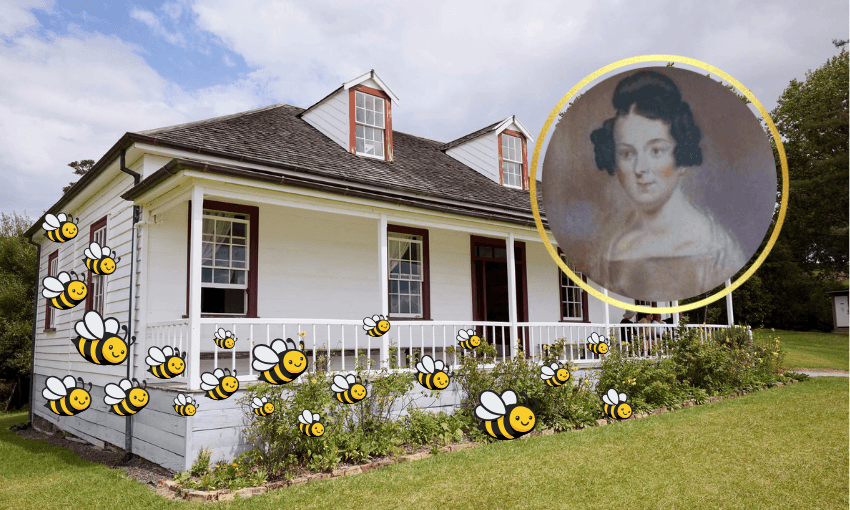
The first honeybees to arrive in Aotearoa were two straw hives of European dark bees. The person who brought them was 27-year-old Mary Bumby from Yorkshire, who is widely regarded as the mother of beekeeping in New Zealand. She landed at the Māngungu mission station in Hokianga on March 19, 1839.

Mary’s brother, John Bumby, was a Wesleyan missionary who had been appointed superintendent of the mission in New Zealand. Mary agreed to come along and support the mission as housekeeper. It was no small sacrifice. In her diary, she wrote about the sorrow of leaving home: “How painful it is to part with friends so dear to us with a prospect never to meet again in this world.” When she saw their ship, she said it was “rather small” and made her “feel very dull with the prospect of a five-month voyage in such a prison”.
It was a difficult passage. She repeatedly complained of “very rough and disagreeable” weather and was constantly sick from the turbulence. When crossing through the Tropic of Cancer she wrote that it was “exceedingly hot and oppressive” and that “we are almost suffocated in the night whilst in the day we are burnt beneath a parching sun”. A bunch of bees buzzing around would have made the experience even worse, but there is no mention of them in anyone’s notes from the voyage. It’s likely that Mary acquired the beehives during a stopover in Hobart, Tasmania.
Upon seeing Hokianga after 184 days at sea, Mary’s mood lifted: “The weather was very fine and we thought the scenery most beautiful,” she wrote. The Māngungu mission, which sits about 25km down the Hokianga harbour, had been established 12 years earlier and was home to a small handful of missionary families. On Sundays, as many as 500 Māori would gather for church service. During the week, missionaries ran schools and developed productive gardens with the help of Māori workers. Mary kept the bees in a “garden at the back of the Mission House,” according to a diary entry by Reverend William Woon.

On February 11, 1840, the mission station had a special guest: captain William Hobson, who had just been appointed the lieutenant-governor of New Zealand. Five days earlier, in the Bay of Islands, he had completed the first signing ceremony for the Treaty of Waitangi. He brought a party of other British officials, missionaries, and armed guards. Around 3,000 Māori from the surrounding bays gathered at the mission station, and 64 rangatira signed the treaty. Afterwards, there was a great feast at nearby Hōreke.
John Bumby was away in Australia when this happened, so the responsibility for hosting fell to Mary. She arranged sleeping quarters in the mission house for Hobson’s party and oversaw dinner services.
Felton Mathew, who would become New Zealand’s first surveyor-general, was part of this contingent. He wrote that Mary was “a very plump and a very nice, good-tempered girl, rejoicing in the unfortunate name of ‘Bumby’. Nothing could possibly exceed the kindness and attention we received from her, and indeed from all of them, and that, too, under circumstances very trying to a lady’s patience.”
Neither Mary nor any of the guests wrote anything about honey in their diaries. In fact, the bees are barely mentioned by any of the missionaries from Māngungu.

However, they made a significant impression on one person: Marianne Hobbs, the nine-year-old daughter of a missionary couple, who later became a successful apiarist and mead brewer. In an article for the British Bee Journal, published in 1897 when she was 67, she recalled being taken to see the bees shortly after they arrived. “We tasted for the first time in our lives real honey in the comb, which Miss Bumby kindly sent to us, knowing our interest in her bees,” she wrote.
An important caveat about the makeup of the honey: although mānuka was plentiful in the area we can’t know for sure what pollen sources the bees drew from. Hobbs wrote that she specifically remembered the bees “working on the clover” and “busy on the peach blossoms” so it was at best a multifloral honey that may have contained some portion of mānuka.
We also don’t know if Bumby’s honey would have been ready by the time Hobson arrived. The first confirmed mention of a honey harvest at the mission is from May 8, 1840. In his diary, Reverend William Woon wrote a brief anecdote about two missionaries visiting the hives who “found a little maiden honey” which they began collecting in a plate.

That doesn’t necessarily mean this was the first honey anyone harvested from the hives. By the time of Hobson’s visit in February, 1840, the bees would have had time to rebuild their honey stores from winter, filling up on the various flowers available. The hives may not have been ready to be fully harvested, but there likely would have been enough honey to draw a small sample. It would have been a suitable gift to present to a visiting dignitary, and one which highlighted the agricultural success of the mission.
We may never know for sure whether Mary Bumby served her honey to William Hobson during the second treaty signing. But we can say that she had the means, motive, and the opportunity. Mānuka honey may not be native to New Zealand, but there’s every chance it played a role in a crucial part of the nation’s history.