Jolly Roger: Farewell to a Waiheke legend

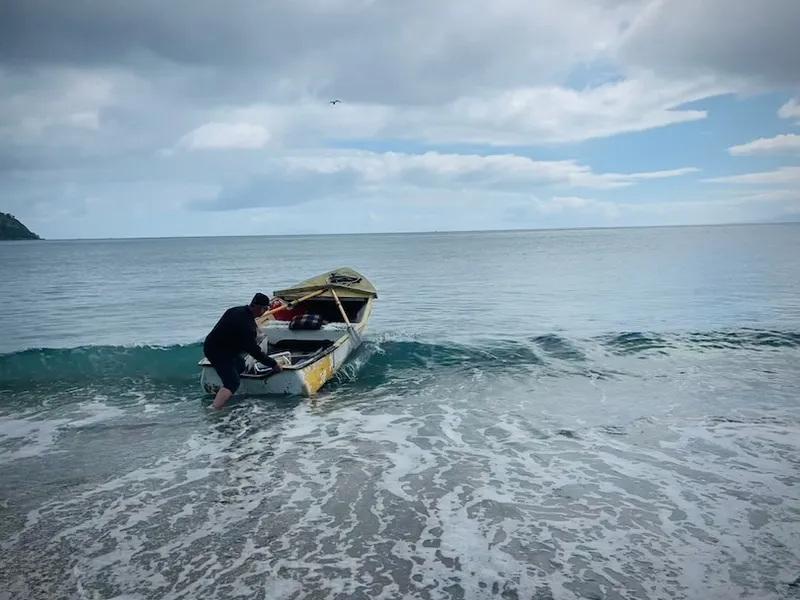
Roger Reardon on Onetangi Beach with his trusty dinghy (Photo: Jenny Nicholls)
Roger Reardon, who died earlier this month, represented the last vestiges of Waiheke Island as a sanctuary for hippies, eccentrics and those less fortunate. Julie Hill talked to some of those who knew him.
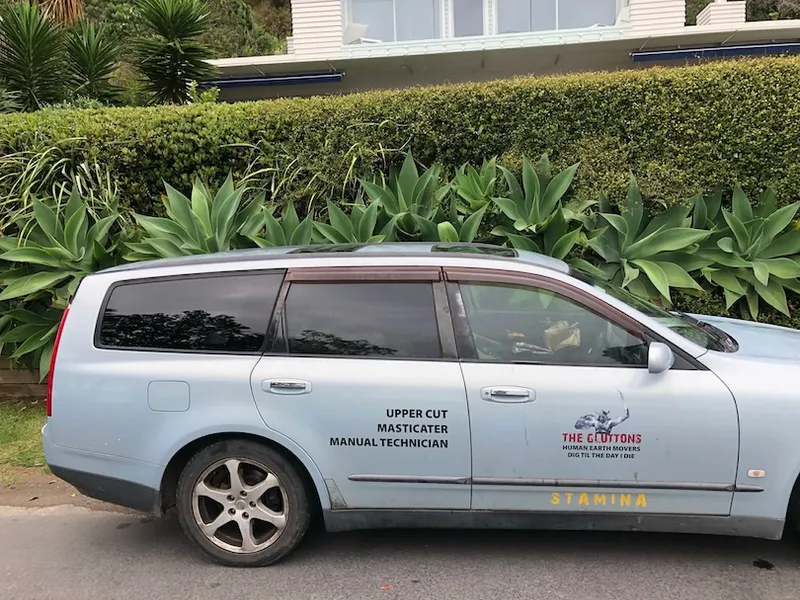
“Hard case”, “mad bastard”, “tough fucker” and “ratbag poet” are among hundreds of comments on social media about Waiheke Island legend Roger Reardon, who up until recently lived in his car on the doorstep of multimillion-dollar holiday homes including the prime minister’s, and who died earlier this month.
The life and death of the 61-year-old labourer, fisher, artist, writer and musician are emblematic of an island where obscenely priced mansions are barely lived in, yet homelessness is among the highest in the country.
A “human earth mover”, Reardon can be seen on his YouTube channel, Gluttons from the Deep, sinking beer while felling trees with a chainsaw and tearing up buildings with an axe, to a soundtrack of squealing guitar riffs.
Local Paul Stokes worked alongside him as a labourer and recalls him using a spade made out of a grader blade to dig through rock. “He was a real hard man, what they used to call a diamond geezer. There was no way you could fit another callous on his hands. But nobody understood his depth.”
Stokes lived with his “guru”, an elderly woman named Shirley Gillespie. “One day Roger was working next door, hard as, and Shirley said, ‘Take that man some scones and a cup of tea.’ She said, ‘That man has a good heart.’ Because the exterior appeared tough but you’re often that way when you’re a vulnerable child. I told him what she said and he welled up.”
Reardon would often talk to Stokes about his hero, the US boxer Rocky Marciano, who held the world heavyweight championship from 1952 to 1956. “He never went down, he never lost. Every fight he had, he won. And I said, ‘That’s like you, Rog.’”
A fixture at Onetangi Beach, Reardon would go fishing in steel-capped boots then give away his entire catch. He once rowed his clapped-out dinghy, Smelly Nelly, 160km from Waiheke to Mayor Island to raise money for the Westpac helicopter, crucial in a community with no hospital.
Craig Kinney met Reardon at a boozy party on the island in the 1980s. “I grabbed some food with my fingers and he said [Kinney mimics Reardon’s gravelly voice], “You dirty, filthy bastard! Never do that again!” Kinney ran a print and design business, and helped Reardon publish his two-part autobiography Hard Yards and illustrated children’s stories Beer Belly, Grumpy Stumpy and Colly Flower Ears.
Kinney feels “partly to blame” for Reardon’s musical oeuvre after complimenting him on his poems and suggesting they could be put to music. “I organised it all and I got my friend to write this quite good music for it. We released it, and everybody loved it, because the words were kind of risqué, like ‘dirty Bertie’ having a ‘smelly blerty’. But then it all went to his head, you see. And he started on this journey of doing more and more and more.” Reardon ended up recording 14 albums featuring delightfully deranged spoken-word odes to hard graft, feijoas and an unrequited crush.
Reardon sold his house on Kennedy Point Road to fund expensive recording studios, music videos and jam sessions with professional musicians. Earlier this year, he won $17,000 on Lotto, which he spent on making a double album of 46 songs. “He was always on a mission to do creative stuff and he had an incredible drive just to keep pushing.”
For Kinney, he represents the last vestiges of a sanctuary for hippies, eccentrics and those less fortunate. “Back in the day, Winz would virtually tell people, solo mothers, ‘You should move to Waiheke, there’s cheap rent there.’ You used to be able to rent a bach for $30 a week.”
A few residents still live on wrecked boats on the causeway but the island has moved on. “A cheap bach on Waiheke now is $600 a week and it’s not really healthy homes standard, and they’ll probably throw you out in eight months’ time. So poor people have to move over and over again.” The island’s police, he says, are inundated with crimes related to meth use and domestic violence.
His comments echo a 2024 report by Auckland University professor Robin Kearns and researcher Pam Oliver, which says that homelessness on Waiheke is the highest per capita in the Auckland region. “And it is not due to poverty or unemployment; it is a direct result of overtourism, as Waiheke homes have been bought up by absentee owners seeking capital gain and rented for short-stay.
“Over the past 10 years, Waiheke locals have been forced increasingly to live in cars, damp caravans, or share overcrowded houses, just to remain where they’ve lived for decades.”
In 2023, Reardon featured in the documentary Underneath Waiheke Island, which contrasts the island’s curated image for tourists with the hardship that lies beneath. Co-director Matt Earle was immediately taken by him. “I just had no idea what I was in for. I came back and said to my mates, ‘I just found the most interesting and hilarious character I’ve ever met.’”
By then, Reardon had suffered three hernias and a heart attack, and the struggle to survive was painfully evident. Sitting in his boat, he points out the mansions on the hill, many of whose foundations he laid himself. “Everyone’s got their big flash houses,” he tells the filmmakers. “I’m busting my guts out and I haven’t got anything. I look up there and say you fucking rich cunts, I’ve worked harder than any of you. I worked for 25 years smashing rock.”
Earle went on to help Reardon with his prolific social media output. He deserved to be famous, Earle says, but maybe not for the reason he thought. In one video, Reardon catches a kahawai then kills it by biting its head off. “He has blood all over his face and he says, ‘That’s how you kill a fish!’ We put it on TikTok and it got a million views.” In another, he rails against an opinion piece by David Farrier arguing Waiheke is “over-rated” before conceding, “I don’t mean to be rude. He’s probably got a point.”
Earle says Reardon had big dreams. “He wanted to make millions and live in a house on the hill. He was going to put his car that he lived in in a big pool, as a reminder of what it used to be like, and have all these women around.” He insisted on hiring models to be in his videos and bouncers to be at his gigs, even when there were only 20 people in the audience.
The real story, Earle reckons, is that Reardon got himself into debt and didn’t handle it very well. But he was a man of contradictions. “He would happily pay people stupid amounts of money on his music yet he was living in his car. He dedicated everything to hitting the big time. He’d always say ‘I’ve got to win the battle then I’ll get all the rewards.’ I don’t know if he won the battle, but he tried pretty hard.”
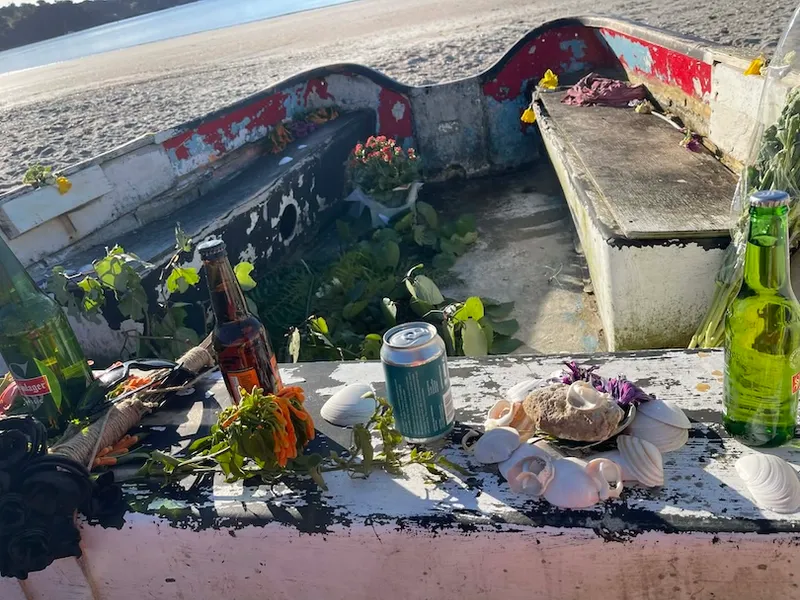
Reardon’s boat, bedecked with flowers and cans of beer, sits on The Strand at Onetangi. Locals are calling for it to be put in a museum.