
The Indian prime minister’s 24-hour Auckland trip produced a strategic partnership and a Spark Arena rally that shook the walls – but the $35bn investment at the heart of the free trade agreement remains in dispute, writes Henry Oliver in today’s excerpt from The Bulletin.
To receive The Bulletin in full each weekday, sign up here.
Indian Prime Minister Narendra Modi landed in Auckland on Friday night for a 24-hour visit – the first by an Indian head of government in 40 years and the most significant state visit New Zealand has hosted in years. It came three months after the two countries signed a free trade agreement, perhaps the crowning diplomatic achievement of Christopher Luxon’s prime ministership, and culminated in the two leaders announcing an elevation of the bilateral relationship to a “strategic partnership”.
The centrepiece of that partnership is a ‘Roadmap to 2030’ containing 43 agreed actions, including a goal of doubling two-way trade, closer naval and counterterrorism cooperation, an annual maritime security dialogue, and encouragement of direct flights. RNZ’s Gaurav Sharma reported that Modi broke protocol by being welcomed at the airport by Luxon himself – a gesture Modi said had “deeply touched” him. Notably, foreign affairs minister Winston Peters, a vocal critic of the agreement, was out of the country for the duration of the visit. Only National Party ministers were present at bilateral meetings.
The $35bn question
The unresolved tension at the heart of the visit – as it has been since the FTA was signed – is whether New Zealand has committed to US$20bn ($35bn) in investment in India over 15 years, or merely to “promoting and encouraging” such investment. According to reports by The Spinoff and RNZ, Modi referenced the figure as a “firm commitment” at least three times on Saturday, including at a business event at the Viaduct Events Centre where Amul managing director Jayen Mehta, who led the Indian business delegation, said New Zealand had “promised” the investment.
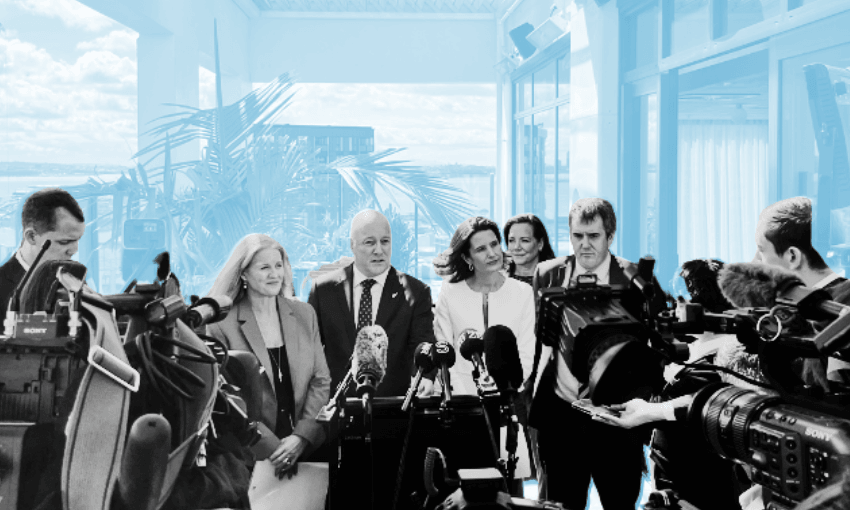
Luxon continued to push back, telling reporters it was “very clearly understood on both sides” that the clause was a commitment to promote investment, not a guaranteed transfer of funds. Labour leader Chris Hipkins, who met Modi on Saturday evening and welcomed the strategic partnership, told RNZ the investment clause represented a “long-standing discrepancy” that needed to be resolved.
Counterterrorism and cows
Among the more substantive outcomes of the visit was the establishment of a joint working group on counterterrorism, an issue with particular sensitivity given Modi’s previous complaints to Luxon about “anti-India activities” in New Zealand, understood to refer to a non-binding Khalistan referendum held at Aotea Square in November 2024. The working group aims to disrupt terrorism financing and dismantle infrastructure, but RNZ noted the two countries still appear to hold different interpretations of what constitutes terrorism.
Dairy, as ever, was the elephant in the room: the FTA secures no significant access for New Zealand into India’s highly protected market. The Post’s Amelia Wade reported that Fonterra – another conspicuous absence – sent no representative to the event, while India’s Amul, which holds a 75% share of the Indian dairy market and counts 3.6m farmers as members, led the Indian business side. BusinessDesk’s Dileepa Fonseka reported that a memorandum of cooperation on animal husbandry was agreed, with India suggesting New Zealand could export agricultural knowledge and technology rather than product.
‘Beautiful chaos’
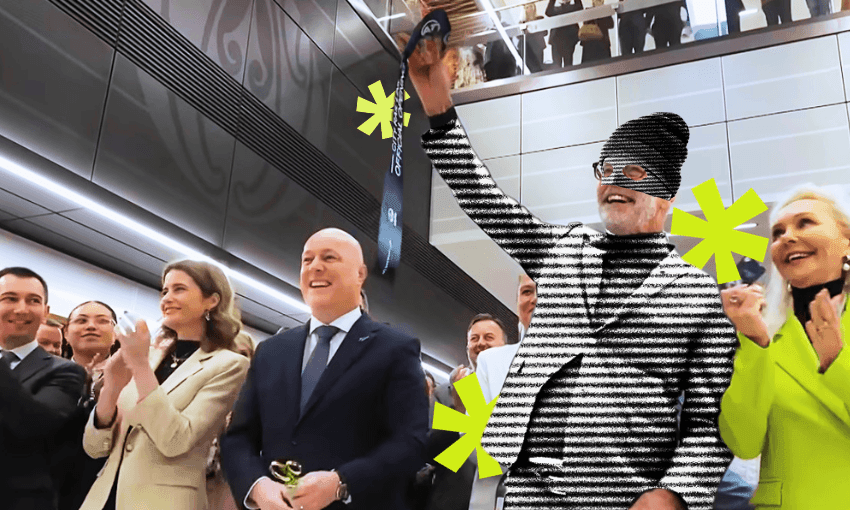
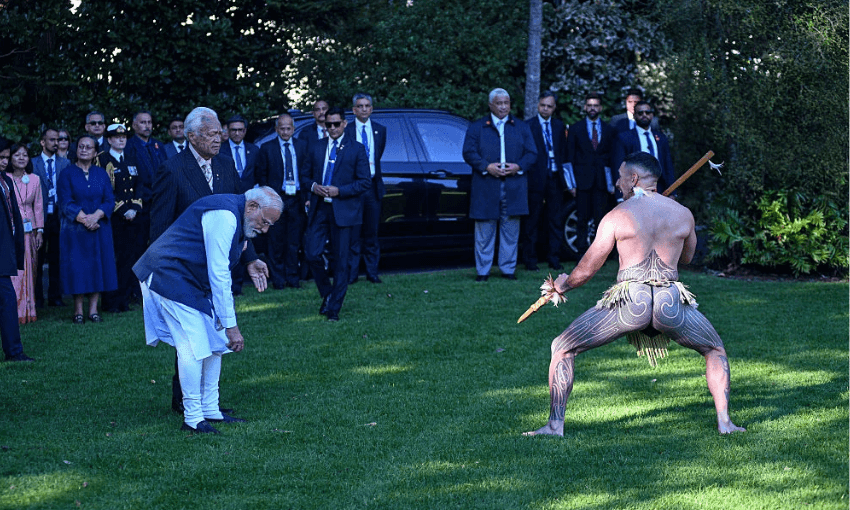
Today on The Spinoff, Joel MacManus recounts his entire days following the visit around Auckland in what one Indian-New Zealander described to him as “beautiful chaos”. At Government House, Modi was offered a carved wooden token as part of the pōwhiri. Modi faced the challenge, picked up the token, clutched it to his chest – then almost immediately handed it to an assistant.
At the Viaduct business event, some of the most powerful executives in both countries stood on stage for a photo op, then remained standing for 29 minutes as they waited for the prime ministers to arrive. Defence minister Mark Mitchell, asked how the lunch was, offered a pointed assessment – “it was vegetarian” – and walked away.
At Spark Arena, more than 10,000 members of the New Zealand-Indian community packed the venue. Modi delivered 45 minutes of oratory – entirely in Hindi, without translation – conducting the crowd through applause, laughter and a deafening call-and-response chant. MacManus noted he understood only scattered words: “Rachin Ravindra … All Blacks, rugby … the moon … mānuka honey … kaitiakitanga … fastest-growing major economy on earth … drone technology, Sikh community, New Zealand economy, guarantee, thank you.” Luxon and Modi held hands as they waved to the crowd. It may, MacManus wrote, have been the defining image of Luxon’s prime ministership.