Where will the tourists go when the glaciers disappear?

Haupapa/Tasman Lake didn’t exist before the glacier began retreating (Image: The Spinoff/Getty)
New Zealand’s glaciers are vital water sources and attract hundreds of thousands of tourists, but a new study shows that most could be gone by the end of the century.
New Zealand has more than 3,000 glaciers – and under the worst-case scenarios of global warming, only 100 will be left by 2100, according to a new global analysis published in the Nature Climate Change journal.
“A lot of previous studies have looked at the surface area of glaciers, or the actual mass or volume of ice lost, but not included information on glaciers actually disappearing,” says Heather Purdie, a glaciologist at the University of Canterbury. The new study models glacier loss under different climate change scenarios: 1.5, 2.0, 2.7 and 4 degrees Celsius of warming. Under each of these conditions, how many glaciers in Aotearoa would remain?
What’s clear is that every fraction of a degree of warming makes a difference, Purdie says. At the moment, the climate commitments of countries around the world have set the planet on a path closer to 2.7 degrees warming, not the 1.5 aimed for under the Paris Agreement. “At 2.7, we lose twice as many glaciers as 1.5 degrees. Even 2 degrees of warming will save 1,500 glaciers,” Purdie says.
Small glaciers are particularly vulnerable. These aren’t the valley-filling glaciers tourists travel thousands of kilometres to see, but little patches on the sides of mountains, fed by smaller basins of snow. Many are unnamed, and some have disappeared already. Purdie is part of a long-term project monitoring Rolleston Glacier in Arthur’s Pass, which began in 2010.
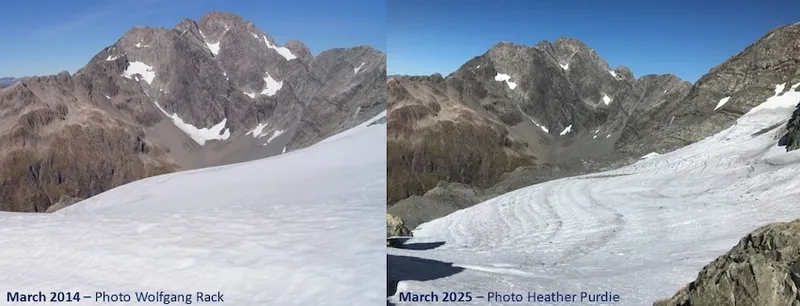
“When we first started monitoring it, the glacier was a kind of fat, convex, bulging surface – we had to climb up onto it from the rocky col [pass],” she says. As a glacier melts, it doesn’t just get shorter, it also loses thickness. Fifteen years later, the Rolleston Glacier looks totally different. “It looks really sunken and thin.” Instead of climbing onto it, they have to clamber down – and with less snow to feed it, more rocks gather on the surface, so the glacier is dirtier and reflects less sunlight, also accelerating the melting.
Most glaciers aren’t monitored as closely as the Rolleston Glacier, but this process is happening throughout New Zealand’s Southern Alps. “They go from white and shiny and healthy, to really skinny and dirty and sad,” Purdie says. Melting glaciers completely change the ecosystem, as ice is replaced by bare rock or scree. A river which runs in summer, fed by glacier melt, would have significantly less flow, for example.
New Zealand’s glaciers are huge tourist drawcards; hundreds of thousands of people visit Franz Josef and Fox Glaciers each year, while many others admire the glaciers dotting Aoraki and its surrounding mountains. Some of these tourists pay for helicopter flights and guides, so they can experience the crunch of ice under their crampons, the thrill of being on a moving river of ice.
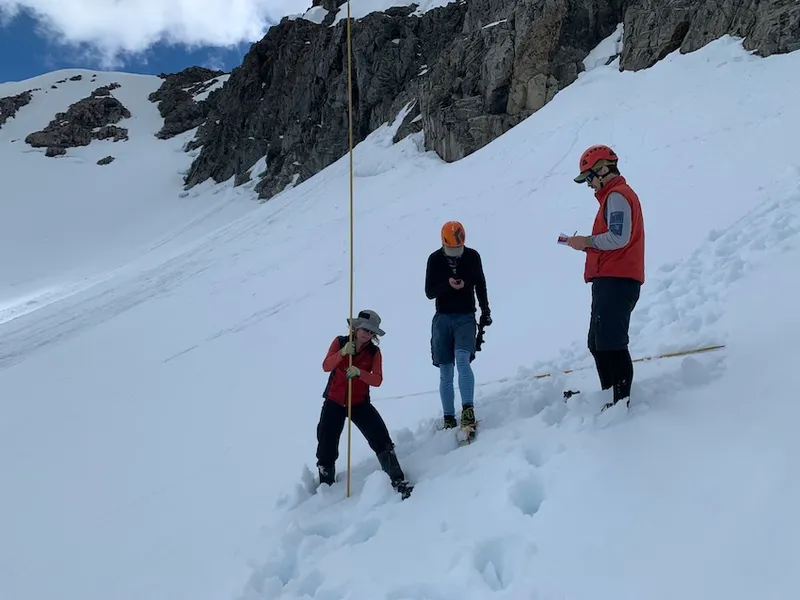
Tourism on the glaciers contributes to science, and many glacier-related businesses are concerned about the melting. Purdie has a GPS on the Fox Glacier, for example, which monitors how fast the ice is flowing. Passing it regularly are the glacier guides, who maintain and check the equipment for her. “They do lots of interpretation to visitors about climate change,” she says. A group of her students also worked with DOC on updating information boards to show how much the glaciers have retreated, and how fast.
Living in Hokitika, Renee Cadigan sees the thousands of people who come to get close to the ice. “Everyone knows we’re on borrowed time,” she says. Since she first saw the Franz Josef Glacier 12 years ago, it’s lost more than a kilometre of length. Regular visits make the changes clear – but tourists who just visited once only see a snapshot, not the change over time.
“People need to see it and understand it, the impact of what we do in our day-to-day life,” she says. “But the reason it’s accessible is all the people driving to see it, all the helicopters – and that isn’t the greatest thing for the glaciers.” How can a balance exist between the need for people to see these places where the damage of climate change is etched so clearly, and the further damage caused by going to look at it?
The irony isn’t lost on Ivan Andrews, a member of Climate Liberation Aotearoa (CLA). The group has a campaign focused on opposing heli-tourism as unnecessary luxury emissions. “Huge amounts of CO₂ are released for a short experience for rich people,” he says. “It’s one of the most egregious ways our economy focuses on low-margin, low–benefit, high-carbon activities at the cost of people and the environment.”
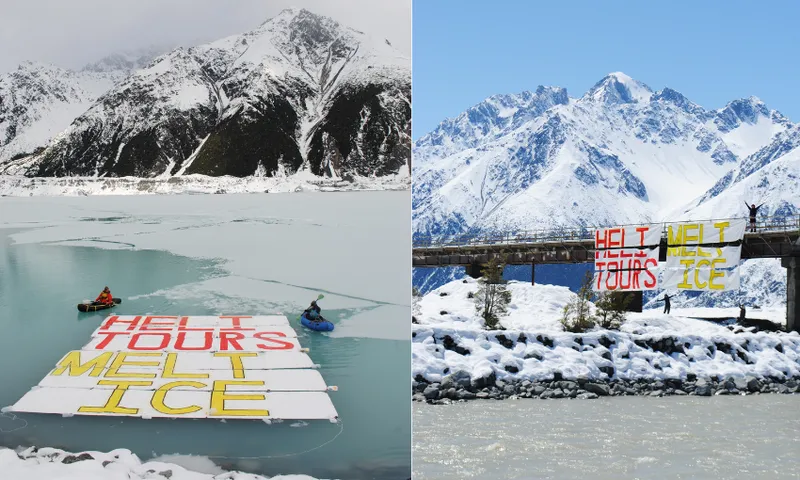
Climate Liberation Aotearoa, which has also campaigned against cruise ships and coal mining, staged a protest at Haupapa, the Tasman Glacier, last year. The longest glacier in New Zealand now has a 5km-long lake at its base. As helicopters buzzed overhead, protesters in packrafts paddled across the lake, floating signs that read “heli tours melt ice”.
Andrews and CLA think there are better ways to do tourism that don’t depend on short, high-emission trips into the mountains. “There are a lot of opportunities for guides to provide stories and narratives around glaciers, grounded in a human view of things – not looking at a glacier out the window of a helicopter.”
New Zealand’s big glaciers all have nearby walks of varying difficulty, where it’s possible to get a view of the glacier. Cadigan, who posts pictures and videos of the West Coast on Instagram, says that people posting online need to talk about how the glaciers are shrinking, too. “I wish people would be more open about what is happening,” she says.
Businesses reliant on glacier tourism – and New Zealand’s broader picture of tourists – must take climate change into account, Purdie says. “New Zealand promotes our fabulous alpine landscape, it’s a big earner for our country,” she says. “What happens when tourists turn up and can’t see the glacier, can’t interact with it and walk on it, all the ice is hidden under rocky debris?”
With the New Zealand government reducing its climate action, glaciers are at risk. “We don’t see policies in the right direction at the moment. Glaciers hang in the balance,” Purdie says.
“Glaciers are spectacular, places of magic and majesty holding up the mountains,” Andrews says. “And they are shrinking so quickly.”

Shanti Mathias
Shanti is a contributing writer at The Spinoff with a focus on Christchurch and the South Island. Email her at shanti@thespinoff.co.nz


