


Nabokov’s controversial novel is back in the headlines after popping up in the Epstein files. Books editor Claire Mabey reviews the arguments on either side of the debate.
Content warning: this article discusses child abuse. Please take care.
Vladimir Nabokov’s Lolita has been in and out of news cycles, variously praised and skewered, since it was released in 1955 by Olympia Press, a Paris-based house that specialised in publishing books that would likely be banned in English-speaking territories. Thousands of pages of scholarship have been devoted to the novel, while nearly a million normies have allocated stars on Goodreads. Lolita’s infamy launched an entire canon across multiple art forms, from film adaptations to contemporary retellings from the victim’s point of view.
Lolita has returned to the spotlight because Nabokov expert and New Zealand English professor Brian Boyd has turned up in the Epstein files. Emails from 2012 between Boyd and Jeffrey Epstein, the convicted sex offender who died in his prison cell in 2019, have revealed that Epstein had offered to fund Boyd’s next book and that Boyd had told Epstein it was Lolita he wanted to write about. Nothing ever eventuated but last weekend, Boyd told the NZ Herald that he was still “particularly interested in the ‘metaphysical layers’ of the novel that had not been explored”.

For some Lolita is a harmful work of depraved filth; for others, a literary masterpiece by a genius. For some, it offers something in between.
What are the arguments for and against Lolita?
First, a brief summary of the plot (there are, by nature, spoilers ahead): the novel is a fictional memoir written in prison by a man awaiting trial. He relates his immigration from France to America, his infatuation with girls and his relationship with his 12-year-old stepdaughter, Dolores, who he kidnaps, controls and repeatedly abuses both sexually and psychologically. Huge spoiler: everyone dies, including the author Humbert Humbert (a pseudonym), who suffers a fatal heart attack in prison. The novel opens with a satirical, fictionalised forward written by “John Ray, Jr., Ph.D”, editor of books on psychology, who says that Humbert’s account may become famous in psychiatry circles as a case study in abnormal behaviour. At the end of the book, Humbert says that if he was his own sentencing judge he’d jail himself for at least 35 years for rape.
Against Lolita
“Can’t do it. Vile. Offensive. Obscene. DNF.” – Goodreads review (one star), 2014
It is easy to see why some readers fear and loathe Lolita. Reddit and Goodreads offer portals into years and years of heated debates – demands that this “disgusting” novel be removed from “classic literature lists” and responses that censorship is fruitless and that it’s a novel about how paedophiles move through society rationalising their predatory behaviours.
From the beginning Lolita was seen as a “time bomb” (Nabokov’s own words). The manuscript was rejected by British and American publishers (“We would all go to jail if the thing were published,” said a representative of Viking) before it was picked up by French press Olympia. Lolita was banned in France and the UK’s Home Office prevented it from being imported after the editor of the Sunday Express called it “sheer unrestrained pornography”. It’s been banned, at various times, from Australia, Austria, Belgium, the UK and, in 1959, New Zealand. The high court ruled the book indecent “for having an undue emphasis on sex that would corrupt the reader”. (In 1964 Lolita was found not indecent by the Indecent Publications Tribunal and copies became available in New Zealand.)

While some arguments against Lolita boil down to an objection to the content, there are robust critical takedowns. Literary haters include Kingsley Amis, who wrote in The Spectator in 1959 that Lolita was “bad as a work of art, that is, and morally bad — though certainly not obscene or pornographic”. A scan of the many thousands of one-star reviews on Goodreads reveals that some readers found Lolita boring, overly wordy, “crap”, and, for some, bemusingly devoid of pornography, the mode of Humbert Humbert being that of euphemism, linguistic obfuscation and denial.
Feminist criticism of Lolita points out that the novel silences the victim. It is told entirely (other than the foreword) in Humbert’s voice so it’s only his memory of Lolita that readers access. Humbert himself describes how he names and renames her: “She was Lo, plain Lo, in the morning, standing four feet ten in one sock. She was Lola in slacks. She was Dolly at school. She was Dolores on the dotted line. But in my arms she was always Lolita.”
In an essay titled “Against Lolita”, Roxana Robinson argues that while Nabokov is an undisputed master of the English language (his third, after Russian and French), Lolita is not his masterpiece because it champions contempt over compassion. Robinson posits that the paedophilia story masks what Nabokov is really up to: contempt for America. Nabokov was forced into permanent exile from his native Russia in 1919 after the communist revolution, then again from France by the second world war. “Contempt is the most serious element in this mocking, ironic, satirical narrative; it’s the one emotion that comes directly from Nabokov’s heart,” writes Robinson. “Exiled from a country that no longer exists, terminally embittered, grieving and resentful, Nabokov reviles an undeserving America, his unintended refuge.”
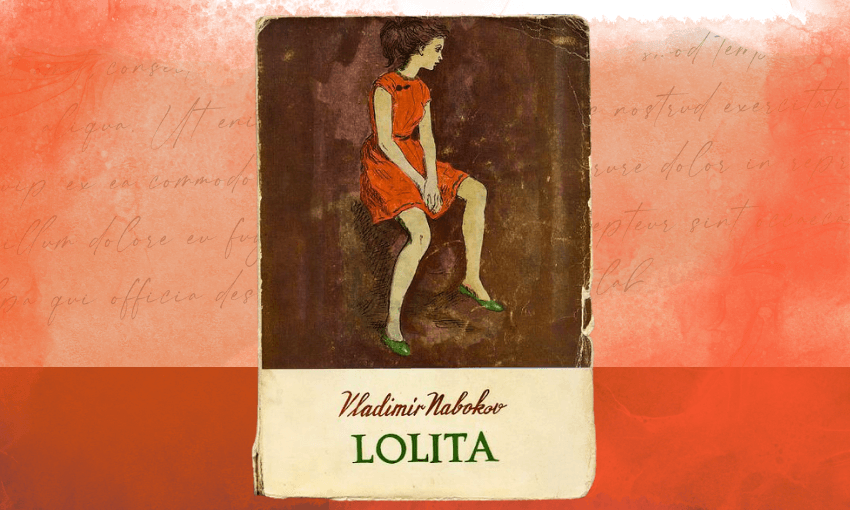
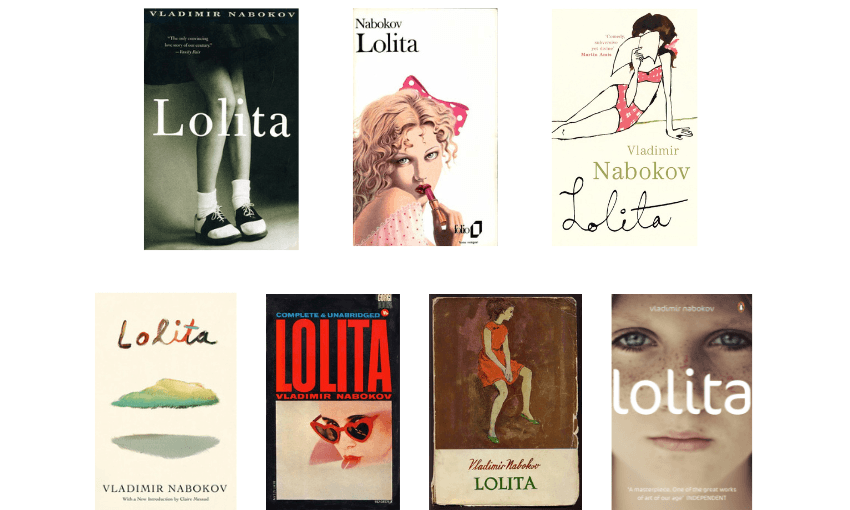
There is a thesis to be written about the evolution of cover designs for Lolita over time. Some (mostly the earlier) designs encourage a reading of the book as a love story – like the cover on the top left in the below image. The juxtaposition of the photograph of a child’s crooked legs and the puff quote from Vanity Fair that reads “The only convincing love story of our century” is extraordinarily disturbing. More recent cover designs have focused less on the representation of the sexualised minor and more on abstract images (and we praise them for this).
For Lolita
“this was my first boyfriend’s favorite book 😭😭 literally the biggest red flag 🚩” – Goodreads in 2024
First, we have to deal with the fact that Lolita has problematic fans, which is why we find ourselves debating, yet again, the merits of this novel. In the same way that a dog-eared copy of JD Salinger’s The Catcher in the Rye on the shelves of a suspected assassin is a damning artefact, so owning a copy of Lolita is ill advised for a suspected paedophile. It has been reported (though not confirmed) that Epstein kept a copy of Lolita, singularly, on his bedside table. We know he owned a first edition of the novel. Among the Epstein files are photos of a young woman, or girl, with Lolita’s opening lines penned onto her skin (the novel begins: “Lolita, light of my life, fire of my loins.”) We also know that 43 days before his arrest in 2019, he ordered The Annotated Lolita for his Kindle. His private plane was called The Lolita Express.
While Epstein may have overlooked Nabokov’s satire (more on that below) and was potentially duped by Humbert’s self-narration, the irony is, some would argue, that Lolita is not on the paedophile Humbert’s side. It’s on Dolores’s. What fans like Epstein tend to do is wilfully misread the novel to suit their own fantasies and actions (FYI, if you find in Humbert a kindred spirit and you get a rise out of arguing that the book is in fact a treatise about the nature of love despite age gaps, then you are the problem). In short: they get it wrong.
The question we could be tempted to ask is: does the fact that Epstein loved Lolita mean everyday readers can’t like it, too?
No.

Plenty of relatively sane people are Nabokov fans and find plenty to like about Lolita. In 1955 Graeme Green was willing to put himself on the line to defend the novel against censorship; and in 1958, critic Donald Malcolm wrote in the New Yorker: “The special class of satire to which ‘Lolita’ belongs is small but select, and Mr. Nabokov has produced one of its finest examples.” In 1959, the Manchester Guardian published a less enthused but nevertheless affirming review, summarised in this paragraph: “Those who wish to know what the ‘Lolita’ row is about had better read the book rather than the denunciations of it. They may not like the book; it is certainly not to everyone’s taste. Although it is written with exceptional economy and force, its subject is an abnormal and perverted man: and to some people he and the portrayal of him will be too repellent for pleasure. But others will find the narration extremely funny and the satire sharp, if bitter. What few who approach ‘Lolita’ unprejudiced are likely to find is that it deserves the strictures of obscenity now being cast upon it.”
Since those early reviews, for every one person who’d love to throw Lolita in the bin you’ll find 10 more who will champion it (there are 37,218 one-star reviews to 326,229 five-star reviews on Goodreads). The majority of the pro-Lolita reviews are responding to the novel’s tragicomic tone, its satire and its style.
Unlike his father, Martin Amis was a fan: “In a sense Lolita is too great for its own good. It rushes up on the reader like a recreational drug more powerful than any yet discovered or devised. In common with its narrator, it is both irresistible and unforgivable.” And, later in the defence: “Lolita is a cruel book about cruelty.” Amis reminds the reader that Humbert is, potentially, an unreliable narrator – we only ever have his words from which to construct an idea of Lolita, the site upon which the cruelty plays out. He also reminds us that what is left at the end of the novel is ruin: ruin of the abuser, ruin of the abused. For Amis, the novel is a study of tyranny.
If you’d rather not take the word of yet another white guy (the alternative title to Lolita is The Confession of a White Widowed Male), Boyd points us to Vanessa Springora’s memoir about her own abuse at the hands of Gabriel Matzneff when she was 14 years old. “I don’t think that Lolita is even remotely an apology for pedophilia. Quite the contrary: it’s the strongest possible denunciation of it – the most compelling ever written on the subject.”
Boyd also points to Neige Sinno, a victim of rape by her stepfather, who writes in her memoir Sad Tiger (2025) that in Lolita is found “a brilliant demonstration of the ‘mental scaffolding’ child-rapists construct to justify themselves”.
Nabokov himself swung between uninterested in moral readings of the story and asserting, as he did in 1961, that Lolita “has a very moral moral: don’t harm children. Now, Humbert does. We might defend his feelings for Lolita, but not his perversity. […] Lolita is a victim … ”
For many readers, reading Lolita is about immersion in Nabokov’s language. English was his third language and another framework within which to define himself as an artist. “I had to abandon my natural idiom, my untrammelled, rich, and infinitely docile Russian tongue for a second-rate brand of English, devoid of any of those apparatuses – the baffling mirror, the black velvet backdrop, the implied associations and traditions – which the native illusionist, frac-tails flying, can magically use to transcend the heritage his own way.”
He is speaking tongue-in-cheek here but Nabokov fans will get a kick out of “second-rate”.
If you still don’t want to read Lolita but are curious about Nabokov, then go straight to Pale Fire: an elaborate literary joke bursting with language and making fun of academics.