

A quick round-up of the lit sector stories that hit the headlines over the holidays.
I don’t know about you, but several consecutive days avoiding the internet really helped boost my book count for 2026. I managed to whittle my to-be-read pile down from a dangerous height thanks to respite from the intoxicating stream of distraction that is social media and news feeds.
As a result, when I turned the machines back on and plugged myself into the world, I was treated to a flurry of book, and book adjacent, news relating the good, the bad and the downright disturbing.
Here’s a round-up of book news that you might have missed, or understandably glazed over, while you were living your best life with a sturdy novel in your oblivious arms this summer.
An investigation into bookpublishers.co.nz
OK, so I was obviously very aware of this story on The Spinoff at the end of 2025, but those of you who took off on your holiday early may have missed it. I’m re-upping it here because the story is a warning: if you’re in the market for self-publishing your masterpiece in 2026, read this and be aware. In summary: bookpublishers.co.nz insinuates that it is a publishing service based in Aotearoa but it does not, in fact, have any offices or staff in the country …
Adelaide Writers’ Week 2026 cancelled
This is one of the biggest stories in the history of writers festivals, let alone of 2026, and has been reported all over the world. Here’s a recap of what has happened so far:
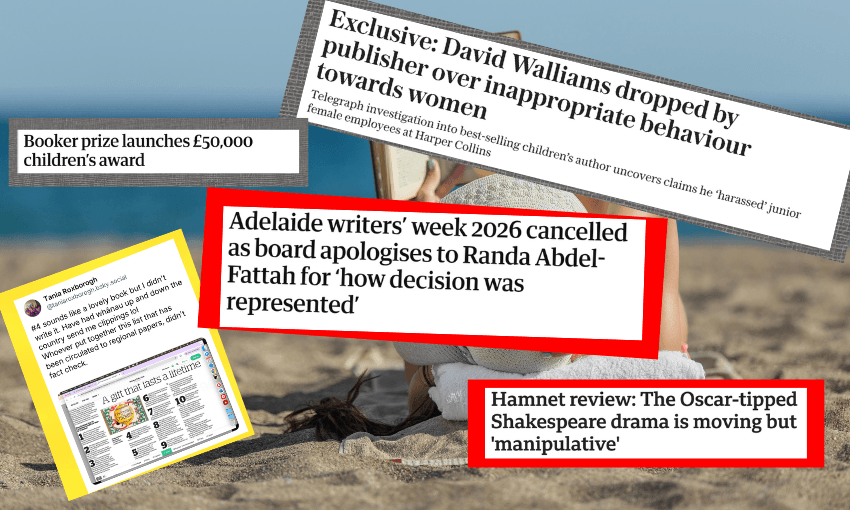
Adelaide Writers’ Week 2026 (AWW; scheduled to take place in March), one of the oldest and most acclaimed writers festivals in the world, is now cancelled after over 180 writers withdrew from the festival, protesting the Adelaide Festival Corporation Board’s decision to un-invite Australian-Palestinian writer Dr Randa Abdel-Fattah. In a statement published on January 8, the board said they were removing Abdel-Fattah from the programme because it would be “culturally insensitive” to include her after the shooting of 15 people at a Jewish festival at Bondi Beach in December.
The backlash against the decision was swift and widespread. Writer after writer, including Jacinda Ardern, withdrew from the programme with many issuing public statements via social media and news platforms expressing disgust at the racist decision to exclude Abdel-Fattah, who festival director Louise Adler had programmed to discuss Abdel-Fattah’s new novel, Discipline.
It was reported in The Guardian that the festival’s board had problems with Adler’s programming back in October 2025 when self-proclaimed Zionist, businessman Tony Berg, resigned from the board, writing that he couldn’t “serve on a board which employs a director of Adelaide Writers’ Week (AWW) … who programs writers who have a vendetta against Israel and Zionism”.
Adler resigned from her position on January 13, saying: “The Adelaide festival board’s decision – despite my strongest opposition – to disinvite the Australian Palestinian writer Randa Abdel-Fattah from Adelaide writers’ week weakens freedom of speech and is the harbinger of a less free nation, where lobbying and political pressure determine who gets to speak and who doesn’t.”

Amid the outrage, the board resigned and a new board was established.
On January 15, the new board put out a statement that said: “We apologise to Dr Abdel-Fattah unreservedly for the harm the Adelaide Festival Corporation has caused her. Intellectual and artistic freedom is a powerful human right. Our goal is to uphold it, and in this instance Adelaide Festival Corporation fell well short.”
The whole furore has sparked conversations about the problematic nature of arts boards; like the fact that many don’t include artists or arts administrators with experience in the sector. It’s also pointed to a fundamental and disturbing politicisation of arts funding, with South Australian Premier Peter Malinauskas under fire for alleged interference in AWW. RNZ reported that Abdel-Fattah’s lawyers are threatening Malinauskas with defamation proceedings after he publicly discredited her character. Acclaimed Australian author Richard Flanagan was moved to write in the Sydney Morning Herald (paywalled) on why politicians should not decide who speaks at a writers festival.
An alternative to Adelaide Writers’ Week – “Guerilla Writers’ Week” – has received Adelaide City Council funding and is looking to go ahead in February or March, it was reported in InDaily on January 20.
This story highlights just how fraught the fight for complexity, nuance and inclusion has become among arts organisations. I suspect there will be more on this over the year as Adelaide Writers’ Week will seek to rise from the ashes and arts boards in Australian and beyond may be forced to reckon with their definitions of governance.
The erroneous AI-addled reading list published by NZME
Ever heard of the book Te Rā Kirihimete o Hemi/Hemi’s Christmas Day by Tania Roxborogh and Tracy Duncan? No? Neither had Tania Roxborogh, because she didn’t write it and it doesn’t exist.
In December several regional newspapers and Scoop published a press release from the World Literacy Foundation featuring 10 New Zealand books for children. The list contained bizarre errors, such as Roxborogh’s ghost book, as well as a title attributed to Margaret Mahy that also doesn’t exist. Literary Bluesky went off on Boxing Day when Roxborogh shared the article, with hundreds of accounts pointing to AI hallucinations as the potential culprit and exclaiming over the fact that New Zealand editors hadn’t picked up the blatant mistakes. The Post reported the story, here; and 1News later reported NZME’s apology, including Roxborogh’s response to the shabby editing: “To me, it indicates how little knowledge and respect mainstream organisations have towards New Zealand books, especially children’s books.”

Australia’s social media ban leads to rise in sales of children’s books?
A scant yet intriguing article on SkyNews Australia reports that since the ban on social media for under-16s came into force, children’s book sales are up by 3.1% and retailers are reporting increases in the sale of puzzles, board and card games, too. What isn’t reported is to what extent the bump in sales could be attributed to the Christmas sales splurge. At any rate, curious to follow this potential trend over 2026. (And here’s an in-depth and related article published in The Conversation in December 2025 anticipating how the ban may affect how teens read).
David Walliams finally dropped by publisher for alleged inappropriate behaviour
Walliams’ reputation has long been mud in publishing circles. Whispers of foul behaviour dogged the writer-entertainer-cum-children’s author for years and finally culminated in an exclusive report in The Telegraph (paywalled) on December 19 2025 that revealed that HarperCollins UK dropped Walliams despite being one of their most successful authors. The Telegraph reported that Walliams had been accused of harassing junior female staff at HarperCollins UK, one of whom made a complaint which triggered an internal inquiry in 2023 and led to a response that involved limiting Walliams’ interactions with staff, discouraging visits to Walliams’ house and encouraging staff to attending meeting in pairs.
In October 2025 HarperCollins CEO Charlie Redmayne stepped down and was replaced on an interim basis by Kate Elton who then initiated the severance between the publishing house and Walliams. Walliams has “strongly denied” the allegations.

The children’s Booker Prize
This was actually announced way back in October 2025 but is worth highlighting because it’s both timely and cool and related to the more gruesome fact that reading for pleasure stats are in freefall among children (and adults) around the world.
Here’s the basic summary from the Booker Prize website: “The inaugural £50,000 award for children’s fiction will open for submissions in spring 2026, with the shortlist of eight books announced in November 2026. The winner, to be announced in February 2027, will be selected by a combined panel of child and adult judges, chaired by the UK’s Children’s Laureate Frank Cottrell-Boyce. At least 30,000 copies of the shortlisted and winning books will be gifted to ensure more children can own and read the world’s best fiction.”
And here’s a delightful recent video featuring Penelope Lively – the only author to have won both the Booker Prize and the Carnegie Medal for children’s writing – on the power of children’s books.
A hot take on the hot takes on Hamnet
This is book adjacent news, but the internet’s hot takes on Hamnet have given rise to some sleepless nights (for me).
There’s a trend out there among Bookstagram and BookTok and the BBC and The Independent in which filmgoers and reviewers are calling Chloé Zhao’s recently-released (in NZ) movie adaptation of Maggie O’Farrell’s (superb) novel, Hamnet, “emotionally manipulative”. If you’re not yet aware, the novel and film explore the death of Shakespeare’s 11-year-old son (true story) through the eyes of Shakespeare’s wife, Agnes. It’s a story about grief – plain and pretty simple. Will and Agnes deal with their loss very, very differently but in the end, storytelling brings them together and is somewhat healing. So yes, the film (like the book) is going to make you feel things – in the same way that all art is consciously designed to elicit particular emotions.

Some of the reviews are more articulate than others, but the greatest crime, according to some, is that Zhao has forced us to either view grief or participate vicariously in it (should you feel moved to) via blunt, even bad, creative decisions: in other words, Hamnet is merely grief porn.
The trouble is most reviews can’t articulate precisely which creative decisions are causing the reviewer’s issues (other than one fairly dull suggestion that the play Hamlet can’t be overlaid over the story of Hamnet and therefore it shouldn’t have been woven in as much as it was). Art is inherently manipulative and if you’re going to adopt the “emotionally manipulative” take you have to work very hard to tell us why a film about losing a child, with one of the all time flawless performances by Jessie Buckley, is more manipulative than usual.
My hot take: Hamnet is a good adaptation of a great novel, especially the last part, and the Max Richter score (superb creative decisions), the costumes, the lush woodland settings and Jessie Buckley’s face.