‘Send in the gryphons’: a conversational review of The Rose Field by Philip Pullman

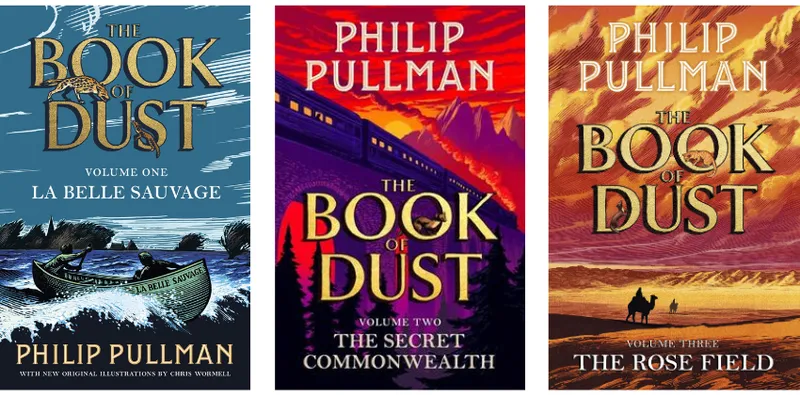
The Rose Field is the third book in The Book of Dust Trilogy by Philip Pullman.
Made possible by

Claire Mabey and Freya Daly Sadgrove discuss the final book in Philip Pullman’s The Book of Dust trilogy.
Spoiler alert: to give this review our fullest, we have decided not to avoid spoilers. Please be warned.
Claire Mabey: Well, Freya. I badly wanted to love this novel. And for the first few chapters I did – I loved being back in Lyra’s world. However, by the middle of the novel I was uncomfortable with how perplexed I was; and by the end? Disappointed, even a touch incredulous. This was not the novel I hoped it was going to be.
How about you? Overall impression to start with before we get into the nitty gritty?
Freya Daly Sadgrove: I personally am not incredulous or disappointed – did you expect like, more?
It felt biblical for me – and I put that pressure on this book. I expected a similar level of world-shattering as the end of His Dark Materials (HDM). I do feel similar to how I felt finishing The Amber Spyglass (the third book in HDM trilogy) – discombobulated and adrift – and part of that feeling is that I am going to be thinking about this for the rest of my fucking life.
Now tell me what you hated/didn’t like!
CM: Biblical is the perfect word for it. But, I kept feeling like Pullman has lost so much faith in humanity that he inserted himself into the story – I could sense him in there, telling us off, and that made me recoil from the world, flustered!
Here is a non-exhaustive list of things I am confused by:
- Plot oddities: many loose threads unexplained. The main one for me was if the windows into other worlds are allowed to/should be open, why were we subjected to the separation of Will and Lyra? That seemed like a huge reversal of the laws of the world. I was always troubled by the closures of the windows: I thought that the overarching metaphor of the HDM books was that it was about fantasy and storytelling itself. And that every time we open a book we are Will with the Subtle Knife, slicing into a world. Sometimes, bad things come out with the good stuff, and that’s correct and no reason to shut it all out. But I don’t think metaphor should rule a fantasy and in the end, that is exactly what has happened in The Book of Dust. It’s even stated at the end of the novel: Lyra says everything acts like a metaphor all the time.
- What was the point of Mustafa Bey? Just to say a system of trade is better than Capitalism?
- What was the point of the gryphons? To give Malcolm a heroic moment? And say creatures who love gold for gold are better than humans who love gold for greed?
- The ending was so weak?!
To me, HDM did profound things with ideas of consciousness and faith: faith in the human capacity to expand and not contract. The Book of Dust seems faithless by comparison.
Also, did Lyra’s personality have to be sacrificed? She is dull!
FDS: Okaaaaaaayyy so. On the windows into the other worlds: I love that reading. Except then isn’t closing the windows kind of anti-book? Or is it because “you have to know in which world you are living” – Werner Herzog said this in an Instagram video and I think about it all the time now. You do … have to close a book. And that is so sad. But also, Spectres came out of the cuts into the worlds, but didn’t Dust also leak out of the worlds through the cuts? I’m just trying to marry that up to them being books.
I found that I related to Lyra, which was devastating, because she is an adult now, and it is devastating to see adult Lyra after His Dark Materials. She is dull in comparison to herself as a child, and many of her opinions are annoying, which is realistic for a 20-year-old university student. But she is also still badass – she’s just a shade of her old self. But of course she is! She’s so vulnerable without her daemon.
What did you think of Lyra in The Secret Commonwealth, if you recall, did you find her dull in that too?
CM: I wasn’t as worried about her in that book: I understood how she had become indoctrinated, unsettled, by those loser men who said daemons were an illusion and pure reason rules. She was traumatised, after all. But I also don’t quite buy that Lyra would have lost her gusto quite so much? (Also, yes, closing the windows is anti-book because it’s anti-complexity! But in Pullman’s world, if they leave the windows open the Dust will leak out and that’s what was so harmful and what Lyra and Will had to prevent? So confused!)
I think what bothered me was where HDM was so wholly convinced of itself – Lyra as Eve, upending the old story and making new connections to set us all free – The Rose Field felt weak in its equivalent. Like, what was that angel encounter all about in this book? The dull angel? I just felt ultimately like Pullman was undermining his own magnificent creations.
FDS: Yeah the angel was weird! But – the imagination/consciousness thing – I think this is where my aspirituality inflects my reading of it. Lyra talking about metaphor – everything being metaphor; metaphor being necessary bonds – I am an absolute sicko for metaphor. I see metaphor everywhere. I am literally faithless, so a faithless argument hits for me.
CM: I think you’ve helped me see how if a person can see metaphor in the world then their imagination is working, which is this book’s primary concern. A new faith, based on what is right there and the poetry within?
FDS: Yeah! It’s our attention/engagement that creates meaning. This is a quote from page 232 of the novel: “Was that what the imagination did? See connections between things, connections otherwise invisible, and find a meaning in them? … She had to be part of the process for the meaning to exist at all.”
Lyra has to be part of the process!
CM: OK. You’ve made me feel better about Lyra’s trajectory. This makes so much sense and does, again, emphasise how brilliant the daemon device is.
But what did you think of Malcolm? I was confused about him as a character after his strong start in La Belle Sauvage. I was befuddled by his role in The Rose Field. Please help me understand him and the gryphon plotline?
FDS: So, the people of Lyra’s world have become more like us: over the past 20 years – experimental theology has become science, and people just don’t talk about gryphons and witches and the sort of semi-mythical things like The Secret Commonwealth. Except for people like Malcolm.
Were we allowed unfettered access to the mythical things in HDM because we were with children, and so were enmeshed in it naturally?
CM: I mean, that is part of the pain of the last two books in The Book of Dust: in those, Lyra is adulting and it’s not as fun.
FDS: Which is literally true! Pullman is right: adults get bogged down in the adult world.
CM: So … is this why the witches think Malcolm is so special? Because even as an adult he never questions The Secret Commonwealth? Never questions the gryphons?
He doesn’t really credit the gryphon folk with much worldliness, though. He tells them a lot of lies. BUT … OH! That was Lyra’s lost gift! Is he supposed to stand for what Lyra could be had she not lost her imagination? I.e., her ability to lie/tell stories?
FDS: Maybe why he’s “happy” in that conversation they have on the gryphon’s back near the end.
You pointed out that the gryphons’ love of gold was a parallel for the way humans love money. The gryphons’ more “pure” love does make you have to think about gold differently from how humans think of it. How we don’t value the things themselves, only what wealth can be made from them.
And then, the gryphons are like the witches and the armoured bears – majestic and unknowable and bizarre and a bit inexplicable? Am I being too forgiving? They may have been a tangent but I did fucking love being up there in the mountain palace with the gryphons and Malcolm and his tools.
CM: You’re helping me see Malcolm’s point … I think. But I have this lingering discomfort that Pullman put himself too far into the story.
FDS: What bits did that for you?
CM: There’s a bit on page 545 where Malcolm and Lyra are talking about binary absolutism. I agree with the conversation – binary absolutism sucks. However, the conversation felt staged. Malcolm was schooling Lyra rather than Lyra discovering this for herself. And it made me feel a little… suspicious that Pullman’s avatar is Malcolm. A scholarly, vital sort of chap. And I did not enjoy that thought. Especially when I was confused about Malcolm’s role in the end. I don’t think he was really needed!
FDS: Interesting! I did feel the staged vibe of that conversation – and I did feel things were a bit too discussed and less embodied in this one – but I don’t think it ever occurred to me that Malcolm was a Pullman. Also, if Pullman has lost his faith…
CM: I think what I mean when I say Pullman has lost his faith is that I felt his gaze on our world, acutely. It felt like he was making very plain big (truthful) statements: Capitalism = bad; imagination = good. Maybe it just felt too obvious? I could see the mechanisms at work too clearly? I worried that he doesn’t think his readers will get it without labouring it?
FDS: I feel like it wasn’t all the way spelled out, though. I thought that was all left quite vague. Like, who killed Mustafa Bey? Was the implication that it was the third enemy who killed him? Was the third enemy Capitalism itself? The conglomerate?
Also, I forgive Mr Pullman for losing some faith in us. I myself have been losing a great deal of faith in us. But lately I have also been shoring it up again in other ways. And that’s the Faerie Queen bit quoted at the end, right…? We’re getting buffeted about but we know what’s good and we keep going towards it…
CM: Can we swerve and just spend a moment on the witches? Pullman has the best witches of all of literature. I want to be one very badly.
FDS: Oh, hell yeah. Cloud pine? The flight with Pan, where he talks about how she moves with it? The bit at the forge where they read all the wispy intention of the clouds and direct it?
CM: Those were my favourite parts. This sense of being a creature in and of a world that is both seen and unseen (like Dust flowing all around!). I love intentions and the idea that you can move through the world with them.
Is there anything you’d like to add? Linger on?
FDS: So much! The thing about Will – it did seem like a massive expectation that we might see him again – I was sure the world through the red building would be our world.
CM: Massive set up there for sure, right? What I do love about this book is how invested I still am in it. I will read it again. But I can’t shake the disappointment. Am I disappointed because adults are disappointing? I wanted young Lyra back?
FDS: I think that is key.
I always thought the hugest thing at the end of HDM is when Lyra loses the ability to read the alethiometer “by grace”. That should be so profoundly and painfully felt – The Book of Dust is an expansion of that terrible, terrible disappointment.
I have a memory that I constantly revisit while reading these books: I was 12, and playing with toys, they were in my hands, and I had known it was coming, and while they were in my hands the magic went out – that particular ability to play just evaporated. It was completely devastating. And I felt like I was living in that moment, a lot of these two books… :(
CM: Send in the gryphons. Fucking hell. Send in the gryphons!
The Rose Field by Philip Pullman ($38, Penguin) is available to purchase from Unity Books.
The Spinoff Books section is proudly brought to you by Unity Books and Creative New Zealand. Visit Unity Books online today.

Claire Mabey
Claire Mabey is a children's author of The Raven's Eye Runaways, The Raven's Eye Rebellion, and a picture book Cass and the Beast illustrated by Jill Calder. For a long time Claire worked on literary festivals and is the founder of Verb Wellington. She lives in Te Whanganui-a-Tara with her partner and son.


