How New Zealand’s AS Colour built a billion-dollar business out of blank T-shirts

How AS Colour filled a blank space. Image: Tina Tiller
It started in an Auckland garage, spread to word-of-mouth warehouse sales, and now, 21 years later, turns over $500m a year via six global distribution centres. Emma Gleason charts the rise of AS Colour.
Do you remember first hearing about AS Colour? If you’re an Aucklander, maybe it was the city’s whisper network in the late 2000s that informed you of the warehouse selling those T-shirts everyone raved about. Initially a wholesale distribution brand, the company began opening the doors of that warehouse, just across from Mt Eden prison, on Saturdays.
“We would buzz the customers in, night-club style, and all of a sudden we were the cool place to get T-shirts – accessible, but cool. It just grew from there. There was a lot of word-of-mouth and social media picked it up,” then sales manager Dan Bycroft told New Zealand Retail magazine in 2014.
It all began with the search for a decent plain T-shirt. Founder Lawrence Railton, who had just turned 30 and had a background in distribution for skate and surf labels, started AS Colour (AS stands for “apparel studio”) in a Parnell garage in 2005. The lightbulb moment, he told an interviewer a couple of years ago, was when his friend was looking for T-shirts to get printed as merch for his band Elemeno P. Railton saw a gap in the market for high-quality blanks.
Initially T-shirt stock was imported from another company, but soon AS Colour was designing and manufacturing overseas its own tees as well as expanding into other garments, like hoodies. By the early 2010s, AS Colour had multiple warehouses and had expanded to Australia, and had become the place to stock up on basics, with that famous (retired) four-for-$100 deal providing the foundation of millennial wardrobes. The uniform stuck. On any given day at least one person in The Spinoff office is wearing something from AS Colour. Look around you and you’ll probably spot one too, though maybe not – the non-identifiable nature of AS Colour garments is part of the appeal.
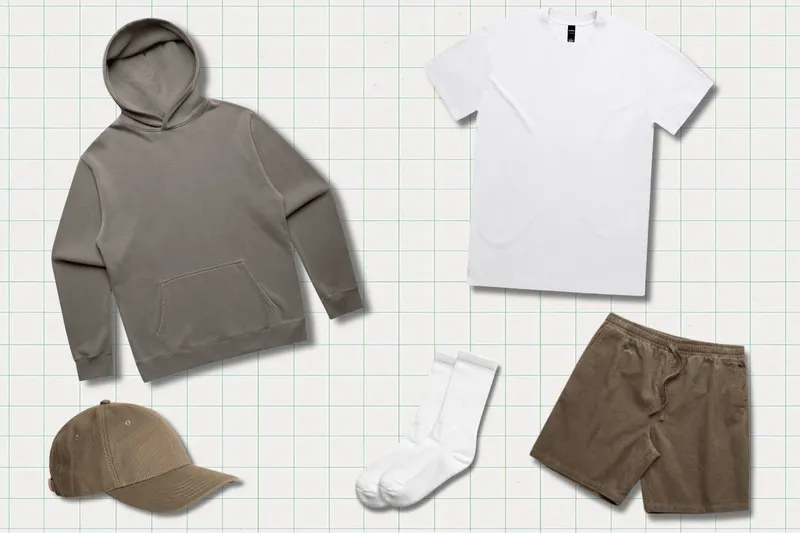
By 2017, New Zealand private equity firm Direct Capital had taken a significant minority stake in the company, which late last year was sold to Sydney-based Quadrant. Today, AS Colour turns over $500 million in product a year, and NBR estimates its value to sit somewhere between $1 billion and $1.5 billion. There are six distribution centres worldwide – New Zealand, Australia, UK, the Netherlands and the US – and 27 retail stores, 16 of them in New Zealand. The ordered, calm and easy-to-browse stores act as one-stop shops for easy wardrobe basics – T-shirts, sweatshirts, hoodies, shorts, caps – in various colours. The garments, made in Bangladesh and China, are high quality but affordable – a white classic T-shirt will set you back $34.95.
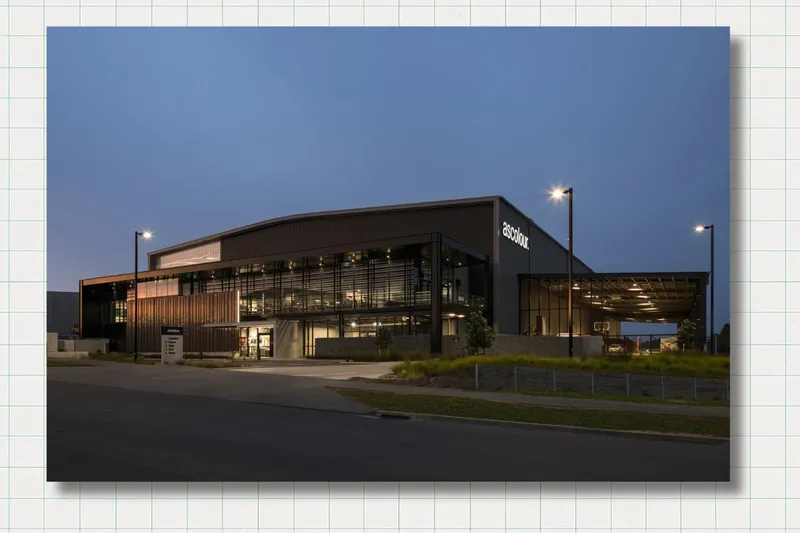
Blank T-shirts are big business
Retail expert Chris Wilkinson points to Japan’s Uniqlo as a comparable example, but says AS Colour’s stores “better balance the ‘overwhelmingness’ of Uniqlo’s scale and volume with a more curated and individual feel”. But those stores are just the tip of the iceberg, with consumer retail “only a fraction of its broader scale”, explains Wilkinson. The wholesale business – supplying blank apparel to other companies to print or embroider for merchandise and uniforms – would surpass the company’s direct-to-consumer sales volumes “considerably”, he says.
The attraction is the quality: the product is good to print on, the range is broad and distribution centres hold a high volume of stock that can be dispatched efficiently; Many local brands use blanks to make added-value designs (some with unanticipated outcomes). New Zealand’s burgeoning streetwear labels relied on AS Colour in the early 2010s. “Everyone probably worked with them at some point,” says Mike Hall, co-founder of skate brand Arcade. “They were kind of the backbone of making any kind of streetwear at that time.” For small brands with small minimums, blanks made “the barrier to entry really low”. Shoppers quickly cottoned on. “Customers would ask what blank you were using… it became part of the literacy of T-shirt buyers.”
Riding the merch wave
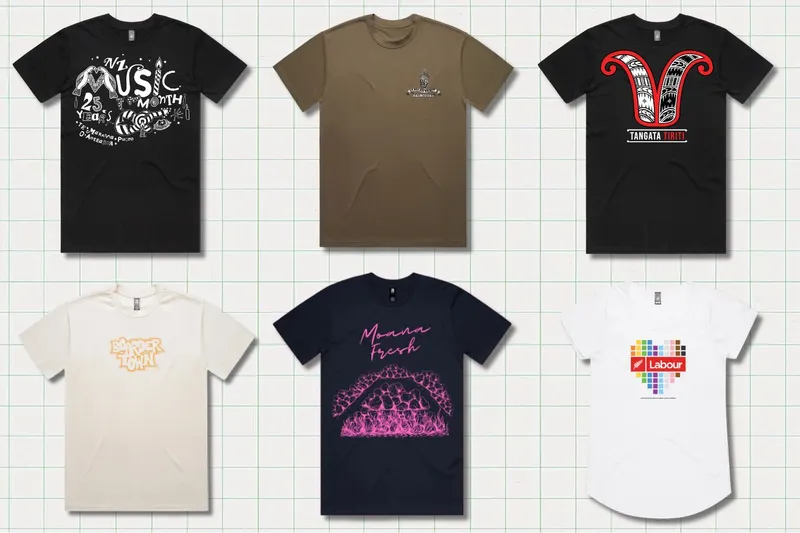
And merch, such an important part of AS Colour’s origin story, is a key part of its ongoing success. Today, it’s not just bands selling merchandise: everyone from cafes to political parties to protest groups are getting on board, and it’s particularly big business in the United States, where the company is “scaling rapidly”. Hats are understood to be one the company’s biggest categories and it’s also branched into aprons, tea towels and flags – all things to print on.
Music merch provides a vital revenue stream for artists and AS Colour is the “industry standard”, says Rachel Ashby, capabilities programmes coordinator at the NZ Music Commission. “The consumer who orders through their website or stores probably thinks that they’re the customer, but we’re kind of the main customer,” explains Jon Thom. He co-founded Print Room, a Dunedin company that does in-house screen printing, embroidery and transfers for the likes of Flying Nun and Garage Project. Print Room is one of AS Colour’s largest accounts, using the blanks since its inception 12 years ago. “As a printer, your work looks a lot better on their shirts.” The tight weave of the ring-spun cotton is easier to print on and produces a crisper outcome, he says.
AS Colour also filled a gap amid the nation’s sliding dress codes. “The casualisation of work has helped these brands,” agrees Wilkinson. In fortuitous timing, basics gained a tick of good taste in the 2010s. “Normcore”, a term coined by New York art collective K-Hole in 2013, described an anti-trend look of plain clothes, with basics like a white T-shirt, blue jeans and a grey sweater signalling taste. Here in New Zealand, AS Colour’s nondescript, relaxed apparel fit the bill, and it continues to do so even as T-shirt styles change.
High-tech logistics helps
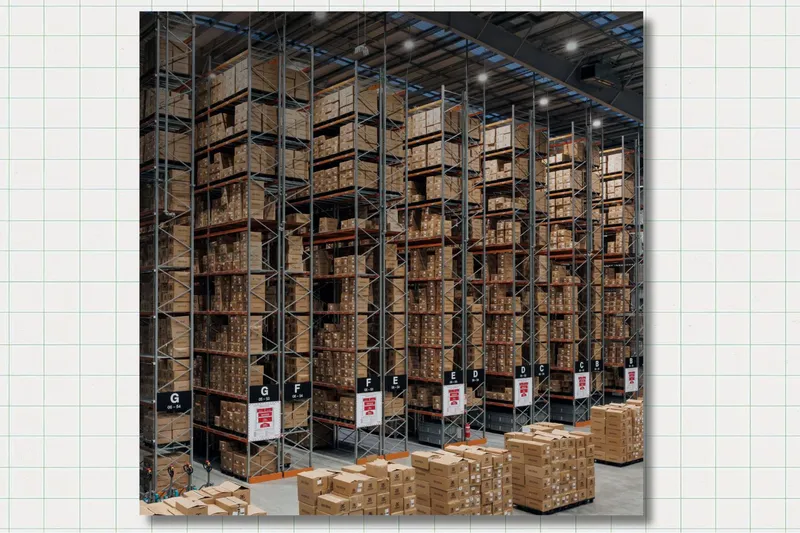
By 2021, AS Colour had opened a 7,500-square-metre automated distribution centre near Whenuapai in Auckland. Inside is a multi-shuttle “goods-to-person” system from global supply chain company Dematic, the first of its kind in New Zealand. A video on Dematic’s YouTube channel takes you inside the warehouse and this space-saving system with its 18-level-high shelves. The Melbourne distribution centre is even bigger, around twice the size, but the largest is in Charlotte, North Carolina – that’s 73,152 square metres (240,000 square feet).
Its suppliers are located worldwide; AS Colour claims 100% traceability across its 37 factories, located in Bangladesh, China, Vietnam, Thailand and Mauritius. The 2024 Ethical Fashion Report from Baptist World Aid put the company in the top 20% of brands, scoring it 65/100 on issues like human rights and environmental sustainability. (Uniqlo scored 50.) A trial of ImpacTex textile recycling bins has been expanded across the company’s store network.
While Thom says people working in apparel and print realise how big AS Colour has become, “they kind of fly under the radar.” What the public sees is just the cusp of the business. “If you’re in the industry, you can spot the garments at a glance. It is crazy how much product of theirs is out there.”
AS Colour declined The Spinoff’s requests for an interview.

Emma Gleason
Emma Gleason is a staff writer at The Spinoff and an award-winning fashion journalist. But it’s not just clothes that interest her, you’ll find her exploring tasty cheese, influenza outbreaks and more important things right here. She has experience with some of the country’s leading media outlets as well as the toaster in our kitchen.


