‘Everyone should just read, full stop’: Delaney Davidson’s books confessional

Musician Delaney Davidson on resisting definitive answers and more.
Made possible by
Welcome to The Spinoff Books Confessional, in which we get to know the reading habits of Aotearoa writers, and guests. This week: musician and Auckland Live Cabaret Festival artist, Delaney Davidson.
The book I wish I’d written
I guess the combination of never seeing myself as a book author and writing looking like so much hard work means I am pretty happy being a fan of them and never felt like I had to write one. I always wonder about these sorts of questions; would this mean I became the author? So, if I said I wish I had written Leonard Cohen’s autobiography, I would become Leonard Cohen? Or should I suggest a bestseller, therefore I’d be rich? I have always been terrible at picking a definitive favourite anyway, so I just can’t understand how to answer.
The book everyone should read
Oh no, another definitive question. I guess my answer might be “yes everyone just should read” full stop. Whatever they have. It’s amazing watching the most recommended books change with the times – does 1984 seem so outlandish these days? Is Salman Rushdie still on a hit list? Is a bestseller still something people want to read or a marketing ploy? Would Percival Everett’s James be possible to publish (or even write) without the years in between Huckleberry Finn and now? Is The Master and Margarita more relevant than ever with its themes of state-sanctioned narrative and artistic control, Kafkaesque layers of online bureaucracy and nuanced re-evaluations of morality?
People should just read. Finding our own moral compass in confusing times has got to be good for us. It almost feels like a reclaiming movement.
The book I want to be buried with
A book of matches. Maybe I can use them to escape if I am buried alive or if I need to light a candle in heaven or a torch in hell. Either that or a blank notebook so I can make some last-minute notes to pass the time. I often carry these round and make notes on song ideas or things I want to catch and be able to continue thinking about. What book would you need if you’re dead? Maybe a family photo album so no one has to wonder what the hell to do with it now?
The first book I remember reading by myself
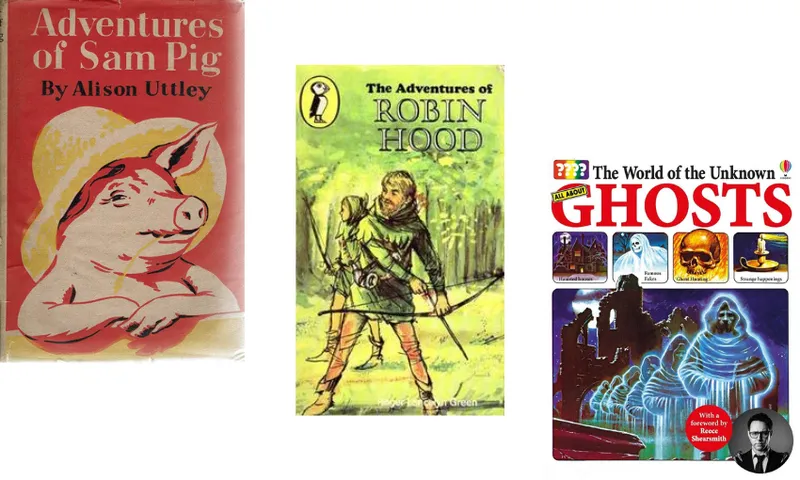
Couldn’t get enough of Sam The Pig, an enchanting story about a pig who steals money and goes to a market where he buys a blue glass marble, an onion and some marzipan. I think I read that book about 20 times. I had to keep getting it out of the library.
I wish I’d never read
Wittgenstein, I only read a bit of it but some of the concepts got lodged into my understanding of the world and I can’t let them go. Language games is now a part of how I interpret things. Especially having learned a couple of languages and I often get stuck on my interpretation of subconscious agendas, be it my own or other peoples. It’s like an infinite mirror. Sometimes I just wish I could take things at face value.
The book I pretend I’ve read
Same author, Wittgenstein, ha ha. I’ll often tell people about some of the concepts as if I am really familiar with them. I think it will be helpful. I think it’s a combination of the Dunning-Kruger curve and a little knowledge is a dangerous thing. I even started writing a book about my experience of reading Wittgenstein.
My book was about a fictional book called The Hideosyncratious, which is in turn a book that a man writes to describe how to approach his book. But this book is so horribly annotated and obliquely complex that you need another book – A guide for the perplexed by Mark Addis – to find your way through. It contains such sentences as: “The very start of this book The Hideosyncratious contains a series of pronouncements about the world, which logically follow from those about language, but this relationship is concealed by their position in the work. These remarks argue for the conception that representations in language are isomorphic with the world they represent and therefore manifest some vague commitment to realism but not total. The abstract generalisation which pervades the book is evident from its opening. ‘The world is everything, that is the case’, could be understood in the light of what follows as claiming that ‘the world is everything that is represented by the totality of true propositions’. The word is the totality of facts not of things”.
I guess the idea was to get lost in the weeds of philosophical meditations in the form of a helpful guidebook to some higher concept, and also some light-hearted jibe at academia. I also wanted to give some offering of Wittgenstein that may be absorbed by osmosis. Needless to say, I didn’t get very far.
Utopia or dystopia
I actually think a combo here is best, otherwise it’s just too much of the same. Only exception was Cormac McCarthy’s The Road: I was amazed at how he could keep describing things as colourless, dark and black without ever seeming to repeat himself. It started to become a feature of the writing. I am a believer of juxtaposition and contrast, so a little flame of hope in the dark makes it all the more poignant and conversely a little poison in the sweet apple of Eden helps give us the true perspective of value.
It’s a crime against language to…
My most hated crimes against the dignity of humans via language sit firmly in the advertising world, and in colour-by-numbers songwriting. There are some advertisements I saw when I was a child that I am still trying to get out of my head. Worse than any film I saw.
The book that haunts me
The World Of The Unknown: Ghosts book appeared at school. This was hi-cult-1977 status stuff here. It had a photo of a ghost on the stairwell. This kicked off all sorts of stories about missing crews on the Marie Celeste, soldiers in the mist, invisible children crying, faces in old hospital windows, a bus with a ghost driver. Pluckley, the village with a dozen ghosts. Captain Kidd and Tom Colley’s Skeleton in a gibbet. The hanging body of the school master, The phantom coach and horses, the spectre of the highwayman. Small black circles with skulls in them and blood on the stairs. It all felt so believable.
The book that made me cry
I think I around age nine Robin Hood really got me, specifically when he shoots the arrow out from his deathbed into the forest and they gotta bury him there. I couldn’t sleep after reading that, and just felt so sad. We were staying at Mum’s cousin’s house and I was sleeping out in the stable. I think I was missing Dad.
The book that made me laugh
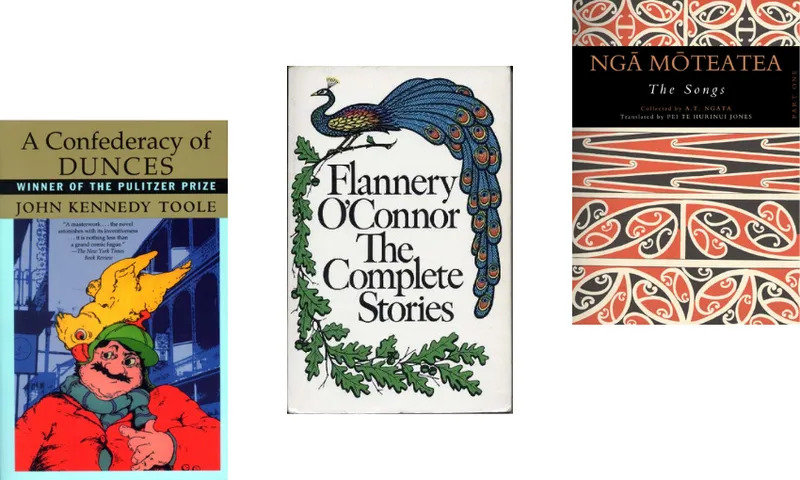
The Confederacy of Dunces is hilarious. Ignatius J Reilly with his barefaced stupidity, his monumental temper tantrums if he is denied soda and cakes despite his ”delicate constitution”, his delusions of grandeur. His moral superiority backed up by his brittle and righteous intellect is a combination of squeamish, personal, reflective – you are constantly walking a tightrope of outrage and relief.
If I could only read three books for the rest of my life they would be
Hemingway – The First Forty-Nine Stories; Flannery O’Connor – The Complete Stories; Apirana Ngata – Ngā Mōteatea, part one.
The book character I identify with most
I am a weed in the stream, so whatever I am reading will take me, unless I am not convinced. But generally, I am very easily co-opted into whatever is in front of me so I gotta be careful what I read. I’m very suggestible. It’s interesting seeing things change over time with what sort of characters people identify with, be it Bridget Jones or Raskolnikov, Frodo Baggins or Atticus Finch, Hermione Granger or Holden Caulfield, Hairy Maclary or Paikea Apirana.
I guess that’s what songwriters are also aiming for in songwriting. Looking for the zeitgeist and harnessing that to get people to relate to their perspective in some way.
The book character I never believed
Watching Ignatius J Reilly squirm his way through teetering denial into his own web of cognitive dissonance was one of the first times I can remember reading a book and realising the main character was not to be believed or sympathised with. This was not a hero and this was someone I should definitely not be identifying with. It seems so obvious now but the epiphany of that concept “not identifying” was something really new to me at the time. I realise this is maybe a creative read of the question. The idea that you are never meant to believe this pompous clown is irresistible.
The book I wish would be adapted for film or TV
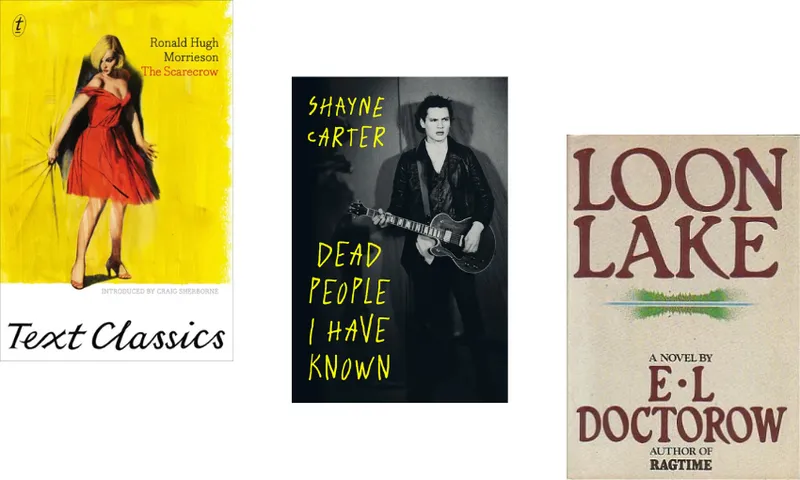
The Scarecrow or any of Ronald Huge Morrieson’s books. They seem to belong in some uneasy, dreamy forgotten time. Areas burned out by depression and post-war fatigue, meat works, abandoned railway sidings, gambling, alcoholism, telephones, small town decay and rotting billiard halls. Post-colonial gothic is a term bandied about in relation to Bill Hammond’s work amongst others, and Morrieson’s work is riddled with examples of this same unsettling impressionism. Rural landscapes, latent bicultural tension, and small-town claustrophobia. The disconnect from whenua resulting in settlers’ guilt and mental unrest has a widespread and unwelcome familiarity (Frame, Mansfield, Gee, Hulme). We have definitely shifted away from our reputation for cinema of unease. So to adapt these stories firmly into that genre of film would be amazing.
Encounter with an author
Shayne Carter’s book, Dead People I Have Known, was really something to read. I had met and hung out with him a few times and somehow that book gave me a whole different respect for him. I’m often suspicious of biographies as they usually used as someone setting the record straight on various dubious events in the past, but I really loved reading about Shayne’s early childhood and his family relationships. The feeling he writes of in the early music times in Dunedin and his creating of some of the seminal work he made really stuck with me. It’s usually hard to separate someone from their art, and his book somehow fused him and his work together in a whole new way for me to connect with.
Greatest New Zealand writer
Again, yikes, these are really the ultimate definitive questions – I am dying! Well … we got some greats. My tastes are pretty dated here, but for incredible work into the history of Aotearoa Michael King has to be acknowledged. For creative writing Witi Ihimaera, Patricia Grace and Keri Hulme are foundational. Alan Duff is a heavyweight.
Best food memory from a book
Loon Lake by E L Doctorow has a section about a man on the run trying to establish an alibi. He goes into a restaurant and orders a dish. He eats it and immediately orders the same thing again, the chef comes out to see what sort of a guy would do such a thing. Alibi established. Smart clever and economic. For some reason it always stuck in my mind.
Best thing about reading
You get to be in your own world. No actors, no voices, no camera angles, no edits. It’s just you and some map to another world you can follow. Even a bad book can be amazing to just let go and fall into something else. You can’t do that on a phone. I think this is a disappearing pastime. Time spent alone.
What I’m reading right now
Right now I am stuck on several books. Making Peoples by James Belich. Incredible historical look at early pacific discovery and the finding of Aotearoa by both Tangata Pasifika and European. Ngā Mōteatea volume one by Apirana Ngata translated by Pei Te Hurunui Jones. Secure Love by Julie Menano, an insight into attachment theory and how to escape the traps of behaviour that reflect from the past and the outdated coping mechanisms we have made that might need some upkeep for the present time. Weirdly enough no fiction. I also dip into those Hemingway stories, and the Flannery O’Connor I mentioned before; and sometimes Raymond Chandler for a holiday.
Delaney Davidson is performing at the Auckland Live Cabaret Festival on 3 & 4 July at The Wintergarden, The Civic ahead of his nationwide tour.
The Spinoff Books section is proudly brought to you by Unity Books and Creative New Zealand. Visit Unity Books online today.

The Spinoff Review of Books
A smorgasbord of books thoughts and formats by The Spinoff.


