‘I felt every one of our cuts’: Catherine Chidgey on finishing Kelly Ana Morey’s ‘epic Māori novel’

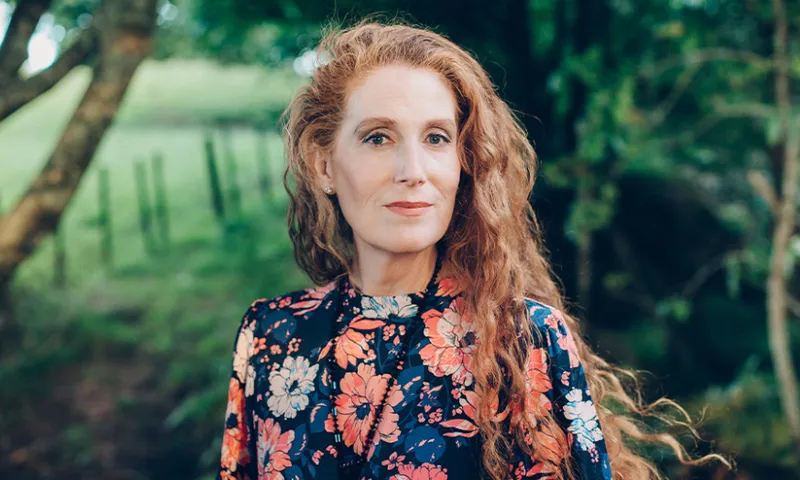
After Kelly Ana Morey died last year her friend the writer Catherine Chidgey took on the role of editing the manuscript that Morey left behind. (Photo of Catherine Chidgey, Ebony Lamb)
Made possible by

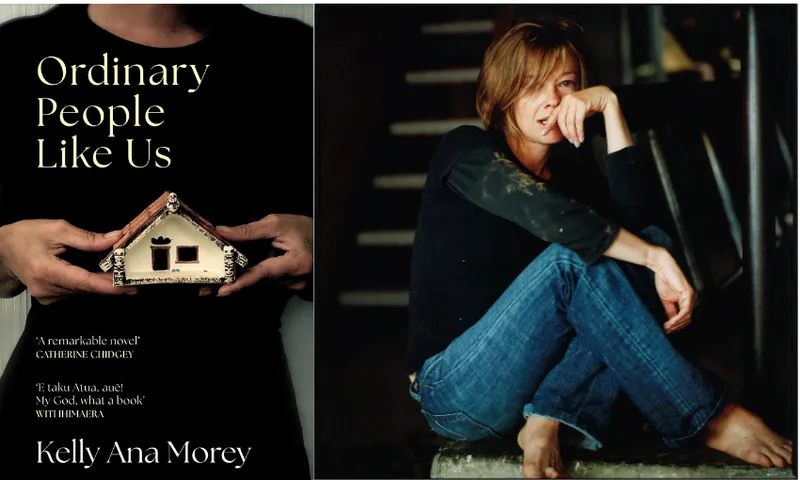
Ordinary People Like Us is Kelly Ana Morey’s final novel, published this week on the anniversary of her death. Catherine Chidgey writes about what it was like to complete the unfinished manuscript while grieving her great friend.
Over the 15 years of our friendship, Kelly and I often messaged each other about the painful, exasperating and sometimes joyous experience of producing a novel. I gave her feedback on an early draft of Daylight Second, her penultimate book (“Does Phar Lap need to talk, though?”) and she read the manuscript of The Starving Bride (“You describe blood as smelling coppery twice, swap one out for ferric”). She fell in and out of love with writing literary fiction and would tell me she was going to throw it in and do something else – something that made more money. She’d return to hospo, she’d work in a gallery, she’d do antiques pop-ups “in the nicer suburbs” and make a killing on the gorgeous little pieces she bought at auction: a Japanese ivory box carved with sakura, a pair of Titian fantail wall vases. She had an excellent eye for the beautiful, the rare, and although she never forged a career in antiques, I recognised many of her treasures as the talismans scattered through Ordinary People Like Us – because she always came back to writing.
Between us, we called the book her “Epic Māori Novel”. It took different forms at different times, and I loved hearing her evolving vision: “Across a century and a half, family stories, crimes and misdemeanours are revealed layer by layer like an archaeological dig. The reader and occasionally the characters move towards the source of a story and its ultimate truth, rather than away from it.” Looking back on the successful funding application she submitted to Creative New Zealand, she said: “I was kind of rattled to see that according to my CNZ paperwork, I was writing a 19th-century novel set in the gum fields.” On the ever-expanding manuscript: “It’s fairly obvious to me that this is two novels. I think this duality works for the story, which I envisage as a meeting house, the rafters being the two sides of the rib cage encasing the heart and the breath of life.”
But ultimately, she knew it was far too long and needed cutting, and she was in the process of refining it before she died last year. She had already slashed it from 170,000 words to 145,000, but that was still pretty unwieldy and would hamper her chances of finding a publisher. When her cousin Emily, kaitiaki of her work, asked me if I would finish the job for Kelly, of course I said yes, without hesitation, but I didn’t feel we should rely on my judgement alone – so we invited legendary editor Harriet Allan on board too. She had long championed Kelly’s writing, having published a number of her short stories going back to 2004, and when Kelly wrote ‘Blind’ for the anthology Pūrākau – a haunting story about Rūruhi-Kerepō, the “evil old child-eater” – she urged her to turn it into a novel. It became part of Ordinary People Like Us, and Harriet had hoped to edit the clearly extraordinary book she knew was in the pipeline. The admiration was mutual: Kelly had every intention of submitting the manuscript to her. “Harriet believes in me so much,” she wrote at a time when her confidence in her talent was shaky.
Harriet and I agreed that I would tackle the editing first so that we didn’t both end up making the same tweaks and corrections. Over the course of three months I streamlined certain unpolished sentences, cleared up continuity glitches, left questions in the margin for Harriet to consider, and cut the brewing, pouring, drinking and savouring of many, many cups of tea. I talked out loud to Kelly as I worked; sometimes I shouted at her. “WTF ARE YOU DOING USING ‘THE LATTER’ FOR A PERSON, KAM??? IT SOUNDS SO CLUNKY! YOU’RE BETTER THAN THAT!!!“ Often I found myself about to flick her a message marvelling at her research into the Pitt Street maternity hospital in Auckland or the firing of Crown Lynn china. Once, she visited me in a dream (we bitched about celebrity plastic surgery, until I started to cry and she stopped answering me).
I felt the need to tread lightly – to preserve her syntax, her cadences, her voice rather than inserting mine. I was extremely careful in that regard, while at the same time weeding out elements that I knew she would have knocked on the head herself as soon as they were brought to her attention. That’s how she was: completely devoid of preciousness about her work, and very open to robust feedback. I knew what her editing experience was like with the late and much-missed Stephen Stratford – he was strict with her, and she trusted him absolutely. “One of my great pleasures when working with Stephen across four novels,” she said, “was the pair of us electronically burning pages to the ground as we tightened everything up.” When he died, she told me, “I’m shook. We adored each other. Now I’m going to have to learn how to use the fucking editing software. Stephen always covered my arse and didn’t bother me with stupid punctuation, tense, etc. He just fixed it.”
After I’d finished, Harriet began to work her magic, making some necessary larger cuts where I, feeling too close to the manuscript and too emotionally blinkered, had hesitated. She told me, “I found I was very quickly of a similar mind to you with your changes and didn’t need to interrogate them, so I really hope that’s a similar experience for you” – and it was, every time. Over the following weeks we kept up a steady conversation about our proposed edits. Given Kelly was halfway through cutting back, the saw marks were still evident: characters removed from one point but not yet from another, draft sentences still requiring some sandpapering, a few splinters and repetitions waiting to be removed. I felt every one of our cuts, but finally, we had a clean 113,00 words – still a chunky book – ready to submit to publishers. I think – I hope – it’s as close as possible to the version that Kelly would have finished.
I cried as I worked on it, a lot. Sometimes I felt as if Kelly was writing about her own death: “she takes her last breath in her little house surrounded by blue hydrangeas“. She often mentioned what she called her “spooky old Māori lady-ness”, telling me about predictions that came true, brushes with a world beyond ours. The ghosts speak in this novel, watching from the rafters, commenting on those who are yet to join them.
Ordinary People Like Us embraces death and fizzes with life. With her fierce intelligence, acerbic wit and lyrical sensibility, KAM is there on every page.
Ordinary People Like Us by Kelly Ana Morey ($38, Moa Press) is available to purchase from Unity Books.
The Spinoff Books section is proudly brought to you by Unity Books and Creative New Zealand. Visit Unity Books online today.

Catherine Chidgey
Catherine Chidgey is a novelist and short story writer, and a creative writing lecturer at the University of Waikato.


