Kelly Ana Morey’s final novel to be published on first anniversary of her death

Kelly Ana Morey. (Photo: Jane Ussher, courtesy NZ Listener).
Made possible by

Kelly Ana Morey died in 2025, but her exceptional literary voice will live on with the publication of her final novel, Ordinary People Like Us, announced today.
Acclaimed Aotearoa writer Kelly Ana Morey (Ngāti Kuri, Te Rarawa, Te Aupōuri) died on the first day of spring 2025. At the time, her great friend, author Catherine Chidgey, wrote on The Spinoff: “Scrolling through our chats, I found a comment from last September: ‘When I die there will be a box of unpublished novels under my bed. Sort those out for me.'”
Chidgey then went on to reveal that she knew Morey had just completed a new novel: “Its official title is Ordinary People Like Us, but we called it her “Epic Māori Novel”, or EMN,” wrote Chidgey.
Today, Moa Press announced that Ordinary People Like Us by Kelly Ana Morey will be published on the one-year anniversary of Morey’s death, 1 September 2026. “This ambitious and deeply affecting work stands as a major literary event for Aotearoa,” says head of publishing at Moa Press, Kate Stephenson. “[The novel] is captivating in its expansiveness, humour and emotional depth.”
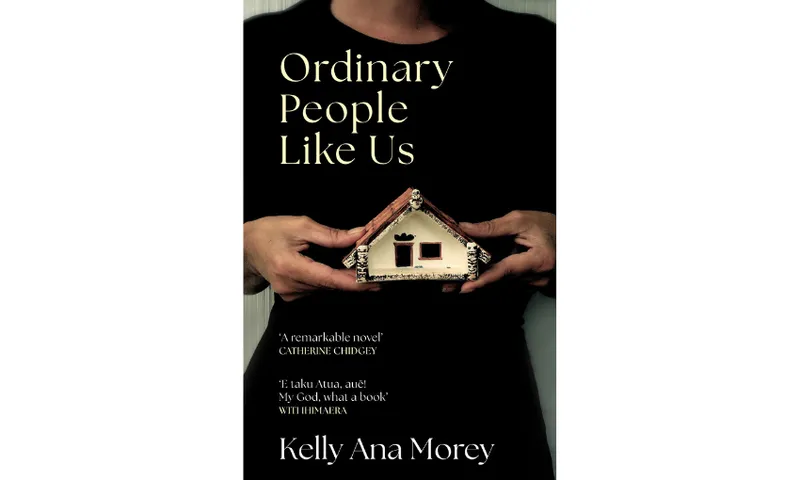
“She was excited about it; with its taniwha and ghosts, it returned, she felt, to the energy of Bloom,” wrote Chidgey last year. Bloom is Morey’s first novel – it won the best first book award for fiction at the 2004 Montana New Zealand book awards. Of Ordinary People Like Us, Chidgey said that Morey “had no interest in producing a novel featuring ‘Māori trauma porn’; this book, [Morey] said, was ‘a quirky black comedy about life, rubbish relationships and death featuring five generations of really quite ordinary Māori women and their choices as they navigate their way through a century of social change’. It would be ‘the bougiest Māori novel ever written’.”
The novel will be published simultaneously in the United Kingdom, by Dialogue Books at John Murray Press, Hachette UK. Hannah Chukwu, publishing director of Dialogue Books, said: “It is such a privilege to be bringing this story, and Morey’s astonishing, distinctive voice to the UK – all of us at John Murray feel honoured to be part of this special publication. I really fell in love with Ordinary People Like Us and found it difficult to leave these characters behind when the book ended. It is a delight to get to share that feeling with readers.”
Morey’s cousin Emily Lane, among others, championed the book, to ensure that Morey’s final story wasn’t lost.
Catherine Chidgey, along with editor Harriet Allan, finished the work that Kelly Ana was unable to complete on the manuscript and submitted it to publishers. “Knowing it was too long, Kelly was in the process of cutting back her manuscript when she became ill,” says Chidgey. “She had discussed her vision for the novel with me in detail over many years, so I felt I knew the kinds of edits she’d be open to.”
Chidgey explained that Morey had worked with Allan, a renowned editor, in the past, including on a short story that Morey went on to develop into an aspect of this book, and that together they were able to finished the editing job they believe Morey would have completed had she been able. Chidgey added that for her, “the book’s publication is a bittersweet moment. I’m immensely proud that this special novel will reach readers both in Aotearoa and beyond – that her work will receive the international attention it has always deserved – but there’s a deep sadness that she isn’t here to see it. She would have been quietly delighted, and would have made a wry, private aside or two that it was ‘about *#$&ing time’. And then she would have used some of the advance money to buy a pair of beautiful and very expensive shoes.”
Chidgey says that Ordinary People Like Us is “a novel that honours the texture of ordinary lives – the small exchanges, the loyalties of friendship and whānau, the ways people muddle through and care for one another – without ever diminishing their significance. It moves through multiple overlapping histories, and although the characters’ lives intersect, parts of their stories remain withheld. These aren’t necessarily dramatic secrets, but the kinds of things we all carry with us, sometimes unspoken, to the end of our lives.” She says that threaded throughout the novel are “‘Kēhua kōrero’ – brief, vivid sections in which the dead speak amongst themselves, observing and commenting on the living. At one astonishing point, KAM herself makes a one-line contribution. I gasped when I read that – here she was, talking directly to the reader, to me, as a ghost.” Chidgey says the ending made her weep.
In Morey’s own words, “Ordinary People Like Us is a celebration of the strength of family and how the people who love us keep us whole.”
The Spinoff Books section is proudly brought to you by Unity Books and Creative New Zealand. Visit Unity Books online today.

Claire Mabey
Claire Mabey is a children's author of The Raven's Eye Runaways, The Raven's Eye Rebellion, and a picture book Cass and the Beast illustrated by Jill Calder. For a long time Claire worked on literary festivals and is the founder of Verb Wellington. She lives in Te Whanganui-a-Tara with her partner and son.


