

A reflection on the controversy, the ceremony and the epic legacy of The Bone People and how it ‘pierced the heart of the British literary establishment’.
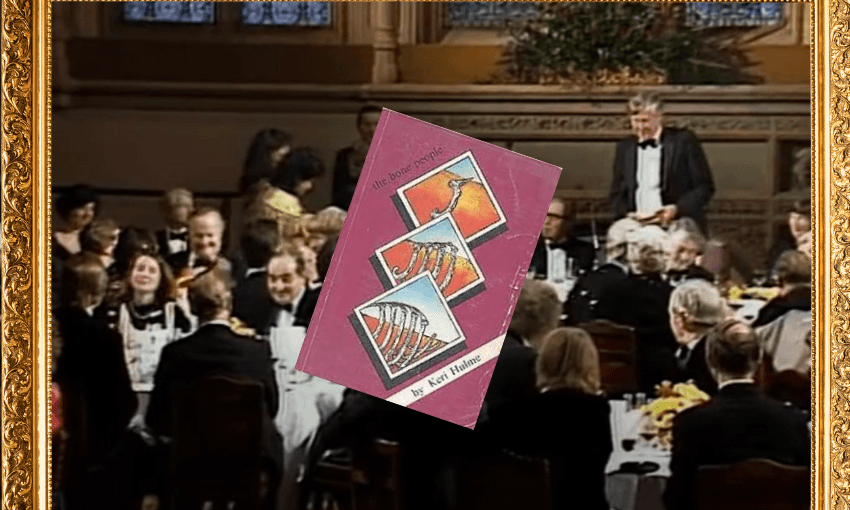
The air is thick with smoke. It’s October 31, 1985 and cigarettes and cigars are fashionable accoutrements at the world’s most British of live, televised book award ceremonies. “The Booker Prize, like British politics, is half a crusade, and half a sporting event,” says chair of the 1985 judging panel, Norman St John-Stevas, standing at the microphone to address the glittering crowd who are eager for him to finally announce the winner. “And the book that has carried off the double laurels is …. The Bone People by Keri Hulme.”
There are shrieks and cheers and applause as Marian Evans, Miriama Evans and Irihapeti Ramsden – members of Spiral Collectives who published The Bone People – rise to collect the award on behalf of Hulme who is miles away in Salt Lake City delivering lectures. Miriama Evans and Ramsden are wearing korowai, while Marian Evans is in a hired tuxedo from Moss Bros (“and white leather sneakers with pink satin laces, best pair of sneakers I ever had”). They are beaming as they walk through the tobacco-scented crowd towards the stage.
Melvyn Bragg, resplendent in a poppy-red bow tie, explains the women are from “a feminist publishing house in New Zealand” and that he thinks they’re singing “a Māori song” as they approach the stage. A soaring karanga reaches out into the silent room before more posh voices say “well done, well done, Keri Home [sic]” and a suited man hands a leather-bound copy of The Bone People and a £15,000 cheque to Marian Evans. Then he shakes his head at Evans, in response to something she’s said to him, and says “no, no”. The women are not permitted to speak.
Bragg speaks to camera, visibly excited to announce they’ve managed to get Hulme on the phone to break the news.
“Hello, Keri Hulme,” says Hermione Lee, phone to her ear. “Congratulations on winning the 1985 Booker Prize. We’re so sorry you’re not here to collect your prize. Are you pleased?”
“You’re pulling my leg aren’t you? Bloody Hell!” Hulme’s voice floats over the shot of Lee, who is smiling.
“Apart from ‘bloody hell’, what is your reaction? Are you pleased that as a New Zealander that you’ve won this prize?”
“Exceptionally pleased. Because in some larger way New Zealand literature gets a look in somewhere else.”
“Do you think it’s an extraordinary thing that you’ve pierced the heart of the British literary establishment in this way?”
“My goodness yes,” says Hulme. “For an amateur’s book that was sort of put together over a long time and published by a dedicated group of women, it’s amazing.”
The camera cuts to Evans, Evans and Ramsden, now seated, grinning ear to ear, near lifting off their seats with pride. Back on the phone, towards the end of the conversation with Lee, Hulme says that the book didn’t come out of her experience and is completely fictional.
Hulme may have had good reason for making that assertion at such a moment. The Bone People was an outsider, an underdog in the 1985 shortlist, up against well-known authors Iris Murdoch, Peter Carey, Doris Lessing, Jan Morris and J.L Carr. It was (and still is) called by the Booker Prizes itself one of the most divisive winners in the prize’s history. Marian Evans told The Spinoff that they (Spiral Collectives) knew Hulme was going to win, but that the odds were against her. In New Zealand and abroad the violence in The Bone People polarised readers and critics, as well as judges.
The 1985 Booker judges Marina Warner, JW Lambert and St John Stevas, supported The Bone People; but judges Nina Bawden and Joanna Lumley vocally and publicly opposed the violence in the novel and wanted The Good Terrorist by Doris Lessing to win.
It interests me that Marina Warner pushed for Hulme’s masterpiece (for that is what it is – The Bone People changed the limited, colonial understanding of literature and really did “pierce the heart of the British literary establishment”) because Warner is a renowned mythographer and feminist, a scholar of the way stories shape reality. The Bone People is, on one level, a stunning allegory for colonial violence and the experiences that were enacted, that are enacted, and that in a way must be experienced by the reader to understand the trauma and to look towards what should happen next; how a self, how a nation, might travel the spiral out into a new understanding, a healing state.
It was Warner who later defended Ramsden and Miriama Evans from misogynist and racist reporting in the Sunday Telegraph where Philip Purser called them a posse of “keening harpies”. A Booker Prizes article on Hulme’s win reports Warner’s view that an attitude of anti-feminism shouldn’t be discounted when thinking about the reception to the novel. In the article, Warner says: “I don’t think many people would have said they were ‘keening harpies’ because they were Māori, they were keening harpies because they were deplorable feminists, they were the monstrous regiment.”
In Marian Evans’ written reflections on the award night she says that she thought nobody understood the karanga and ultimately the night was “strange”. One of her lasting memories attached to the prize-night photograph used in the newspapers next day was that “the photographer suggested that we stick our tongues out. I think he wanted us to pukana”.
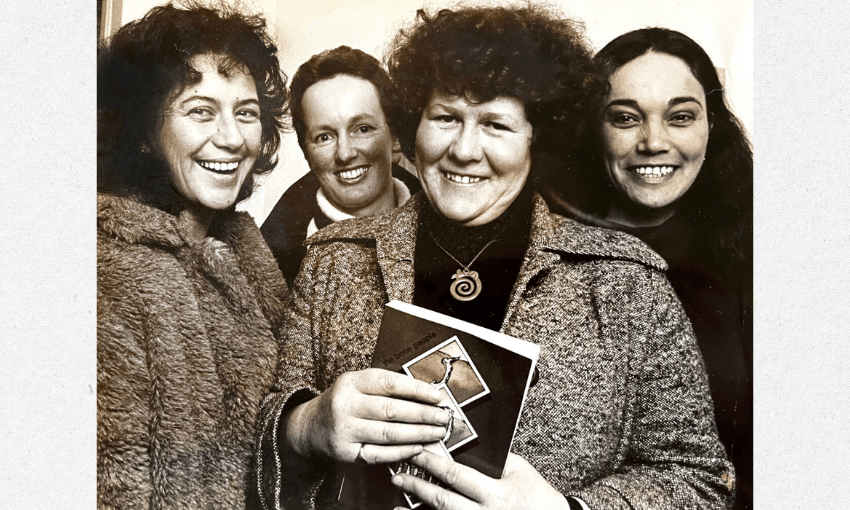
The Bone People remains one of Aotearoa’s most precious and demanding texts. It is one of the most frequently invoked titles in The Spinoff’s Books Confessional, when writers are asked to state their best Aotearoa novel. I have read it twice: once as a 14-year-old and again as a 38-year-old. Both readings were entirely different and both readings changed me. It is an embodied experience to move through the lives of Kerewin (an artist), Simon (a deeply traumatised, mute child; a character who came to Hulme in a dream, she saw him dancing on the beach) and Joe (Simon’s foster father, also traumatised) – to go through, with them, incredible pain and incredible transformation.
In an interview in Australian and New Zealand Studies in Canada, issue 12, 1994, Hulme says of her novel: “I very much wanted… to be a bridge between my Māori relations and my Pākehā relations, and I wanted very much to make explicit, explicable, the spiritual world. And I wanted to make clear why, when people are alienated from that, they do terrible things to themselves and to others. So there was no way I was going to water down, for instance, that final section, which for me is the heart of the book and points to the ‘strangely bright future’, with hope and healing.”
In the clip of the 1985 Booker Prize ceremony, Hulme tells Lee that she’s working on a novel titled Bait. That book, she says to Lee, draws from her real life experiences, unlike The Bone People. Twelve years later, in 1997, Hulme was recorded reading excerpts from the still unfinished novel, calling it a story of “death and fishing” at the Going West Writers Festival. In the end, Bait was never published. Hulme’s UK publisher at Picador, Peter Strauss, who had read 100 pages of the manuscript and described it as “scintillating”, tried to cajole Hulme into finishing it, but in the end was forced to accept that for Hulme the novel was not a priority.
Hulme’s life post-Booker was full of what she loved most: painting and fishing and whānau. She rarely gave interviews. When Hulme died on December 28, 2021 her nephew Matthew Salmons told Stuff that she didn’t seek adoration and her literary fame wasn’t something she discussed.
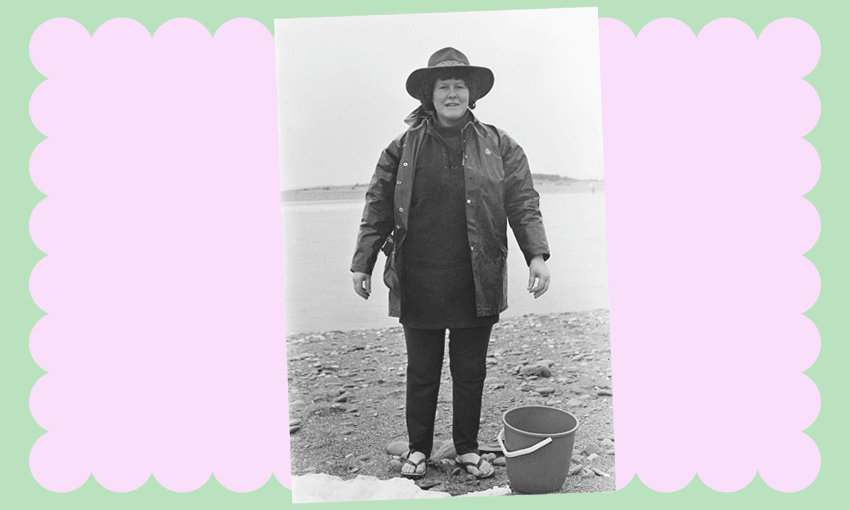
It is hard to think of any other novel, any other piece of art, in Aotearoa’s history that has made such an impact on readers and on writers worldwide. You can see Hulme in the exceptional novels of Becky Manawatu, in her potent lyricism, in the truth of the characters, the food and the water. You can see the Hulme in our poets like Arihia Latham, essa may ranapiri, Ruby Solly. British novelist and fellow Booker Prize winner for Girl, Woman, Other Bernadine Evaristo said that The Bone People was her favourite novel and has influenced her own work.
The future of The Bone People still lies with Spiral Collectives who are working with four different artists and four different writers to adapt the story into a series of four graphic novels. In Spiral Collectives’ way, there is no publication date yet: “it will take as long as it will take,” Marian Evans, the last living member of the collective, told The Spinoff. There is an extensive and transparent explanation of the project online, which includes how Hulme’s wishes and kaupapa will be taken into account, particularly around the representation of child abuse in the book.
After the graphic novels, there is talk of an animation adaptation, too – Hulme preferred the idea of animation over live action, and turned down over 100 offers both local and international to turn it into a film.
But, for now, the novel exists. In millions of copies and many languages. For those yet to read it, 2025 is an apt year to take it in, to let it work its potent and singular magic.