Rent is getting cheaper. Here’s why that’s not necessarily a good thing

The rent is too damn high. Or too damn cheap. Or something.
The underlying factors driving this change are not a sign that New Zealand has suddenly become a more equitable place for the young, poor and disenfranchised.
At the end of 2025, as statisticians added up all the important numbers from the year that had been, they found something remarkable. Over the course of the year, based on realestate.co.nz data, the average weekly rent in New Zealand fell by 1.8%.
It was the first annual decline since 2015. Rent has been on an almost-continuous upward climb for decades, easily outpacing inflation, so any year when that trend reverses is a big deal.
There are 663,000 rented homes in New Zealand, housing about 1.5 million people. For those people, rent is one of – probably the – largest living expense they face. At a time when 61% of New Zealanders say cost of living is the top issue they face, this should be a huge win for young people, those on low incomes, and for the government, which campaigned on addressing rising inflation, a key driver of rent increases.
But don’t celebrate too soon, for not all that glitters is gold. Unfortunately, the underlying factors driving this change are not a sign that New Zealand has suddenly became a more equitable place for the young, poor and disenfranchised. In fact, it’s mostly the opposite.

Housing economist Stuart Donovan says the price changes we’ve seen for rents are the result of a “demand shock” followed by a “supply shock”. Here’s what that means:
The price of rent, like any good or service, is driven by supply and demand. In market economics, prices are set by the seller (landlord) who will take the highest price at which they can find a willing buyer (tenant), and the buyer will take the lowest price they can find that fits their needs.
This is easier to observe in the rental market than the house sales market, because rent prices aren’t affected by interest rates in the same way home prices are. It’s simply an equation of the number of people looking to rent houses and the number of houses available to rent.
When demand exceeds supply, prices go up. When supply exceeds demand, prices go down.
Right now, it’s the latter. Surveys of property investors show that many landlords are struggling to find good tenants.
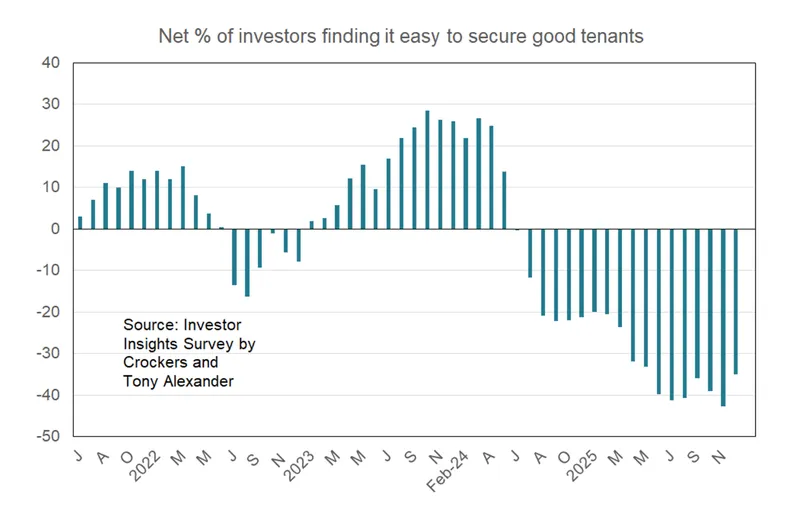
The demand for rental housing has collapsed over the past four years. That’s primarily driven by record numbers of New Zealand citizens leaving the country. Since January 2022, there has been a combined net loss of 162,000 New Zealand citizens. Total population growth is still positive due to non-citizen migration, but is much lower than would otherwise be expected.
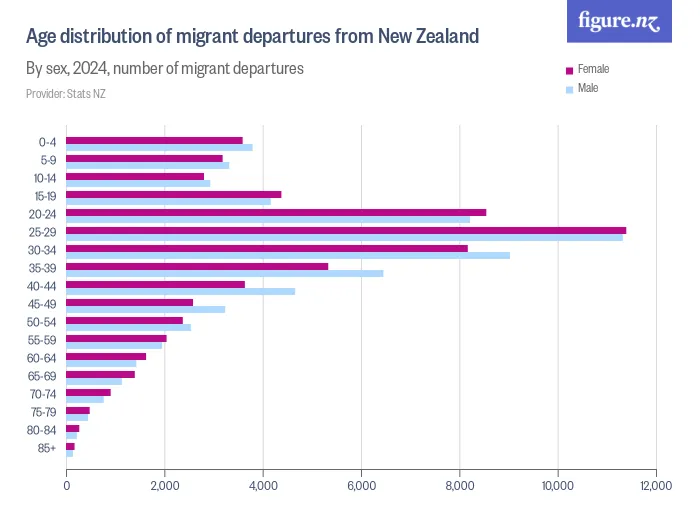
Migrant departures of New Zealand citizens are mostly young, with 38% of the 2024 cohort aged 18-30, and 25 the most common age. These people are disproportionately more likely to be renters.
This effect can be seen clearest in Wellington. The capital had the largest population decline of any council area in 2025, almost entirely driven by international migration. As a result, Wellington’s average rent had the steepest decline in the country, at 9.7%.
Economist Ed McKnight of Opes Partners points out another source of demand drop: people can’t afford to move. In a strong economy, tenants with good incomes will seek to move into homes that are nicer or suit their needs better. But in a cost of living crisis, the expenses involved with moving are enough to put some people off, so they stay in inferior housing for longer.
There also appears to have been an increase in young people choosing to live with their parents due to the cost of flatting, especially students and those struggling to find employment. This takes demand out of the market even further.
Aside from potential tenants leaving the market, there has also been growth in the number of homes available to rent. The number of rental properties listed on Trade Me hit an all-time high in 2025 and currently sits at 12,322.
There are several reasons for this. Homeowners who moved country or city are more likely to put their house up for rent rather than sell during a down market. Property developers will rent out units that they haven’t sold – something which is happening increasingly often, especially for newbuild apartments. And rentals are sitting on the market longer due to low demand.
The most significant reason – and the most positive sign for renters and prospective home owners – is that more homes are being built. Just under half of rental listings on Trade Me are apartments, townhouses or units – a sign that they are disproportionately made up of newer housing.
Having crashed out after 2008, the rate of consents for new dwellings rose consistently for over a decade and spiked even further in 2020 as developers took advantage of Covid-era low-interest loans. There is usually a lag of a couple of years between a building consent being approved and a home being ready to live in, but most of the developments from the peak of the construction market are live now.
As interest rates increased in 2023, the number of consents started to decline, but was still higher than would typically be expected from the economic conditions. In the second half of 2025, the rate of dwelling consents began to climb again.
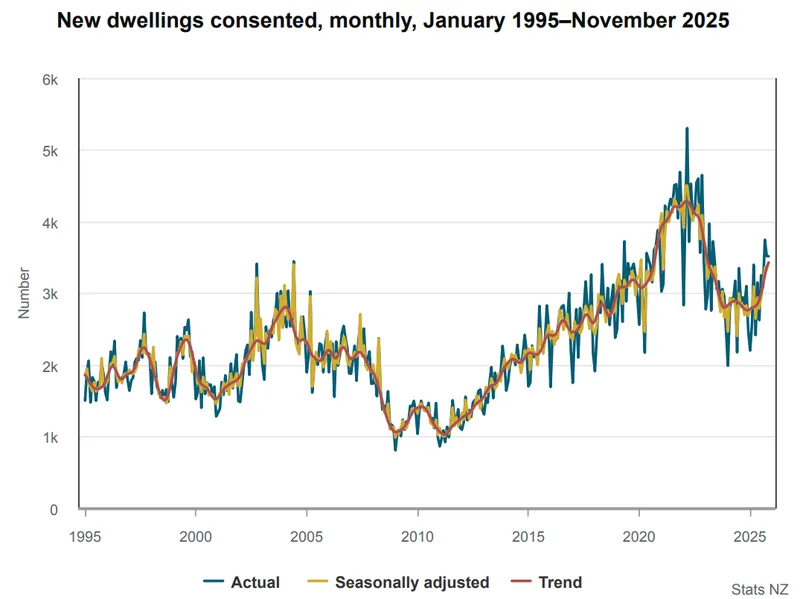
Donovan credits this rebound primarily to the National Policy Statement on Urban Development, a regulatory change by the last Labour government which supported higher-density dwellings in most cities. Under the current government, housing minister Chris Bishop has advanced further changes aimed at increasing supply, including zoning changes in Auckland and Christchurch, and a reform of the RMA. However, these more recent changes are unlikely to show up in the data yet. (Donovan has been appointed to housing advisory panels by Bishop.)
There’s one final silver lining contained in the data. While many young people fled the country due to poor job prospects and over-inflated house prices, some of those who remained have taken advantage of the crash, with house prices down 17.6% from their peak and bank loans getting cheaper.
First-home buyers made up 28.4% of all property purchases in the fourth quarter of 2025, the highest number ever recorded. In fact, for the first time since Cotality’s records began in 2006, first-home buyers were the largest proportion of the market.
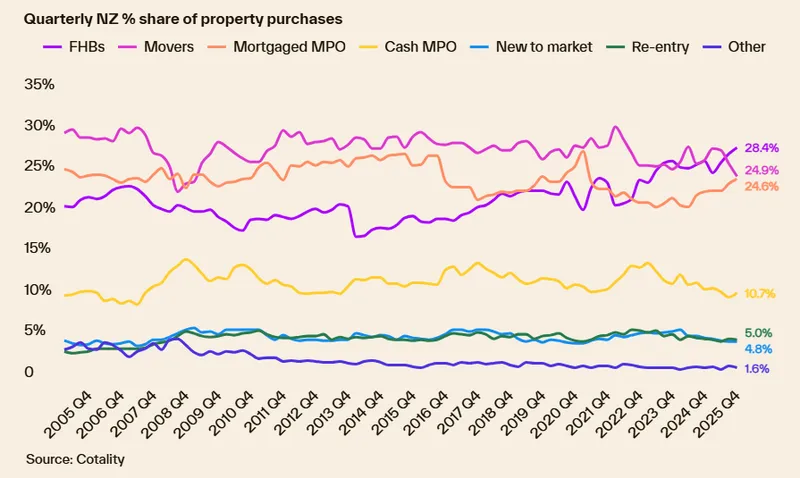
Those newly minted homeowners are almost entirely people who would otherwise have been renting. This has taken even further demand out of the rental market.
These are the most important green shoots and the most optimistic sign of balance returning to New Zealand’s housing market. Recessions and demand crashes help to drive prices down, but it’s not necessarily useful if people are struggling to pay for other essentials. The only long-term solution to the housing crisis that will deliver better value for renters and homebuyers without drastic market crashes is to build more homes.

Joel MacManus
Joel MacManus is a senior writer for The Spinoff. He previously worked at RNZ and Stuff, and began his career at Critic Te Ārohi. His writing explores the political, economic and cultural systems that underpin modern New Zealand. He won the 2025 Voyager Media Award for Best Columnist, Opinion or Critique.


