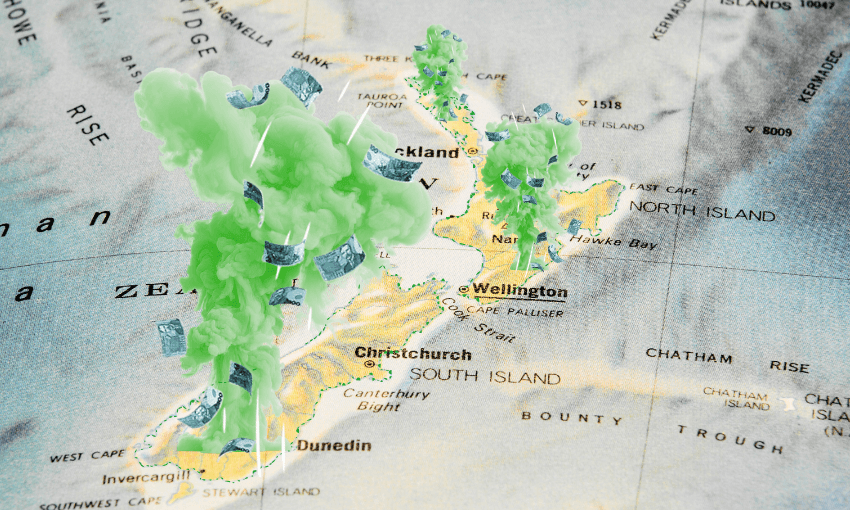



Keeping all things nuclear out of New Zealand may or may not make moral sense. But it almost certainly makes economic sense.
Chris Penk barely had time to shut his mouth before everyone started yelling at him. The defence minister made an apparently off-hand comment at a security forum in Singapore intimating it could be “helpful” for us to have a “conversation” about allowing nuclear-powered submarines into our waters. Labour was first off the blocks when it came to telling him he was, to paraphrase, committing treason against David Lange. In a Facebook post, its leader Chris Hipkins accused National of wanting to abandon the former prime minister’s crowning 1987 policy achievement. “Our nuclear-free status remains a defining part of who we are as a nation. For the first time in decades, three more years of National could put that at risk,” he said.
Labour tried to rope the prime minister into Penk’s wavering, pointing to a recent response from Luxon to a question from Te Pāti Māori co-leader Debbie Ngarewa-Packer on whether National would support nuclear fission energy. “We’re very interested in exploring all sorts of energy options for New Zealand. It’s an and, and, and strategy,” he replied.
Nuclear power is actually legal in New Zealand, with Labour’s nuclear-free legislation banning only nuclear weapons and nuclear-powered vessels in our territory. But anti-nuclear sentiment is still hard-baked into the country’s DNA, and Luxon moved quickly to clamp down on the suggestion that he might be partial to a little bit of enriched uranium. “I’m really proud of our nuclear-free position and it ain’t changing while I’m prime minister, period,” he told Newstalk ZB.
Most of the objections to National’s brief flicker of nuclear doubt have been framed in moral terms. It wasn’t just Labour appealing to virtue and identity. Sharon Murdoch summoned the memory of a nation-shaping zinger in a cartoon for The Post, which depicts the ghost of Lange floating towards the defence minister with a tin of “nuke mints” in hand. “What have you been swallowing, Penk?! I can smell the uranium on your breath as we speak,” the spectral PM asks.
That framing makes sense when it comes to nuclear weapons, which are generally only useful for murdering millions of people or turning the world into an arid hellscape. But there’s a good argument our kneejerk aversion to anything involving nuclear power is based more in fear than fact. Nuclear-powered ships have a relatively good safety record. Scientific reports dating back decades show nuclear power is one of the safest and cleanest sources of energy. As others have noted, we could do with at least being open to a conversation about it as an option.

The case for keeping New Zealand pristinely nuclear-free may have some holes in it, ethically speaking. Economically, it’s a different story. Richard Meade, an economist with a particular interest in New Zealand’s electricity markets, says nuclear power doesn’t stack up as a reliable solution for the country’s future energy needs. Reactors are massively expensive, take a long time to build and often suffer delays, he says. “They literally can take a couple of decades to get up and running. We’ve got cheaper options available to us, and they’re far less controversial.”
Proponents for nuclear energy often respond to those sorts of arguments by pointing to recent technology developments that have made nuclear energy more accessible. Act’s David Seymour and the retired judge David Harvey have promoted the potential benefits of small modular reactors, which are used in China and Canada. They point out that the reactors can be produced in large quantities in factories, allowing governments to skirt the risk of single custom-built megaprojects and turn nuclear generation into something more like manufacturing.
Meade remains sceptical. Small modular reactors may be promising, but they still haven’t been built and operated economically at scale anywhere in the world, he says. He doesn’t see New Zealand becoming a pioneer in that regard, given we’d be starting from scratch with no existing workforce, safety institutions or nuclear waste management systems. “Even if we didn’t have a very strong political preference against nuclear, it’s not like we’ll be rushing to do nuclear.”
Meade believes we’d be better off investing in more geothermal power generation, even after accounting for future demand escalation from projects like data centres. He touts the potential benefits of supercritical geothermal generation, which involves digging deep into the Earth’s crust to generate potentially massive amounts of energy. “The debate in New Zealand is often not ‘nuclear or more fossil fuels?’ It’s nuclear or more renewables,” he says. “The closest competitor is something like geothermal, and you can build geothermal cheaper than nuclear.”
Simplicity’s chief economist Shamubeel Eaqub agrees. He points out that we already have a highly skilled workforce in geothermal energy generation. Combined with other renewable power sources like solar, it could easily provide enough electricity for the future, he says. “Those are the low-hanging fruit for us, and would provide plenty of base-load energy for New Zealand.”
Though it seems unlikely as things stand, maybe one day New Zealand will have the conversation Penk was talking about. Maybe that could result in a nuclear-powered ship finally entering our waters or one of Australia’s expensive new nuclear submarines docking at our ports. But if many of our energy market experts are to be believed, New Zealand will still stay nuclear free in the ways that matter. Even if politics wasn’t an impossible obstacle, economics almost certainly would be.