
Productivity levels in developed countries are often directly tied to the suppression of wages and workers’ rights in developing countries, writes Sebastiaan Bierema.
As workers around Aotearoa are preparing for the holidays, the political and media classes have found some free time at work to write about how we’re not productive enough.
We have this discussion every few years. This time it was kick-started by a column in The Post blaming our long summer break for our supposed productivity crisis. Alice Neville has outlined in The Spinoff how summer holidays are only the most recent in a long and colourful list of scapegoats, which has included everything from bureaucracy and a lack of infrastructure to simple laziness.
You will likely have gathered from the opinion-havers in the media that “productivity” is used to describe how efficiently economic inputs like capital and labour are converted into outputs. Most of the time, though, these pieces are talking specifically about labour productivity, measured by how much GDP is produced per hour of work.
Most of us will be familiar with the story by now. We used to be really productive, but then something happened in the 1970s, and our productivity began to fall behind. Even though we’ve started to work more hours since then, we’re producing less per hour.
This is a good point to stop and ask what, exactly, we’re producing less of. We’re not making less “stuff”. That’s not actually what’s being measured here. We’re producing less “value add” – or rather, we’re producing less profit. The difference between producing stuff and producing profit is important, as one does not necessarily lead to the other. As the International Labour Organisation put it:
“productivity could increase in volume terms, eg more coffee beans picked with the same number of workers, but decline in value terms through plummeting market prices…”
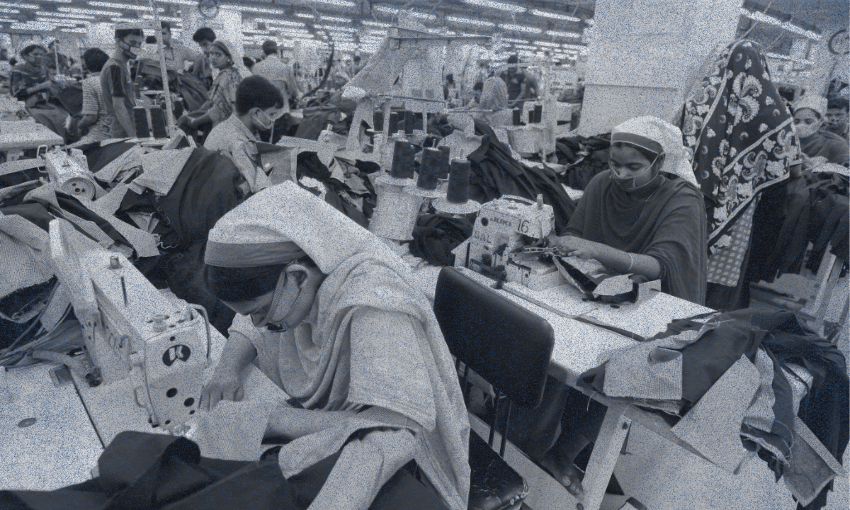
The difference between producing stuff and maxing out your productivity stats becomes clear if we look at what else happened around the time we began to fall behind. The 1970s and 1980s saw industrial jobs outsourced from the global north to the global south at unprecedented levels. In Imperialism in the 21st century, John Smith shows how the easiest way to increase productivity is to offshore labour-intensive tasks to a sweatshop in, say, Bangladesh. Because the wealth created ends up on “our” side of the ledger, but the hours worked on the side of the sweatshop, “our” productivity appears to go up while theirs goes down. In other words, outsourcing labour means importing productivity.
If the numbers are to be believed, making a lot of stuff isn’t very productive. It’s much more productive to buy all the stuff somebody else has made, and then to sell it for a huge markup – or to do other value-add services, like logistics or advertising.

In this way, productivity levels in developed countries are often directly tied to the suppression of wages and workers’ rights in developing countries. You could call it productivity, but Marxists have another name for profiting from somebody else’s labour: exploitation.
Surely, you might ask, exploiting cheap labour isn’t the only way to be productive? Take Ireland for example. It’s the country that many column-writers and politicians like to compare Aotearoa to. We’re both island nations, with similar population sizes, and temperate oceanic climates. Yet Ireland’s GDP per capita is more than double ours, meaning the Irish are more than twice as productive as us.
Does the average Irish worker simply focus twice as hard as the average New Zealand worker? Or are their labours unburdened by bureaucracy and red tape? Or are they way better at implementing technological solutions? Having lived in Galway for five out of the last seven years, I don’t think it’s any of these things. What Ireland does have going for its GDP and productivity stats is that it allows big tech and pharmaceutical companies to funnel profits through the country virtually tax-free.
Being a tax haven doesn’t necessarily get you all that far away from exploiting foreign workers, though. Apple, for example, is one of the companies registered in Ireland for tax avoidance purposes, but their profits wouldn’t exist were it not for the workers in Foxconn factories (the ones with the suicide nets) and (alleged) conflict minerals mined in rebel-held areas in the Democratic Republic of Congo.
More importantly, high productivity stats don’t necessarily translate to a better life for workers. The Irish Statistics Office has had to develop a new economic measure called “modified gross national income” (GNI*) to keep track of how much wages lag behind GDP and productivity. GNI* per capita – the measure that captures how much workers have to spend – is about half its GDP per capita.
The assumption that wages will increase when productivity goes up is back to front. We see this most clearly in industries which are difficult to automate or to outsource to the global south – say, hairdressers. Because all hairdressers are roughly working with the same tools, they can roughly cut the same amount of hair in an hour. Still, the cost of a haircut in Bangladesh is going to be significantly lower than in Aotearoa. According to the numbers, then, Kiwi hairdressers appear absurdly more productive than their Bangladeshi counterparts. Workers appear less productive because they are paid less, not the other way around.
By focusing on how hard or how smart we work, all this talk about productivity is completely missing the point. Productivity is just about where we sit in the global economic system, and doesn’t have all that much to do with your holiday plans.