

Since opening in the South Auckland suburb in 1965, Decor Cakes has become a local icon. Charlotte Muru-Lanning visits to find out how it’s endured, what makes its cakes so incredible, and what they can tell us about the community.
With its profusion of satin ribbon, dainty piping, plastic pillars, pearlescent sea creatures, edible drapery and fondant roses, the shop window of Decor Cakes in Ōtāhuhu is impossible to pass without slowing down. The shop’s various glass cabinets, exhibiting whole cake samples in pale pinks, creams, greens and metallics, feel more like museum displays. The cakes are ornate and romantic, and resolutely eschew the tendencies of contemporary baking trends. At first glance, many appear to belong to another era entirely.
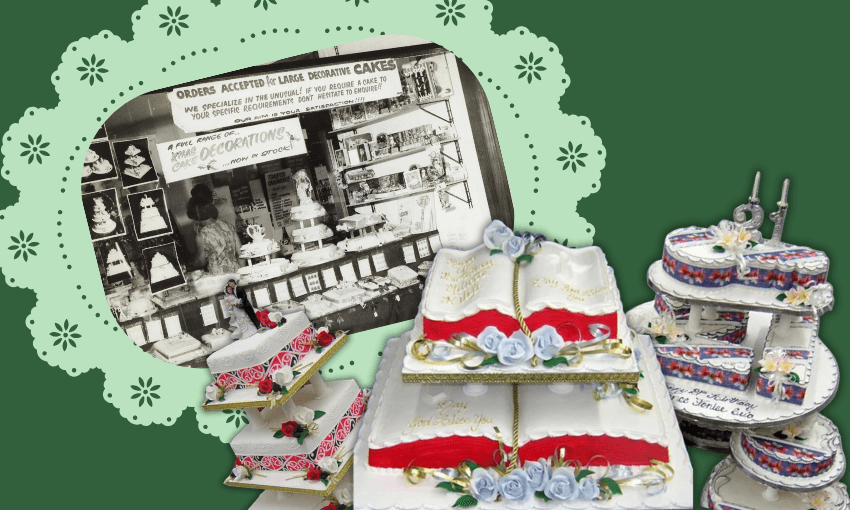
Decor Cakes was opened in 1965 by Eileen and Bob Faulkner, at the height of frilled, mid-century cake decorating. Sixty years later, the shop has new owners but remains in its original site, in the Victoria Arcade, a low-slung mid-century passageway on Ōtāhuhu’s main street. Original square tiles still line the corridor – even if some are peeling. The contents of the glass display cabinets look much as they did in a photograph taken in 1969: tiers propped on pillars, slabs wrapped in shiny ribbon, fondant roses arranged among romantic, looping piped borders.
There are some differences, of course. Alongside the classical designs are cakes adorned with kōwhaiwhai and tāpā motifs. Some are ornamented with frangipani flowers or miniature ‘ulu fala. There is an enormous Heineken cake in deep green, and nearby, a solitary Minion forged in fondant. Together, the cakes in the window function as a visual (and edible) record of the community it has served for six decades.

Behind a glass window to the side of the shop is where these creations come into being. The lights come on early – around 6am this morning – and by 10am, three women sit at their stations on wheeled stools glancing studiously over mounds of fondant and buttercream. Patricia Hopkinson has worked here for 40 years; Rachel Lawler for 34; Anne Browne for 24. All three began in the industry as teenagers.
Patricia rotates a delicately iced cake slowly on the stand, piping “Happy Birthday” across the top in looping cursive. “That design,” she says without looking up, “I’ve been doing that since 1973 – now people bring in pictures of that style and call it ‘vintage’.”
When the Faulkners first opened the shop, Ōtāhuhu was a borough of around 9,000 people, largely Pākehā, with British and Irish roots dating back to the 19th-century Fencible settlements. The country’s first supermarket had opened down the road seven years earlier, and the town centre was in the midst of expansion. At the same time, the demographic foundations of South Auckland were beginning to shift. From the 1940s onward, Māori were actively encouraged by the Māori Affairs Department to move from rural areas into cities, to fortify the industrial labour force. Pasifika migration followed, accelerating through the 1950s and 1960s. By the mid-1970s, gentrification of Auckland’s inner suburbs pushed many Pasifika families south, into areas like Ōtāhuhu.

Today, the suburb has a distinctly Polynesian character. Nearly half of Ōtāhuhu’s residents identify as Pasifika, more than a quarter as Māori, and fewer than 20%as Pākehā. The cakes in Decor Cakes’ window reflect that evolution: mid-century western cake traditions overlaid with Pacific and Māori visual language, all held together with buttercream, royal icing and fondant.
On average, the shop produces about 20 cakes a day. Orders are clipped to the wall by month. There are already bookings for April. Rolls of ribbon sit in labelled boxes – “white and gold hearts”, “teal and aqua,” “lemon”. Drawers hold handmade flowers and plastic figurines: tiaras, dinosaurs, Barbies, Moana dolls, “kava beads” and shells. At the counter, Sandy (who has also worked here for decades) serves a regular customer. “Two-tier?” she asks. “Seven-inch? Buttercream or fondant?” The shop smells faintly sweet, and occasionally a cluster of edible glitter drifts through the space as someone adds a final dusting of lustre to a cake.
In a 2021 interview, founding owner Eileen Faulkner described her staff as “artists”. Watching them work, the term feels accurate. While one cake sets, another is iced; while buttercream firms in the fridge, a glossy drip edge is piped onto a birthday cake. While one person shapes fondant flowers by hand, another attaches decorations to a beer-themed cake with real bottles bursting from the tiers. Additional structural support is added quickly and with confidence to tiered cakes. Occasionally someone pauses to search for the right tool, or the perfect spangly ornament to complete their piece. It is calm but constant work.

Patricia started in the industry at 16, straight out of high school. Rachel and Anne began around the same age. Back then, cake decorating was something that was learned by doing on the job. “Now,” Rachel says, “young people don’t really come in looking to learn. There’s YouTube, so people just learn online.”
The repetitive nature of the work has also taken a physical toll. Patricia has had two carpal tunnel operations. Her thumb has swollen up and her fingers won’t close at night. She’s had knee surgery too, though she’s not sure whether it’s the fault of work or life.
From their vantage point within this shop, the decorators have observed as the industry has changed over the decades. New generations of the same families have become regulars. The popularity of fruit cake has waned and given way largely to chocolate. There are more requests for novelty cakes. What once had to be hand-painted in food colouring can now be printed directly onto cakes with a printer. Their pastel pink uniforms have been replaced by more industrial workwear. Economic conditions mean their hours have been cut back. Butter costs have skyrocketed. And in 2020 the shop was sold (for the first time in its history) to new owners.

Perhaps the biggest shift, Patricia says, is a creative one. “People get pictures online nowadays and bring us the picture for us to make exactly,” she explains. “They know what they want, or they’ve seen it somewhere else and it’s too expensive, so they just come to us because we’re cheaper.” Reproducing replicas, she feels, takes away the most joyful part of the job. “You hardly ever get to choose what you want to do any more.”
Search online for cake shops in South Auckland and the map fills up with options. There are cake shops throughout the entirety of Tāmaki Makaurau, of course, but few corners seem to have the same density or stylistic exuberance as those south of the isthmus. If you look close enough, you’ll notice that each corner of Auckland has its own baking vernacular. South Auckland has developed a particularly idiosyncratic cake culture: more kitsch, more retro, more out-the-gate.
Decor Cakes sits firmly within this genre. If contemporary baking orthodoxy favours restraint, imperfection and natural finishes, the cakes here exist in another universe. They are symmetrical, polished, elaborate and often preposterously complex architecturally.
Anne passes over a stack of booklets documenting past creations and it is filled with feats of cake engineering. There’s a photo of an absurdly intricate 20-tier wedding cake priced at $2,314, with the option to upgrade to the same cake “with bling” for $2,514. There are cakes shaped as splayed books, gilded in gold and mounted on high metal heart-shaped stands. One absurd four-storey structure: a key-shaped cake resting on a 21-shaped cake, balanced on two cakes, which then sit atop three more. It feels like you need a very particular type of community to sustain such cake making.

That community is one built around gathering – en masse. The idiosyncrasy of Decor Cakes, or of South Auckland’s cakes more generally, speaks to the cultural rituals of the people who order them and the centrality of expansive celebrations, church and marking life events as a collective.
“It’s a very good market for cakes here in South Auckland and if you look at our customer base, it’s predominantly Pasifika,” says Decor Cakes co-owner Krishna Rajan. “Pacific Island communities, when they order our cakes, they don’t come for just one cake, they come for 20, 30 cakes.” Customers return for baptisms, graduations, birthdays, weddings, church events and funerals. Just a week ago, Krishna set up a set of 152 cakes at a church. Tomorrow, they’re preparing 23 cakes which will go to a wedding. South Auckland is often described through narratives of deprivation – poverty, crime, violence. While socioeconomic hardship is very real, these cakes might tell a parallel story: one of generosity, celebration, abundance and continuity.
“We want to keep the same tradition,” says Krishna. “Their grandparents come, their aunts and uncles come, people come from far away to have these cakes, so we don’t want to change. No matter what we’re making for people, we really take pride in it.”

A few blocks away is Decor Cakes’ wholesale factory, where all the cakes beneath the icing begin. The scale is industrial: thousands of cakes in ovens, cooling on racks, in massive refrigerators – some destined to be decorated at the shop, but mostly for supermarkets across the country. The operation has grown from seven staff to more than 25 since the current owners took over the business, with plans to expand further and export to the Cook Islands. Though their own licensed pre-mixes are now used, much of the work remains manual. In the factory space, workers at long metal benches trim domed sponges, pipe cream in even rings, spin cakes on stands while cloaking them in fresh cream.
Back at the shop, Patricia swings open the door to the walk-in fridge. Cakes at every stage line the shelves. Buttercream in various hues sets between stages. Boxed cakes wait for pickup. Bare cakes in plastic wrap await icing. A towering 21st birthday cake studded with maraschino cherries and chocolate shards stands beside a pastel-pink number, frilled and ribboned – identical to the Instagram-sourced reference image tucked beneath it. Amid it all, one particular cake stands out. A three-tier wedding cake in off-white, ribbed buttercream, curling flowers creeping at its sides, sprouting tiny edible gold leaves and sprays of even tinier pearls. At the top stand plastic bride and groom figurines. In this case, Patricia explains with a smile, the customer gave her full creative licence. It is, perhaps, what happens when an artist is allowed to be an artist. And it’s magnificent.