YouTube killed the TV star: What new NZ On Air stats tell us about media’s last decade

We’re going to need a bigger adjective to describe YouTube’s popularity.
NZ On Air’s latest research on children’s media use surveys today’s landscape, but is most revealing when compared with research done 10 years ago.
Back in 2015, YouTube was reaching 32% of New Zealand children aged 2-to-14 every day. NZ On Air’s first survey of children’s media use in New Zealand proclaimed the Alphabet-owned video platform was “extremely popular”, sharing first place with TV2.
A decade on, and as anyone with kids can likely testify, we’re going to need a bigger adjective to describe YouTube’s popularity.
The third iteration of this research, released last week, shows YouTube (including YouTube Kids) now reaches seven out of 10 children every day. TV2 sits at 6%. Content broadcast on the TVNZ channel is being watched on demand, but the idea of a television channel — something you change by pointing a “dumb” black stick at a “dumb” black box plugged into an aerial — is fast becoming a relic.
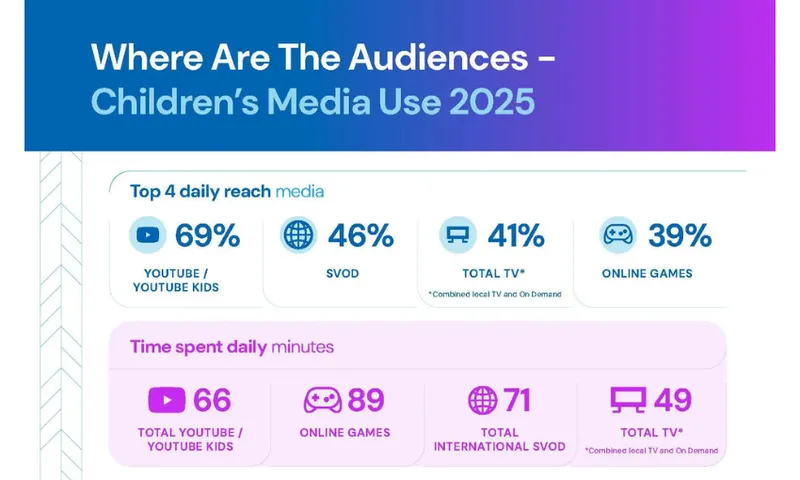
The daily reach of live free-to-air television has collapsed. In 2015, it reached 74% of children. In 2025, it’s 14%. What Now, a stalwart of children’s television in this country, preempted this latest round of research, shifting to a digital-first approach in 2024, with a focus on building its YouTube channel.
Radios and DVD players are going the same way as free-to-air television. Only 40% of households have a radio now, down from 84% in 2014. Spotify is the dominant audio platform, reaching 25% of all children each day; it’s 40% among 12-to-14-year-olds. Listening to a New Zealand radio station, whether via broadcast or online streaming, is something only 13% of kids do on a daily basis.
Most TVs are now smart, with household access at 82% compared to 54% in 2020 and 22% in 2015. Smartphones are ubiquitous, found in 95% of all New Zealand homes. As children get older, their viewing shifts away from controlled, communal environments like the family television to smartphones or laptops. While 63% of 5-to-8-year-olds use smart TVs to watch YouTube, 56% of 12-to-14-year-olds use smartphones.
Over half of all children are choosing what they watch on YouTube with little or no caregiver intervention. Parental controls like YouTube Kids, supervised accounts and restricted mode are in place for 68% of children, but as the report highlights, this drops away sharply: 39% of 12-to-14-year-olds report no parental controls at all.
Netflix comes a bit of a cropper in this research. In 2015, it had just arrived in New Zealand, barely registering in NZ On Air’s 2015 report at 2%. By 2020, it was sitting at 47%, just 4% behind YouTube. Its daily reach with New Zealand children now sits at 36%. That’s in line with global trends as the two giants continue to battle for audience supremacy. Netflix’s latest deal with Spotify, bringing podcast video to the streaming platform, is being viewed by some as a bid to loosen YouTube’s grip on podcasting.
YouTube’s dominance highlights the differences between platforms and lends weight to claims that the audience, not the content, is now king. YouTube’s model is built around serving the individual, moment-to-moment interests of a highly fragmented user base. Netflix, while still algorithmically driven, relies on convincing audiences that its content library is worth paying for month after month. Compared to YouTube’s “free” (advertising-supported), algorithmically targeted, user-generated, short-form content, Netflix’s more controlled environment and commissioned programming looks quaint – and, according to NZ On Air research, is losing its appeal with younger audiences.
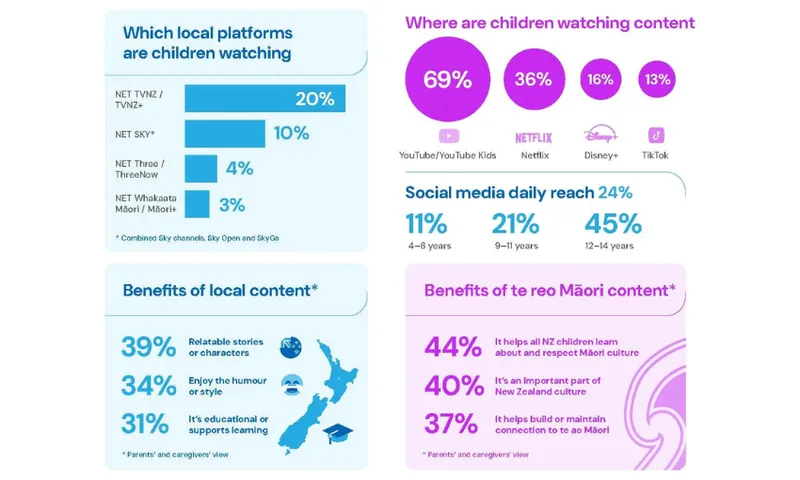
Despite YouTube’s dominance, the report has some heartening insights. Both parents and children value New Zealand-made content for its relatable stories, educational benefits, cultural connection and safety. Te reo Māori content is especially appreciated for supporting language development, fostering pride in identity and helping all children learn about and respect Māori culture. There’s an expectation that local platforms like TVNZ+ and Whakaata Māori will provide local content.
The challenges of meeting those expectations and fighting for shelf space in a vast international “mall” of content are very real. Regular viewing of New Zealand content is down from 59% in 2020 to 44%, and 43% of parents say they don’t know where or how to find it. Responding pragmatically to these findings, which highlight a lack of awareness of local content and a preference for overseas content and global platforms, NZ On Air has launched two YouTube channels: Kidogo Jnr and Kidogo, which house New Zealand-made programming funded by NZ On Air and Te Māngai Pāho, like Kiri and Lou, Toi Time, and Let’s Get Inventin’. If you can’t beat them, join them, or at least meet these young audiences where they are.
For more on the NZ On Air research, Duncan Greive and I dissect it in this week’s episode of The Fold. We also dig into fascinating new research from the Broadcasting Standards Authority on the often vexed issue of trust in news media. It offers an up-to-date picture of where people get their news and information, fresh details on the types of media they consume, and how trust actually works in this context.
Listen in full on Apple Podcasts, Spotify, YouTube or wherever you listen to podcasts.

Anna Rawhiti-Connell
Anna Rawhiti-Connell is a former head of audience, senior writer and editor of The Bulletin at The Spinoff.


