The BSA vs The Platform will be a generationally important battle

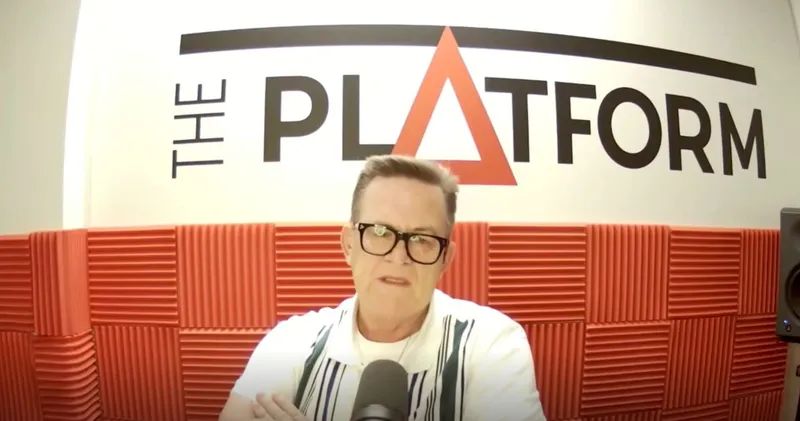
Sean Plunket speaks on The Platform
The Broadcasting Standards Authority’s decision to claim jurisdiction over the internet forces us to pick one of two wildly different directions, writes Duncan Greive.
The document doesn’t look like much. It’s a four-page PDF, issued by a small, anonymous crown agency, headlined “PROVISIONAL INTERLOCUTORY DECISION”, with “DRAFT” written in large grey type running diagonally across the page, underneath a large “NOT FOR PUBLICATION”. Much of it is concerned with the definitions of broadcasting and of a programme, two subjects about which the average person cares little. It’s coy about what the titular “decision” is concerning, simply naming “unacceptable racist comments” as the charge, without specifying what exactly was said.
Yet this short, mostly boring document has set off a bomb in legal, political and media circles. It has a chance to bring to a head one of the trickiest challenges of our time, one with no obvious solution. Basically, it asks the government what it intends to do about speech on the internet.
Other countries have taken diverging paths here, some with powerful regulators or activist courts, others favouring a distinctly libertarian ethos. New Zealand has adopted a wait-and-see approach, one which now borders on farce, given how long we have waited, and how much we’ve seen.
Much ado about mumbo jumbo
The incident occurred on July 22 of this year, and appears to be a relatively innocuous episode to launch such a momentous challenge. In it, Sean Plunket, the owner and breakfast host of The Platform, described the Māori concept of tikanga as “mumbo jumbo”. Offensive to many, sure, but in line with numerous other public statements from Plunket, and therefore likely defensible as his honest opinion.
A listener named Richard Fanselow heard the segment and sent an email of complaint to Plunket, who replied with characteristic tact. “You plonker,” Plunket wrote. “We aren’t subject to the Broadcasting Standards Authority.” What Fanselow did next was the crucial step, one no previous complainant had taken. He forwarded the response to the BSA, asking if Plunket was correct.
“Our accepting the current complaint is in line with a BSA policy published in 2020,” the BSA’s Stacey Wood wrote in a statement provided to The Spinoff. “This said we would not be extending levy or publicity notice requirements to providers of online content at that time. But if we received a relevant complaint and there’s no other applicable standards body or regulator, and if the complaint raises issues of public interest or a risk of harm, we may accept the complaint and engage with the parties using our established processes.”
Effectively Fanselow triggered a process which had been lying dormant for five years, and now forces our politicians to decide whether the BSA’s reading of its legislation is correct.
The explosion
The Broadcasting Standards Authority is a crown agency created by the passage of the Broadcasting Act 1989, a late part of the wave of reforms enacted by the fourth Labour government. The internet barely existed at the time, and certainly wasn’t imagined by the legislation. In fact it specifically excludes programming made “on demand”, a definition which arguably describes the vast bulk of content displayed on the internet, whether on streaming or social media.
The act’s definition of broadcasting – “any transmission of programmes, whether or not encrypted, by radio waves or other means of telecommunication for reception by the public by means of broadcasting receiving apparatus” – manifestly takes in linear TV and AM/FM radio. But it also leaves out a lot of audio and video: most of TVNZ+ is out of bounds, as are NZ on Air funded shows for The Spinoff (which are also outside of the remit of the Media Council, despite stories like this being within its purview). There are some obvious grey areas – NZME is under the BSA for Newstalk ZB, but what about Herald Now?
Ultimately part of the act is sufficiently vague that the BSA decided that some forms of internet content could be argued as within its remit. Essentially, the BSA thinks that if it looks like broadcasting and sounds like broadcasting, and happens in New Zealand, then it should be regulated the same regardless of whether it happens on radio waves or a website.
This is, to put it mildly, a controversial view. When Plunket went public last week with the complaint’s acceptance, former deputy prime minister Winston Peters, a Platform regular, called it “Soviet-era Stasi” style censorship. Current deputy prime minister David Seymour gave an interview to radio veteran Michael Laws on The Platform, and said it was “extraordinary”. “They seem to be saying that anyone who is transmitting sound and pictures in realtime – anyone with a livestream on Facebook – is somehow in their purview.”
The BSA explicitly rejects this, saying it is only concerned with content which, like Seymour’s interview, looks like broadcasting. This seems somewhat semantic – the creator economy of YouTube and Tiktok is vast and far more influential than talk and news media, whether radio, TV or digital. But it does belie the idea that this is a power grab by the BSA, which has just eight staff.
The BSA says its position only takes in institutions like The Platform and Big Hairy Network (BHN), and not social media more broadly. It also fits a pattern with the BSA, which has been comfortable pushing into new realms as it searches for a viable digital role. It was to be the mediator between big tech and news organisations under the Fair Digital News Bargaining Bill – until that process fizzled out.
Still, despite its protestations, the BSA’s decision did not just trouble Plunket and politicians. The Free Speech Union prompted 2,000 people to get in touch with broadcasting minister Paul Goldsmith to demand he “put the BSA back in its place”. Retired judge David Harvey, writing on the Substack A Halfling’s View, gave a withering critique, noting that a 2013 Law Commission review explicitly said the BSA’s remit “does not extend to online only content”. Lawyer and conservative commentator Liam Hehir called the BSA’s move a “purposive” and activist reading of the act, one which ignored recent governments that looked at media regulatory reform and decided against it.
The most sophisticated reading came from the NZ Herald’s Shayne Currie, who wrote “there is no doubt that media regulation needs to be tidied up – social media is a wild west, and there are inconsistencies across the industry more generally.
“But there’s a right way and a wrong way to sort the mess out. On the face of it, the BSA has elected the wrong way – but it might also be a deliberate strategy to force the government’s hand on legislative changes.” Currie implied that the BSA had tired of watching its influence wane while the real battle raged online, and accepted the complaint to force attention to the issue.
A bigger blast zone
That’s the reason the BSA’s decision is so fascinating: it represents an acknowledgement that the current two systems of regulation seem ludicrous. We currently operate with a variety of laws and institutions which well imagine the old world and seem utterly incapable of grappling with the new. A few examples:
- Advertising on television and radio is heavily scrutinised, but scam ads on Facebook regularly lead to huge losses, with no consequences to its multi-trillion dollar owner.
- The tax system deals well with our major corporations, but wildly profitable big tech companies offshore their profit leaving only tiny sums for the IRD.
- The workforce of ride-sharing apps largely exists outside our employment law – courts have ruled them in, while legislation might yet rule them out again
Other countries are grappling with these tensions head on. Australia is weeks away from implementing its social media ban for under 16s. Brazil’s Supreme Court has stared down X (formerly Twitter) over what it defined as rampant misinformation on its platform. Singapore has introduced rules fining platforms S$100,000 per day for running harmful posts. The UK’s Ofcom oversees social media and pushes it “to identify risks of harm to their users, and take steps to protect them from illegal content”. The EU has a raft of laws grappling with everything from tax to AI.
Locally, the most substantive attempt to engage with this in a media context was the Department of Internal Affairs’ Media Content Regulatory Review, later renamed Safer Online Services and Media Platforms. It ran for five years, before being shelved early in this government’s term, with internal affairs minister Brooke Van Velden saying that “the principle of free speech is important to this coalition government and essential… in the digital world. On this basis, the department will not be progressing work to regulate online content.”
When combined with the stalled Fair Digital News Bargaining Bill, and the discharge of the proposed Digital Services Tax Bill, it suggests that the internet remains too scary a place to contemplate muscular regulation or taxing in the way we routinely do offline. Yet with this one move, the BSA has forced the government to come right out and say what has been clear for decades now: that the internet is a wild west, where anything goes.
Ironically, there is a natural response, should the government want to formalise that position. Namely, it might shut down the regulators. This is not idle speculation. Former National MP Simon O’Connor explicitly suggested as much in his own Substack. “This BSA overreach also raises the question why we need the authority at all. Just as the law is arguably outdated, so too is the BSA,” he wrote. Even TVNZ seems to agree, telling The Spinoff in a statement that “the current system is incomplete, expensive for media and confusing for viewers.” It favours a self-regulatory regime.
It also thinks “all media should be subject to the same standards”. There are only two ways to achieve that. One would be a new Ofcom-style super regulator, the kind the DIA was leaning towards but has been explicitly ruled out. The other is by ending our current regulatory regime entirely.
It seems an extreme response to an extreme situation – to remove what little protections remain in place for us. But in some ways it might also be the most honest acknowledgement of what is increasingly unavoidably clear: on the internet, you’re on your own.

Duncan Greive
Duncan Greive is the founder of The Spinoff, along with the agency Daylight and music platform Lume. He also hosts The Fold, a podcast which features interviews and analysis about the media sphere in New Zealand.


