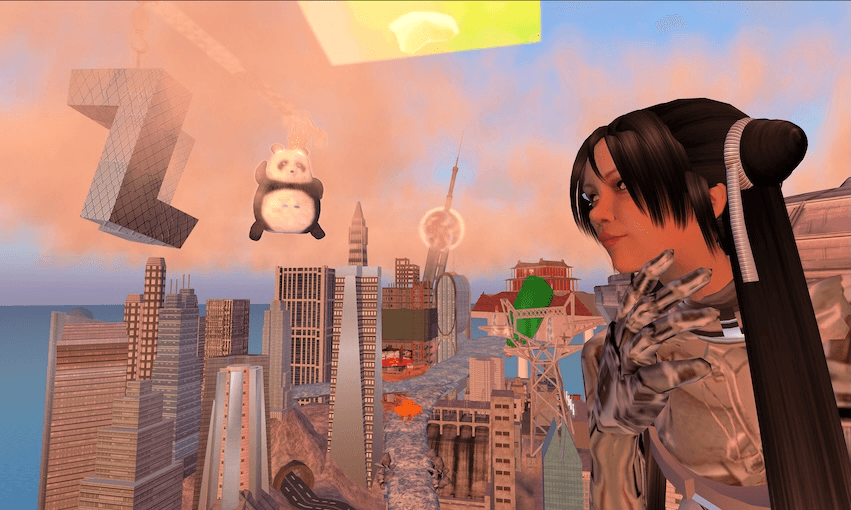
Auckland Art Gallery’s Forever Tomorrow: Chinese Art Now 永远的明天:中国艺术进行时 invites you into the lived experience of modern China.
Running until August, Auckland Art Gallery Toi o Tāmaki is currently home to an extensive exhibition of Chinese contemporary art, including the likes of Ai Weiwei as well as artists exhibiting in New Zealand for the first time. The show is described as the largest major survey of Chinese contemporary art in Aotearoa.
Knowing this, I was hopeful that as a Chinese New Zealander, I would feel a profound connection to some of the 67 works in the show. And indeed, as I spent more time with the works, I did. But if I’m honest, at first I didn’t get the first section – but neither was I prepared for a lesson in Chinese art history, because that’s what it ended up being for me, when curator H. Wilco walked me through the exhibition on a quiet Thursday afternoon.
We began in 1978: a time you could say contemporary Chinese art began sowing its seeds. Against the backdrop of China’s economic reform and opening-up in 1978, not only were young people in particular influenced by ideas from abroad, but so too were the artistic practices in China. Important institutions reopened after the Cultural Revolution, including the Central Academy of Fine Art and what’s now known as the China Academy of Art.
As Wilco explained, “It was a period in which hundreds of artist groups and movements emerged across the country, exploding with activity and experimenting with the major artistic languages of 20th century Western art history.” Eventually, these people and practices converged at the 1989 China Avant-Garde exhibition: the very first national exhibition of contemporary art.

Although performance art was banned from the 1989 exhibition, it ended up featuring – and in no small way. Wilco brought me over to a small box television in the corner of the room, where we watched the watershed moment when artist Xiao Lu unexpectedly fired two gunshots at her work, Dialogue, prompting panic among attendees. Acts of defiance like Xiao Lu’s not only characterised the exhibition but mirrored the political zeitgeist, defined by student demonstrations and the Tiananmen Square protests of the same year.
I began to see how each item in this section served as an entry point into these defining cultural moments. With that cognitive gear shift, items that followed made more sense to me, too. Wilco said that for those who don’t know anything about Chinese contemporary art, understanding its history is key to understanding everything that follows. “I thought of this early section of the exhibition as being a bit like a preface to a novel, so it’s a bit didactic in that sense.”

While the first section is a sort of art exhibition about art, “everything else that follows is more socially orientated – the exhibition shifts into a different register altogether”. The exhibition explores four decades of Chinese art, seen through the lens of globalisation, urban migration and rapid technological change. These might be the concepts that surface when China is thought of as a monolithic society. However, within that, the works reveal more about the internal worlds of those who have lived, or are living, through those changes.
The intent is not to depict China as exceptional, but to show that these experiences are shared by countries the world over. “One of the challenges in curating Chinese contemporary art is the tendency to frame practices in one of two ways,” said Wilco. “They are often positioned either as exoticised expressions of cultural difference or as acts of political resistance. I wanted to avoid both of those reductive frameworks and instead foreground the complexity, diversity, and breadth of material practice.”

The next section speaks to mass urban migration and the changing landscapes and connection to homelands. It’s a hard watch, but Li Binyuan’s Freedom Farming is an incredibly personal expression of contrition emerging from his emigration from a small farming village to study art in Beijing. In the video of his performance, he repeatedly throws himself into a shallow area of mud in a rice paddy of his ancestral village, which he’d inherited from his late father. As penance for not meeting his filial duties by working the land, he performs this brutal act for hours in front of an audience of his mother and the villagers. I couldn’t help but wonder if his audience understood what he was attempting to communicate.
The middle section, Tender Revolutions, is where I softened and connected the strongest to the works. This section invites you into private lives and expressions of intimacy and sexuality. Wilco said that in the previous sections there were audience expectations that needed to be met. “Of course, you have to include Ai Weiwei, for example. You can’t avoid that…but Tender Revolutions – that just gets upended.”

There’s a visually arresting piece of work, Gate, by Xiyadie that made an impression on me on opening night, but I became captivated later, having learned that it was also made in secret. The work uses Chinese papercutting methods to explore homoerotic desire and queer expression. Like many of the pieces in this section, Gate feels courageous and uses a voice familiar to many people stuck between cultural expectations. It’s an arresting exploration of sexuality and intimacy, subverting the clichéd depictions of my people’s sexuality through fetishisation and Orientalism.
For Wilco, the exhibition resists portraying China’s contemporary condition through familiar binaries such as tradition and modernity, control and freedom, East and West. Instead, it sits in a liminal space between past and present. The name of the show, Forever Tomorrow, is inspired by the shared mentality of making sacrifices today for a better life sometime in the future. But, as Wilco asks, “When does tomorrow arrive?”
I appreciate the way this show reaches beyond the geopolitical and sociopolitical characterisations of China and makes space for lived realities, rather than merely representing ‘Chinese art’. There are parts of Forever Tomorrow that can feel challenging, but if you are prepared for the conceptual nature of many of the works – and handle a few “-isms” and “-ations” along the way – you’ll be rewarded with an experience that celebrates the breadth and depth of personal expression that makes Chinese art now.