Appeasing Trump in the Middle East is not cost-free for New Zealand

Donald Trump greets Israeli prime minister Benjamin Netanyahu as he arrives at the White House for a meeting on April 7, 2025 (Photo by Chen Mengtong via Getty Images)
The government’s responses to recent events in the Middle East indicate that its desire not to offend the Trump administration has compromised New Zealand’s commitment to uphold an international rules-based order, argues Robert Patman.
While distant in geographic terms, brutal violence in Gaza, the West Bank and Iran marks the latest stage in the unravelling of an international rules-based order on which New Zealand depends for its prosperity and security.
It should be emphasised that New Zealand’s founding document, the 1840 Treaty of Waitangi, emphasises partnership and cooperation at home, and, after 1945, helped inspire a New Zealand worldview enshrined in institutions such as the United Nations and norms such as multilateralism.
In the wake of Hamas’ terrorist attacks in Israel on October 7, 2023, the National-led coalition government has in principle emphasised its support for a lasting ceasefire in Gaza and the need for a two-state solution to the Israeli-Palestinian conflict over the occupied territories of East Jerusalem, Gaza and the West Bank.
However, in practice, this New Zealand stance has not translated into firm diplomatic opposition to the Netanyahu government’s quest to control Gaza and annex the West Bank. Nor has it been a condemnation of the Trump administration for prioritising its support for Israel’s security goals over international law.
Foreign minister Winston Peters has described the situation in Gaza as “simply intolerable” but the National-led coalition had little specific to say as the Netanyahu government resumed its cruel blockade of humanitarian aid to Gaza in March and restarted military operations there.
Even more striking was the government’s silence on president Trump’s proposal to own Gaza with a view to evicting two million Palestinian residents from the territory and the US-Israeli venture to start the Gaza Humanitarian Foundation (GHF) in late May in a move which sidelined the UN in aid distribution and has led to the killing of more than 600 Palestinians while seeking food aid.
While New Zealand, along with the UK, Australia, Canada and Norway, imposed sanctions on two far-right Israeli government ministers, Bezalel Smotrich and Itamar ben Gvir, in June for “inciting extremist violence” against Palestinians – a move that was criticised by the Trump administration – it was arguably a case of very little very late.
The Hamas terror attacks on October 7 killed around 1,200 Israelis, but the Netanyahu government’s retaliation by the Israel Defence Force (IDF) against Hamas has resulted in the deaths of more than 56,000 Palestinians – nearly 70% of whom were women or children – in Gaza.
Over the same period, more than 1,000 Palestinians have been killed in the West Bank as Israel accelerated its programme of illegal settlements there.
In addition, the responses of the New Zealand government to pre-emptive attacks by Israel (13-25 June) and Trump’s America (June 22) against Iran to destroy Iran’s nuclear capabilities were strangely ambivalent.
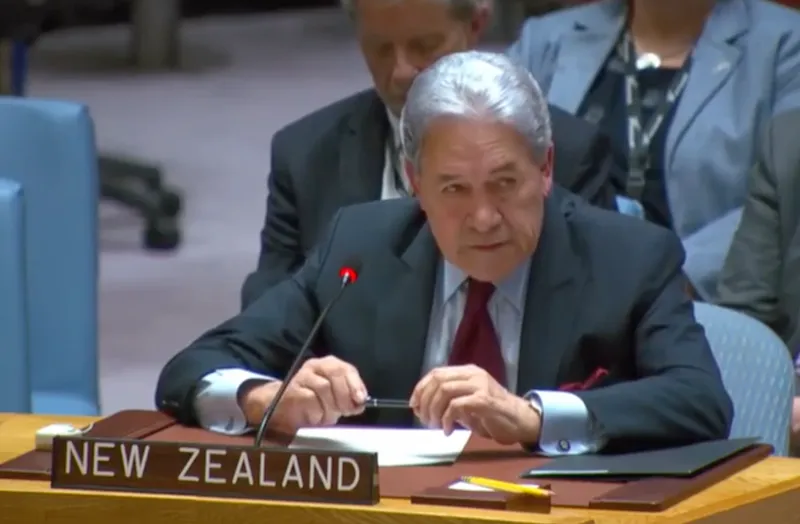
Despite indications from US intelligence and the International Atomic Energy Agency (IAEA) that Iran had not produced nuclear weapons, foreign minister Peters said New Zealand was not prepared to take a position on that issue.
Citing provocative behaviour by both Iran and Israel, Peters adopted a neutral stance toward the 12-day war between the two nations.
With respect to the attacks by the US on three Iranian nuclear facilities at Fordow, Natanz and Isfahan, the current New Zealand government seems to have echoed the view of Mark Rutte, the secretary-general of NATO, that such actions were consistent with international law.
Peters and deputy PM David Seymour reiterated Iran could not be allowed to have nuclear weapons and tacitly supported the US decision to bomb nuclear facilities in Iran.
Peters noted that the Trump administration’s targeted attacks were aimed at “degrading Iran’s nuclear capabilities” and acknowledged the US statement to the UNSC claiming these attacks were taken “in collective self-defence consistent with the UN charter”.
Taken together, the coalition government’s responses to recent events in the Middle East indicate that its desire not to offend the Trump administration has compromised New Zealand’s commitment to uphold an international rules-based order.
To be clear, Israel’s conduct in Gaza is clearly at odds with its legal responsibilities as an occupying power, and the pre-emptive attacks by nuclear armed Israel and America on Iran cannot be justified legally when the clerical regime in Teheran does not have nuclear weapons and the diplomatic process had not been exhausted.
Of course, some observers maintain that a relatively small state like New Zealand has no choice but to tacitly accept flagrant violations of international law when they are committed by big powerful friends like Trump’s America.
However, such a perspective understates the capacity of small and middle powers to shape what is an increasingly interconnected world.
In 2003, then prime minister Helen Clark bravely refused to support an illegal US invasion of Iraq and the wisdom of that stance was subsequently confirmed in what was a disastrous military adventure for the George W. Bush administration.
Moreover, New Zealand’s leadership in promoting the 2021 Treaty on the Prohibition of Nuclear Weapons (TPNW) – which has been ratified by 73 states – means it should have a strong voice on the military actions by Israel and the Trump team that have effectively incentivised Iran to develop nuclear weapons.
Confronted with Trump’s “might is right” approach, the National-led coalition faces stark choices.
The government can continue to fudge fundamental moral and legal issues in the Middle East and risk complicity in the further weakening of an international rules-based order it purportedly supports, or it can get off the fence, stand up for the country’s values, and insist that respect for international law must be observed in the region and elsewhere without exception.
Robert G. Patman is an Inaugural Sesquicentennial Distinguished Chair and a specialist in international relations at the University of Otago

Robert Patman
Political studies professor Robert Patman's research interests concern international relations, global security, US foreign policy, great powers, and the Horn of Africa. In 2019 he was named one of the University of Otago’s inaugural Sesquicentennial Distinguished Chairs.


